Bohemian National Hall

Why it's listed
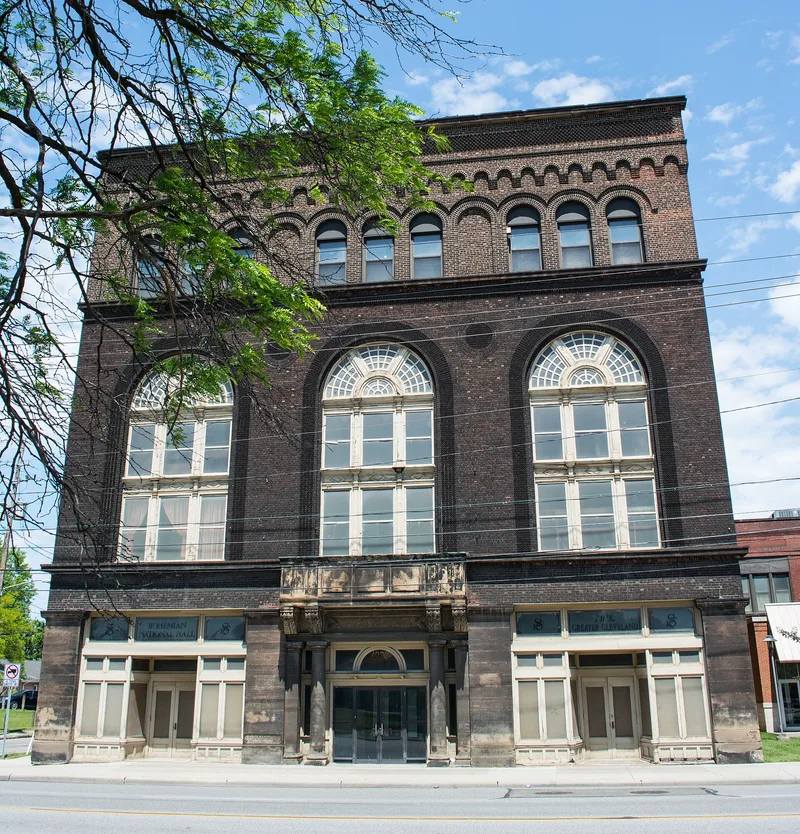
Bohemian National Hall, at 4939 Broadway in Cleveland, is a four-story rectangular block of brick, stone, steel and wood completed in 1897. Forty Czech societies built it, beginning with plans in 1887, buying the Broadway and Mead Avenue site in 1889, laying the cornerstone in December 1896 and dedicating it in September 1897 at a cost of about $50,000. Its two corner elevations carry Romanesque and Second Renaissance Revival detail, including round-arched windows, stone Tuscan columns and a corbeled cornice. Inside, a 1,000-seat auditorium with a proscenium stage, two levels of boxes and Italian Renaissance ornament survives, along with scenery sets and a painted fire curtain. A four-room classroom building for a Czech freethinkers language school was added in 1911. Cleveland had one of the world's largest Czech populations by 1910, and in 1919 seventy-three societies used the hall for meetings. The hall is valued as an ethnic cultural center and as a well-preserved auditorium.
Significance in brief: It was the social and cultural center of one of the largest Slavic ethnic groups in the United States and the largest and best-known hall serving Cleveland's Czech communities. Its design is transitional between Romanesque Revival and Second Renaissance Revival. It also preserves an excellent late nineteenth-century proscenium auditorium.
Machine-generated summary. This summary was generated by a language model from the official nomination document and has not been reviewed line by line by an editor. It may contain errors. Check the source document before relying on any detail. Source: nomination document (PDF) · National Archives catalog entry. NRHP reference 75001359, listed May 28, 1975. Summary generated October 2026 (model claude-sonnet-5-5, prompt v1.0-2026-10-29, confidence high).
Key facts
| Address | 4939 Broadway St., Cleveland |
|---|---|
| County | Cuyahoga County |
| Listed | May 28, 1975 |
| Reference number | 75001359 |
| Resource type | Building |
| Period of significance | 1896-1897; 1911 |
| Architectural style | Transitional Romanesque Revival to Second Renaissance Revival |
| Areas of significance | European, Architecture, Social History |
| Level of significance | State |
| Status (as stated in the nomination) | Listed in good condition and altered; the form says the original structure and ornamental scheme are virtually intact despite insufficient maintenance. It is marked occupied. |
| Acreage | 0.9 |
| Coordinates | 41.47218, -81.65631 (NPS GIS) |
What listing means for this property
National Register listing is honorary for a privately owned home: it does not by itself restrict what an owner may do with their own money, and it does not require public access. Restrictions come from local landmark or historic-district ordinances, which are separate (how they differ).
Owner-occupied houses are not eligible for the 20% federal rehabilitation tax credit, which applies to income-producing buildings, but many states offer credits for homeowners. Listing also opens the door to preservation easements and to buying a plaque. Start with what listing means for homeowners, renovating a listed house and selling one.
General information, not legal or tax advice. Rules change; confirm with your State Historic Preservation Office or a qualified adviser.
Sources and further reading
- National Park Service, National Register of Historic Places database (snapshot May 2026), reference 75001359.
- Nomination form (PDF, National Archives) — catalog entry
- Wikipedia article (used for cross-checking only; text not reproduced here)
- Wikidata Q4938113
- This listing as JSON
Last updated October 2026. Found an error? See the editorial policy for how to report it.