Ward, John Q. A., House

Why it's listed
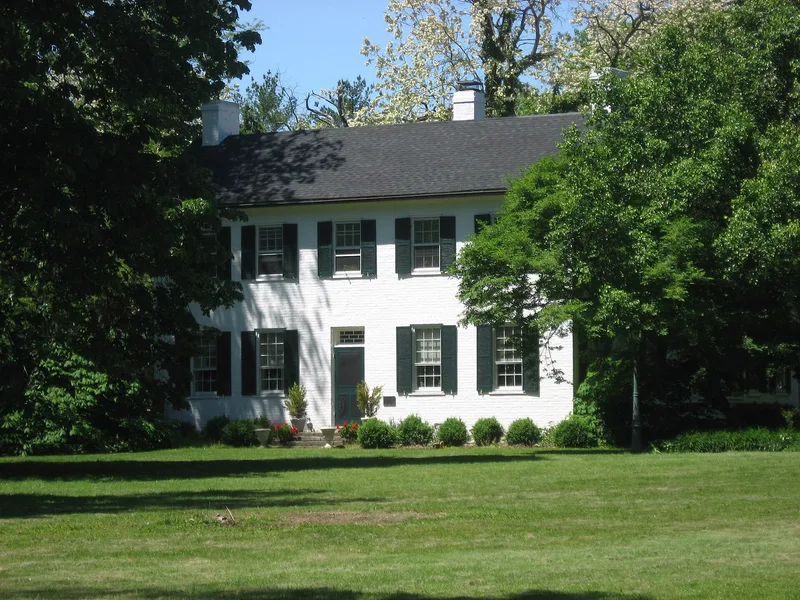
Built around 1820 on a stone foundation, this two-story brick house in Urbana has an ell-shaped plan, a five-bay front facing east, and a center hall interior. Its double-hung windows have six lights over six, and a rear wing includes a porch that was probably enclosed in the twentieth century. Colonel William Ward, who founded Urbana in 1805, built it as a wedding gift for his son John A. Ward. In 1830 the sculptor John Quincy Adams Ward was born there. He trained under Henry Kirke Brown, later worked in Columbus and New York, and made statues of Washington, Commodore Perry and Lafayette, as well as the pediment of the New York Stock Exchange Building. He served as president of the National Sculpture Society from 1896 until his death in 1910. A one-and-one-half-story frame barn on the five-acre tract still holds his intact studio. The house and grounds are described as the only physical record of his life.
Significance in brief: The house was built by Colonel William Ward, founder of Urbana, as a wedding gift for his son John A. Ward. It is the birthplace of sculptor John Quincy Adams Ward, who lived and worked there for much of his life. The nomination says the house and grounds are the only physical record of his life.
Machine-generated summary. This summary was generated by a language model from the official nomination document and has not been reviewed line by line by an editor. It may contain errors. Check the source document before relying on any detail. Source: nomination document (PDF) · National Archives catalog entry. NRHP reference 74001409, listed July 30, 1974. Summary generated October 2026 (model claude-sonnet-5-5, prompt v1.0-2026-10-29, confidence high).
Key facts
| Address | 335 College St., Urbana |
|---|---|
| County | Champaign County |
| Listed | July 30, 1974 |
| Reference number | 74001409 |
| Resource type | Building |
| Period of significance | 19th Century (built circa 1820) |
| Architect / builder | Colonel William Ward (builder) |
| Areas of significance | Art, Architecture |
| Level of significance | State |
| Status (as stated in the nomination) | Listed in good condition and altered; in use as a private residence; the barn is now used as a garage, with the studio intact. |
| Acreage | 5 |
| Coordinates | 40.10322, -83.73377 (NPS GIS) |
What listing means for this property
National Register listing is honorary for a privately owned home: it does not by itself restrict what an owner may do with their own money, and it does not require public access. Restrictions come from local landmark or historic-district ordinances, which are separate (how they differ).
Owner-occupied houses are not eligible for the 20% federal rehabilitation tax credit, which applies to income-producing buildings, but many states offer credits for homeowners. Listing also opens the door to preservation easements and to buying a plaque. Start with what listing means for homeowners, renovating a listed house and selling one.
General information, not legal or tax advice. Rules change; confirm with your State Historic Preservation Office or a qualified adviser.
Sources and further reading
- National Park Service, National Register of Historic Places database (snapshot May 2026), reference 74001409.
- Nomination form (PDF, National Archives) — catalog entry
- Wikipedia article (used for cross-checking only; text not reproduced here)
- Wikidata Q6253618
- This listing as JSON
Last updated October 2026. Found an error? See the editorial policy for how to report it.