Urbana Monument Square Historic District

Why it's listed
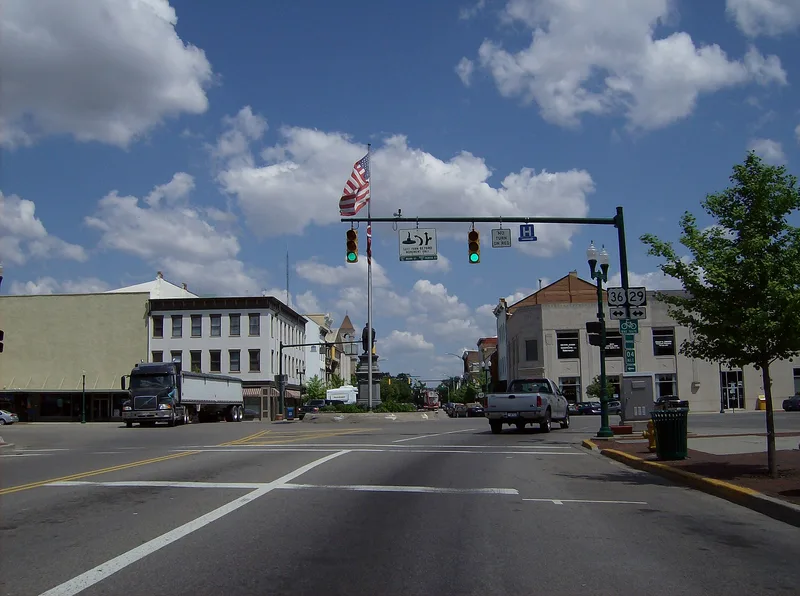
Monument Square Historic District covers the core of downtown Urbana, Ohio, about 25 acres built around a public square roughly 250 feet on each side. Colonel William Ward platted the town in 1805 with this square at its center. It became a market center for the surrounding farmland, and a Civil War monument erected in 1871 gave the square its name. Around 70 mostly brick buildings, two to four stories tall, line the streets. They display Federal, Italianate, Second Empire, Richardsonian Romanesque and Georgian Revival styles, along with some eclectic designs. Examples include the c. 1811 building at 20 Monument Square, the large Second Empire Douglas Hotel of the early 1870s, and the c. 1889 Mosgrove Building. The streetscape is largely intact, with few intrusions and few vacant lots. Urbana has been the Champaign County seat since 1807, and the square served as its commercial, transportation and cultural focus, with hotels, markets, celebrations and the first classes of Urbana College.
Significance in brief: The nomination argues the district is significant as a consciously planned open space laid out when Urbana was platted in 1805, and for the variety of its commercial architecture. It also stresses the square's role as the commercial, governmental and cultural heart of Urbana and Champaign County. The buildings show the town's growth and prosperity from the early 19th to early 20th century.
Machine-generated summary. This summary was generated by a language model from the official nomination document and has not been reviewed line by line by an editor. It may contain errors. Check the source document before relying on any detail. Source: nomination document (PDF) · National Archives catalog entry. NRHP reference 84002909, listed March 1, 1984. Summary generated October 2026 (model claude-sonnet-5-5, prompt v1.0-2026-10-29, confidence high).
Key facts
| Address | Roughly bounded by Market, Walnut, Church, and Locust Sts., Urbana |
|---|---|
| County | Champaign County |
| Listed | March 1, 1984 |
| Reference number | 84002909 |
| Resource type | District |
| Period of significance | 1805, 1870-1910 |
| Architectural style | Federal, Greek Revival, High Victorian Italianate, Second Empire, Richardsonian Romanesque, Georgian Revival, and eclectic buildings |
| Criteria |
|
| Areas of significance | Community Planning and Development, Commerce, Architecture |
| Level of significance | Local |
| Status (as stated in the nomination) | Condition is marked excellent, good and fair, with some buildings altered. The central business district is described as busy and thriving, although the Douglas Hotel had ceased hotel use about two years earlier and its owners were considering reuse. |
| Acreage | 25 |
| Coordinates | 40.10893, -83.75230 (NPS GIS) |
What listing means for this property
This is a historic district. Buildings within its boundary are either contributing (they add to the district's significance) or non-contributing. Owners of contributing income-producing buildings can claim the 20% federal rehabilitation tax credit; homeowners should look at state credits. National Register districts impose no design review by themselves; a local historic district ordinance, if one exists, does (the difference explained).
General information, not legal or tax advice. Rules change; confirm with your State Historic Preservation Office or a qualified adviser.
Sources and further reading
- National Park Service, National Register of Historic Places database (snapshot May 2026), reference 84002909.
- Nomination form (PDF, National Archives) — catalog entry
- Wikipedia article (used for cross-checking only; text not reproduced here)
- Wikidata Q2493294
- This listing as JSON
Last updated October 2026. Found an error? See the editorial policy for how to report it.