Ohio Theatre
Also known as: Ohio Theatre 2-Fantasia Disco

Why it's listed
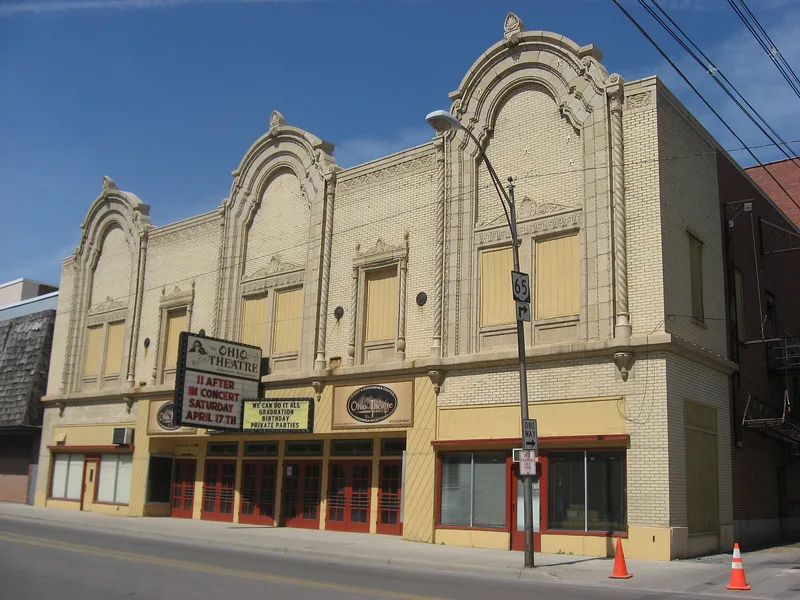
Built in 1927 at 122 West North Street in Lima, this two-story reinforced concrete theatre was designed as a movie and vaudeville house for the Schine Corporation and owned by Max Bernstein. Its tan brick exterior shows a Spanish Churrigueresque character, with terra cotta ornament on three flowing arches enclosing two windows and a central section. Inside, the Italian Renaissance design includes Corinthian columns, mosaic and marble tile floors, a 2,500-pound crystal chandelier, a high domed loggia, a balcony, ornate box seats and a 30-by-80-foot stage. The theatre housed what was described as the most sumptuous theatre interior in the area, and hosted live performances by Bob Hope, Ezio Pinza and Artur Rubinstein. The original Wurlitzer organ was given to an Illinois school in 1971. After Warner Brothers sold it, the building was threatened with demolition, then reopened as a disco in 1979 with most features intact. It is valued as the region's only Churrigueresque facade.
Significance in brief: The inventory describes it as significant as the only Churriguesque facade in the region, with an ornate Italian Renaissance interior. It was built for the Schine Corporation and hosted live performances by well-known entertainers. It was described as a typical 1920s movie palace with most architectural features intact.
Machine-generated summary. This summary was generated by a language model from the official nomination document and has not been reviewed line by line by an editor. It may contain errors. Check the source document before relying on any detail. Source: nomination document (PDF) · National Archives catalog entry. NRHP reference 82001866, listed October 7, 1982. Summary generated October 2026 (model claude-sonnet-5-5, prompt v1.0-2026-10-29, confidence medium).
Key facts
| Address | 122 W. North St., Lima |
|---|---|
| County | Allen County |
| Listed | October 7, 1982 |
| Reference number | 82001866 |
| Resource type | Building |
| Architect / builder | Architect or engineer: Peter Hulsken, Lyman T. Strong; contractor or builder: Green Sawyer |
| Architectural style | Churrigueresque (exterior); Italian Renaissance interior |
| Areas of significance | Architecture |
| Level of significance | Local |
| Status (as stated in the nomination) | At the time of the inventory (1979) it had reopened as the Fantasia disco, with most architectural features intact; condition listed as fair inside and out, and it was noted as having been in danger of demolition. |
| Acreage | 0.9 |
| Coordinates | 40.74299, -84.10601 (NPS GIS) |
What listing means for this property
For an income-producing building, listing (individually or as a contributing building in a district) is the gateway to the 20% federal rehabilitation tax credit on qualified rehabilitation costs, often stackable with state credits. Work claiming the credit must follow the Secretary of the Interior's Standards and be approved in advance.
Listing does not restrict a private owner acting without federal money or permits; where federal funding or licensing is involved, Section 106 review applies.
General information, not legal or tax advice. Rules change; confirm with your State Historic Preservation Office or a qualified adviser.
Sources and further reading
- National Park Service, National Register of Historic Places database (snapshot May 2026), reference 82001866.
- Nomination form (PDF, National Archives) — catalog entry
- Wikipedia article (used for cross-checking only; text not reproduced here)
- Wikidata Q7080983
- This listing as JSON
Last updated October 2026. Found an error? See the editorial policy for how to report it.