Bernhardt House
Also known as: Bernhardt,Paul Mathias,House
Bernhardt House is a building in Salisbury, Rowan County, North Carolina, listed on the National Register of Historic Places on June 11, 1992 (reference number 92000701). The National Park Service records its significance in Architecture at the local level.
Facts from the NPS National Register database (); nomination summary October 2026. Last updated . Sources for each fact.

Approximate location: the National Park Service places this pin arbitrarily within the property, not at a surveyed point (stated accuracy ±12 m).
Why it's listed
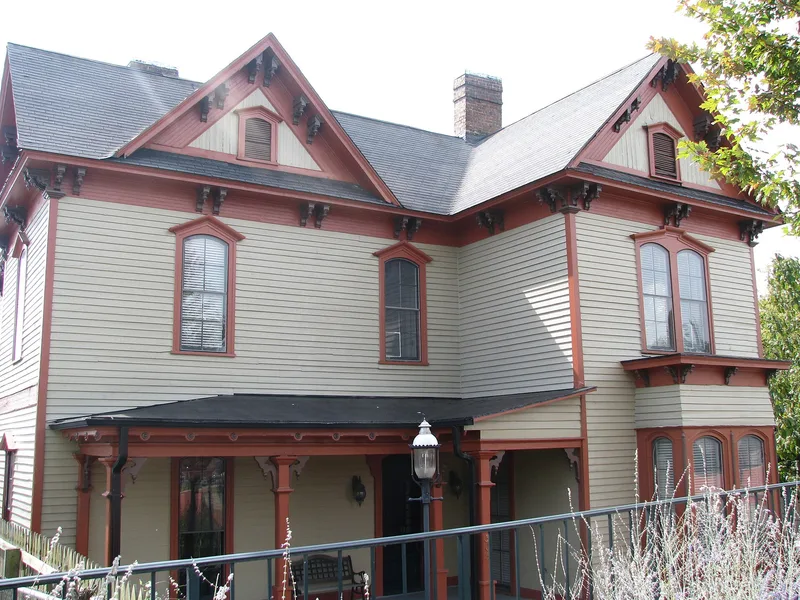
Built in 1882 on East Innes Street in Salisbury, the two-story weatherboarded frame house was raised by Paul Mathias and Mary Jane Leak Bernhardt on a lot she bought that year for $700. It was first built in the Italian Villa style, with arch-headed windows in molded surrounds, hooded openings, and a porch with chamfered posts. Around 1900 the family remodeled it in the late-Victorian Italianate manner, adding bracketed eaves and ornamental sheathed gables. The house remained in the family until 1947 and was converted to four apartments in 1948, with rear additions that kept the original exterior windows. It is regarded as a largely intact example of late-Victorian domestic architecture in Salisbury. Its listing rests on that architecture, and on its link to the Bernhardt family, who were hardware merchants in the city. The house is the only survivor of a group of family houses and a residential neighborhood on East Innes Street.
Significance in brief: The nomination argues the house is significant for its architecture as a largely intact late-Victorian dwelling showing two successive phases of the Italianate style. It is also tied to the Bernhardt family's role in Salisbury's commercial and social life, and it is the only surviving house of a Bernhardt family group on East Innes Street.
Machine-generated summary. This summary was generated by a language model from the official nomination document and has not been reviewed line by line by an editor. It may contain errors. Check the source document before relying on any detail. Source: nomination document (PDF) · National Archives catalog entry. NRHP reference 92000701, listed June 11, 1992. Summary generated October 2026 (model claude-haiku-5-5, prompt v1.1-2026-10-29, confidence medium).
Key facts
| Official database NPS National Register database, ref. 92000701 , checked | |
|---|---|
| Address | 305 E. Innes St., Salisbury |
| County | Rowan County |
| Listed | June 11, 1992 |
| Reference number | 92000701 |
| Resource type | Building |
| Areas of significance | Architecture |
| Level of significance | Local |
| National Historic Landmark | No |
| Acreage | 0.3 |
| Official document, machine-extracted Nomination form (National Archives) , checked | |
| Period of significance | 1882; ca. 1900 |
| Architectural style | Italian Villa; Italianate |
| Criteria |
|
| Status (as stated in the nomination) | Converted to four rental apartments in 1948 after the Bernhardt family sold it; the document describes the interior as essentially intact. |
| Official dataset NPS cultural-resource GIS (NRHP locations) | |
| Coordinates | 35.66524, -80.46768 |
| Computed Computed from NPS GIS district boundaries | |
| Within district | Salisbury Historic District |
What listing means for this property
National Register listing is honorary for a privately owned home: it does not by itself restrict what an owner may do with their own money, and it does not require public access. Restrictions come from local landmark or historic-district ordinances, which are separate (how they differ).
Owner-occupied houses are not eligible for the 20% federal rehabilitation tax credit, which applies to income-producing buildings, but many states offer credits for homeowners. Listing also opens the door to preservation easements and to buying a plaque. Start with what listing means for homeowners, renovating a listed house and selling one.
General information, not legal or tax advice. Rules change; confirm with your State Historic Preservation Office or a qualified adviser.
Questions about Bernhardt House
When was Bernhardt House added to the National Register of Historic Places?
Bernhardt House was listed on June 11, 1992. Its National Register reference number is 92000701.
Is Bernhardt House a National Historic Landmark?
No. The National Park Service database (snapshot of May 2026) lists Bernhardt House on the National Register but does not record it as a National Historic Landmark.
Where is Bernhardt House?
305 E. Innes St., Salisbury, Rowan County, North Carolina; coordinates 35.66524, -80.46768.
Why is Bernhardt House historically significant?
According to a machine-generated summary of its nomination form: The nomination argues the house is significant for its architecture as a largely intact late-Victorian dwelling showing two successive phases of the Italianate style. It is also tied to the Bernhardt family's role in Salisbury's commercial and social life, and it is the only surviving house of a Bernhardt family group on East Innes Street. Check the nomination document before relying on any detail.
Is Bernhardt House in a historic district?
Yes. Its location falls within the Salisbury Historic District, itself listed on the National Register. (Computed from National Park Service boundary data; the district nomination's own list of contributing resources may differ.)
Where can I read the original nomination for Bernhardt House?
The nomination form is a public record held by the National Archives: nomination document (PDF).
Sources and further reading
- National Park Service, National Register of Historic Places database (snapshot May 2026), reference 92000701.
- Nomination form (PDF, National Archives) — catalog entry
- Wikipedia article (used for cross-checking only; text not reproduced here)
- Wikidata Q19871175
- This listing as JSON
Last updated November 2026. Found an error? See the editorial policy for how to report it.