Humber, Robert Lee, House
Humber, Robert Lee, House is a building in Greenville, Pitt County, North Carolina, listed on the National Register of Historic Places on July 9, 1981 (reference number 81000425). The National Park Service records its significance in Art, Politics/Government and Architecture at the state level.
Facts from the NPS National Register database (); nomination summary October 2026. Last updated . Sources for each fact.

Approximate location: the National Park Service places this pin arbitrarily within the property, not at a surveyed point (stated accuracy ±12 m).
Why it's listed
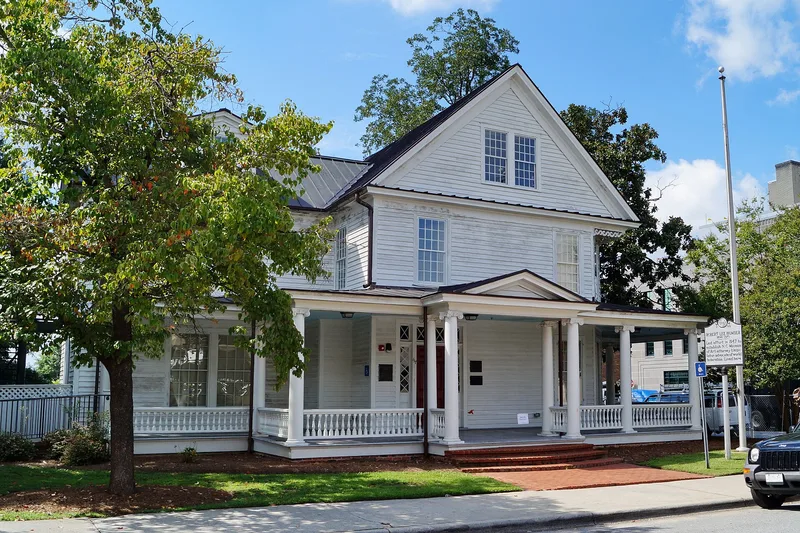
Built in 1895 for Robert Lee Humber, Sr., this two-and-a-half-story frame house in Greenville combines Queen Anne and Colonial Revival features. Its T-shaped plan, wraparound Ionic-columned porch, and sawn scrollwork under the eaves give it a late nineteenth-century urban character on a corner lot. Interiors were enriched during renovations in the 1940s and 1950s with Georgian Revival woodwork, imported French marble mantels, and a walnut-paneled sitting room. The house is best known as the birthplace and home of Robert Lee Humber, Jr. (1898-1970), an attorney and state legislator. From this house he worked to establish and develop the North Carolina Museum of Art and to promote world federation and the United Nations. The property is also regarded as a representative example of a late nineteenth-century residence that was altered over time.
Significance in brief: The house is significant for its association with Robert Lee Humber, Jr., who was born and lived there and whose public career included work to establish the North Carolina Museum of Art and promote international peace through a world federation and the United Nations. It is also cited as a representative late 19th-century urban residence that has been altered to reflect changing tastes.
Machine-generated summary. This summary was generated by a language model from the official nomination document and has not been reviewed line by line by an editor. It may contain errors. Check the source document before relying on any detail. Source: nomination document (PDF) · National Archives catalog entry. NRHP reference 81000425, listed July 9, 1981. Summary generated October 2026 (model claude-haiku-5-5, prompt v1.1-2026-10-29, confidence high).
Key facts
| Official database NPS National Register database, ref. 81000425 , checked | |
|---|---|
| Address | 117 W. 5th St., Greenville |
| County | Pitt County |
| Listed | July 9, 1981 |
| Reference number | 81000425 |
| Resource type | Building |
| Areas of significance | Art, Politics/Government, Architecture |
| Level of significance | State |
| National Historic Landmark | No |
| Acreage | 1 |
| Official document, machine-extracted Nomination form (National Archives) , checked | |
| Period of significance | 1900- |
| Architectural style | Queen Anne and Colonial Revival |
| Criteria |
|
| Status (as stated in the nomination) | The house with minor renovations is scheduled to become the eastern field office for the North Carolina Division of Archives and History. |
| Official dataset NPS cultural-resource GIS (NRHP locations) | |
| Coordinates | 35.61099, -77.37132 |
| Computed Computed from NPS GIS district boundaries | |
| Within district | Greenville Commercial Historic District |
What listing means for this property
National Register listing is honorary for a privately owned home: it does not by itself restrict what an owner may do with their own money, and it does not require public access. Restrictions come from local landmark or historic-district ordinances, which are separate (how they differ).
Owner-occupied houses are not eligible for the 20% federal rehabilitation tax credit, which applies to income-producing buildings, but many states offer credits for homeowners. Listing also opens the door to preservation easements and to buying a plaque. Start with what listing means for homeowners, renovating a listed house and selling one.
General information, not legal or tax advice. Rules change; confirm with your State Historic Preservation Office or a qualified adviser.
Questions about Humber, Robert Lee, House
When was Humber, Robert Lee, House added to the National Register of Historic Places?
Humber, Robert Lee, House was listed on July 9, 1981. Its National Register reference number is 81000425.
Is Humber, Robert Lee, House a National Historic Landmark?
No. The National Park Service database (snapshot of May 2026) lists Humber, Robert Lee, House on the National Register but does not record it as a National Historic Landmark.
Where is Humber, Robert Lee, House?
117 W. 5th St., Greenville, Pitt County, North Carolina; coordinates 35.61099, -77.37132.
Why is Humber, Robert Lee, House historically significant?
According to a machine-generated summary of its nomination form: The house is significant for its association with Robert Lee Humber, Jr., who was born and lived there and whose public career included work to establish the North Carolina Museum of Art and promote international peace through a world federation and the United Nations. It is also cited as a representative late 19th-century urban residence that has been altered to reflect changing tastes. Check the nomination document before relying on any detail.
Is Humber, Robert Lee, House in a historic district?
Yes. Its location falls within the Greenville Commercial Historic District, itself listed on the National Register. (Computed from National Park Service boundary data; the district nomination's own list of contributing resources may differ.)
Where can I read the original nomination for Humber, Robert Lee, House?
The nomination form is a public record held by the National Archives: nomination document (PDF).
Sources and further reading
- National Park Service, National Register of Historic Places database (snapshot May 2026), reference 81000425.
- Nomination form (PDF, National Archives) — catalog entry
- Wikipedia article (used for cross-checking only; text not reproduced here)
- Wikidata Q19874451
- This listing as JSON
Last updated November 2026. Found an error? See the editorial policy for how to report it.