Dickinson Avenue Historic District

Why it's listed
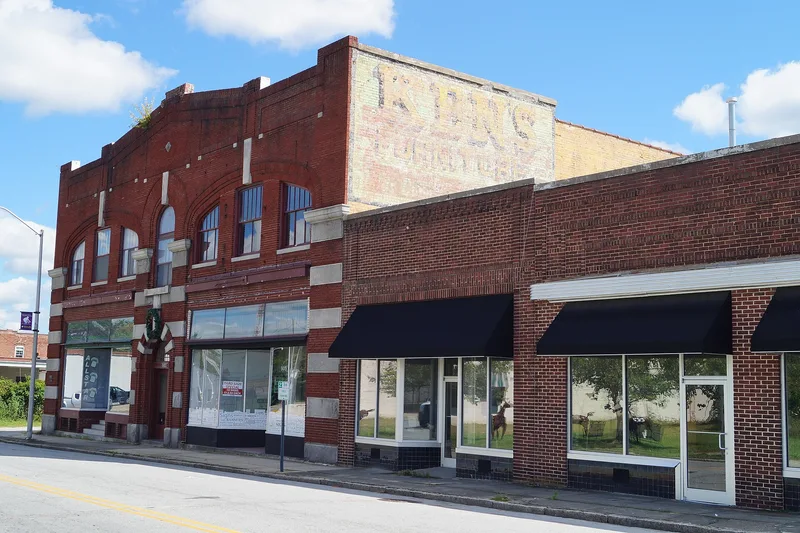
Dickinson Avenue Historic District covers the 600-900 blocks of a diagonal commercial street in Greenville, North Carolina, along with one block of adjoining side streets and a CSX railroad right-of-way. Most of its 45 resources are one- and two-story brick commercial buildings in the early twentieth-century Commercial Style. The district also includes a Classical Revival church, a movie theater, a tobacco warehouse, a remnant of railroad track, and remains of the Imperial Tobacco Company factory. During the 1910s and 1920s, the central business district spread along Dickinson Avenue toward the railroad tracks and replaced earlier houses with stores, garages, bottling plants, and warehouses. Many lower storefronts have been modernized, and demolitions have left vacant lots, yet the upper facades, streetscape, and much architectural detail survive from the period of significance, about 1902 to 1956. Thirty-five buildings and three structures contribute to its historic character.
Significance in brief: The district shows how Dickinson Avenue changed from a residential street into a commercial corridor in the 1910s and 1920s as Greenville's business center expanded toward the railroad. Its buildings reflect the town's tobacco, retail, and railroad-related commerce. It retains its streetscape and much of its architectural detail from the period of significance.
Machine-generated summary. This summary was generated by a language model from the official nomination document and has not been reviewed line by line by an editor. It may contain errors. Check the source document before relying on any detail. Source: nomination document (PDF) · National Archives catalog entry. NRHP reference 07000092, listed March 1, 2007. Summary generated October 2026 (model claude-sonnet-5-5, prompt v1.0-2026-10-29, confidence medium).
Key facts
| Address | 600-900 Blks Dickinson Ave., one blk of side Sts, inc.W. Eighth, Flicklien, S. Pitt, Clark Sts., Atlantic, Albermarle, Greenville |
|---|---|
| County | Pitt County |
| Listed | March 1, 2007 |
| Reference number | 07000092 |
| Resource type | District |
| Period of significance | ca. 1902-1956 |
| Architectural style | Commercial Style, Classical Revival, Art Deco, Romanesque, Industrial Italianate |
| Areas of significance | Architecture, Commerce, Industry |
| Level of significance | Local |
| Status (as stated in the nomination) | Many storefronts have been altered and several buildings were demolished, leaving vacant lots. Some buildings remain in commercial or religious use, and a few are vacant. |
| Acreage | 12 |
| Coordinates | 35.61144, -77.37765 (NPS GIS) |
What listing means for this property
This is a historic district. Buildings within its boundary are either contributing (they add to the district's significance) or non-contributing. Owners of contributing income-producing buildings can claim the 20% federal rehabilitation tax credit; homeowners should look at state credits. National Register districts impose no design review by themselves; a local historic district ordinance, if one exists, does (the difference explained).
General information, not legal or tax advice. Rules change; confirm with your State Historic Preservation Office or a qualified adviser.
Sources and further reading
- National Park Service, National Register of Historic Places database (snapshot May 2026), reference 07000092.
- Nomination form (PDF, National Archives) — catalog entry
- Wikipedia article (used for cross-checking only; text not reproduced here)
- Wikidata Q19877883
- This listing as JSON
Last updated October 2026. Found an error? See the editorial policy for how to report it.