Greenville Tobacco Warehouse Historic District

Why it's listed
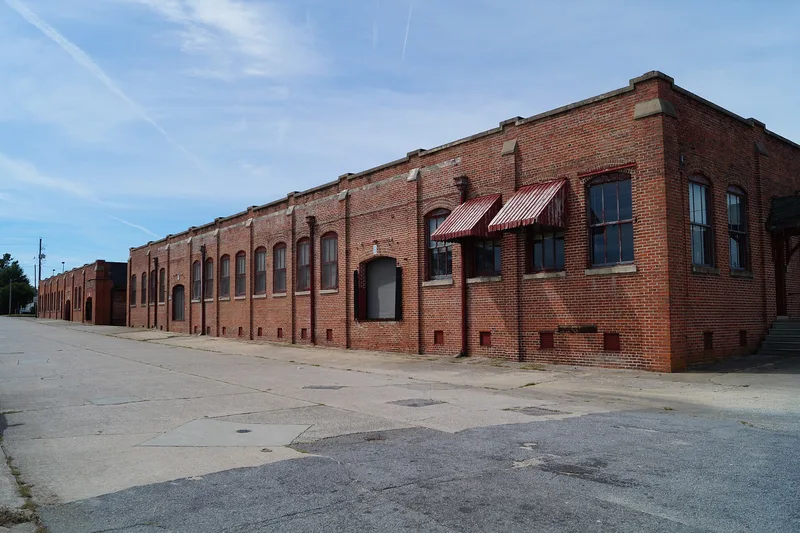
Six brick and frame tobacco buildings clustered beside the railroad in south Greenville form a district built largely between about 1905 and 1930. The complex includes sales warehouses, prizeries where leaf was cured and stemmed, and storage houses for aging tobacco. Greenville grew into a major marketing center after a cotton slump led Pitt County farmers to plant tobacco in the mid-1880s, and the first sales warehouse opened in 1891. Fires destroyed much of the earlier frame industry in 1901, 1903 and 1905, and brick construction followed. The Prichard-Hughes Warehouse, thought to date from about 1905, marks the start of the period of significance. The Export Leaf Factory of 1914 and the Star Warehouse of 1930 are among the largest buildings. The district is regarded as the best surviving group of early tobacco buildings in the city, with the railroad that shaped its growth.
Significance in brief: The nomination argues the district is locally significant for its role in Greenville's commerce and industry, especially the growth of flue-cured tobacco marketing and processing from 1905 to 1947. It also argues the buildings are an intact grouping of eclectic tobacco-industry architecture, built with slow-burn fire-resistant construction and Industrial Italianate and Art Deco detailing.
Machine-generated summary. This summary was generated by a language model from the official nomination document and has not been reviewed line by line by an editor. It may contain errors. Check the source document before relying on any detail. Source: nomination document (PDF) · National Archives catalog entry. NRHP reference 97000726, listed July 17, 1997. Summary generated October 2026 (model claude-haiku-5-5, prompt v1.1-2026-10-29, confidence medium).
Key facts
| Address | Roughly bounded by Twelfth, Clark, Ficklen, and Washington Sts., Greenville |
|---|---|
| County | Pitt County |
| Listed | July 17, 1997 |
| Reference number | 97000726 |
| Resource type | District |
| Period of significance | 1905-1947 |
| Architectural style | Other: Industrial Italianate; Art Deco |
| Criteria |
|
| Areas of significance | Industry, Architecture, Commerce |
| Level of significance | Local |
| Status (as stated in the nomination) | Except for the Gorman Warehouse, now the 531 Planters' Warehouse, none of the buildings are used for tobacco-related enterprises; the Star Warehouse and E. B. Ficklen Factory house a chemical company. |
| Acreage | 10.4 |
| Coordinates | 35.60698, -77.37656 (NPS GIS) |
What listing means for this property
This is a historic district. Buildings within its boundary are either contributing (they add to the district's significance) or non-contributing. Owners of contributing income-producing buildings can claim the 20% federal rehabilitation tax credit; homeowners should look at state credits. National Register districts impose no design review by themselves; a local historic district ordinance, if one exists, does (the difference explained).
General information, not legal or tax advice. Rules change; confirm with your State Historic Preservation Office or a qualified adviser.
Sources and further reading
- National Park Service, National Register of Historic Places database (snapshot May 2026), reference 97000726.
- Nomination form (PDF, National Archives) — catalog entry
- Wikipedia article (used for cross-checking only; text not reproduced here)
- Wikidata Q19867143
- This listing as JSON
Last updated October 2026. Found an error? See the editorial policy for how to report it.