Wilmington Historic and Archeological District

Why it's listed
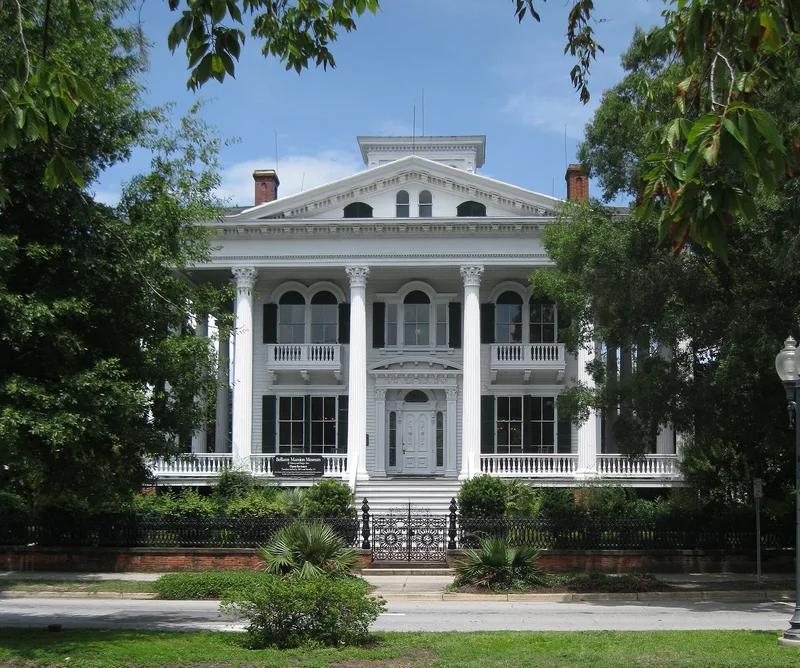
Wilmington's historic district takes in the downtown of a North Carolina port city on the east bank of the Cape Fear River, along with a stretch of the river and marshland on the far side. The 1737 street grid, clarified in 1743, remains intact, and broad Market and Third streets carry grassy plazas first introduced in the late 1880s. The architecture reflects the wealth of commission merchants and businessmen. The Smith-Anderson House, dated about 1745, is the earliest surviving building, while the Burgwin-Wright House and St. John's Masonic Lodge represent the Georgian period. Italianate houses with vented friezes and bracketed eaves dominate, alongside the Bellamy Mansion, Second Empire, Queen Anne, Stick and Shingle-style homes. Commercial blocks include cast-iron fronts and early twentieth-century skyscrapers. St. James Episcopal Church was designed by Thomas U. Walter. The river portion is included for its archeological potential, with documented wrecks, barges and marine railways.
Significance in brief: The district is significant as a thriving port city whose architecture reflects its commercial and social vitality, especially its long-lived local Italianate style. It keeps its original street plan, early survivors such as the Smith-Anderson House, and notable works by architects including Thomas U. Walter and Henry Bacon. The river section is included for its likely archaeological resources, including shipwrecks, barges and marine railways.
Machine-generated summary. This summary was generated by a language model from the official nomination document and has not been reviewed line by line by an editor. It may contain errors. Check the source document before relying on any detail. Source: nomination document (PDF) · National Archives catalog entry. NRHP reference 74001364, listed May 6, 1974. Summary generated October 2026 (model claude-sonnet-5-5, prompt v1.0-2026-10-29, confidence medium).
Key facts
| Address | Roughly bounded by Wright, S. 7th, and Harnett Sts., and N/S line 100 yds. W of North East Cape Fear River, Wilmington |
|---|---|
| County | New Hanover County |
| Listed | May 6, 1974 |
| Reference number | 74001364 |
| Resource type | District |
| Architect / builder | Thomas U. Walter; Henry Bacon; James F. Post; Rufus Bunnell; Charles McMillin; J. F. Leitner; Kenneth Murchison; G. Lord Preacher |
| Architectural style | Predominantly Italianate, with Georgian, Federal, Greek Revival, Second Empire, Queen Anne, Stick, Shingle and Neo-Classical Revival examples |
| Areas of significance | Industry, Community Planning and Development, Commerce, Historic - Non-Aboriginal, Military, Architecture |
| Level of significance | National |
| Status (as stated in the nomination) | Condition is marked excellent, good and fair, with a mix of occupied and unoccupied buildings. The form notes that urban renewal has razed some commercial buildings and that Market and North Third streets have lost trees, plazas and fine buildings. |
| Acreage | 900 |
| Within district | Wilmington Historic District (Boundary Increase) |
| Coordinates | 34.23632, -77.94285 (NPS GIS) |
What listing means for this property
This is a historic district. Buildings within its boundary are either contributing (they add to the district's significance) or non-contributing. Owners of contributing income-producing buildings can claim the 20% federal rehabilitation tax credit; homeowners should look at state credits. National Register districts impose no design review by themselves; a local historic district ordinance, if one exists, does (the difference explained).
General information, not legal or tax advice. Rules change; confirm with your State Historic Preservation Office or a qualified adviser.
Sources and further reading
- National Park Service, National Register of Historic Places database (snapshot May 2026), reference 74001364.
- Nomination form (PDF, National Archives) — catalog entry
- Wikipedia article (used for cross-checking only; text not reproduced here)
- Wikidata Q22061146
- This listing as JSON
Last updated October 2026. Found an error? See the editorial policy for how to report it.