Highland Park Manufacturing Company Mill No. 3
Highland Park Manufacturing Company Mill No. 3 is a historic district in Charlotte, Mecklenburg County, North Carolina, listed on the National Register of Historic Places on October 20, 1988 (reference number 88001855). The National Park Service records its significance in Industry and Architecture at the local level.
Facts from the NPS National Register database (); nomination summary October 2026. Last updated . Sources for each fact.

Approximate location: the National Park Service places this pin arbitrarily within the property, not at a surveyed point (stated accuracy ±12 m).
Why it's listed
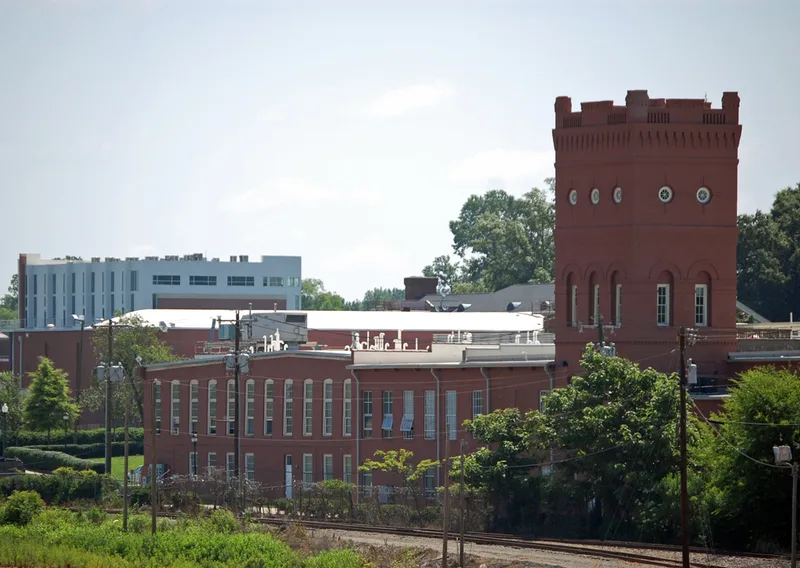
Highland Park Mill No. 3 is a cotton mill complex on North Davidson Street in Charlotte, built in 1903-4 on a site next to the railroad and beside a planned mill village. Designed by engineer Stuart Warren Cramer, the L-shaped brick mill has a low gable roof and several towers, the largest of which is four stories with corbelled brickwork and a crenelated parapet. Outbuildings include a gate house, dye house, boiler house, waste house and a later water tower. When finished, it held 30,000 spindles and 1,000 looms, employed over 800 people, and was the largest mill in the county. It was among the first North Carolina mills driven by electric power. Cramer used its plans as a model and published them in his book on mill construction. Among Charlotte's fifteen early mills, it is one of the two most nearly intact, which supports its listing for industry and architecture. Textile production ended in 1969.
Significance in brief: The mill was the largest in Mecklenburg County when built and played a major part in Charlotte's industrial growth. It was designed by Stuart Cramer, who used it as a model for his mill designs and documented it in his book on mill construction. It was also one of the state's first electrically driven mills and is among the most intact surviving mills in Charlotte.
Machine-generated summary. This summary was generated by a language model from the official nomination document and has not been reviewed line by line by an editor. It may contain errors. Check the source document before relying on any detail. Source: nomination document (PDF) · National Archives catalog entry. NRHP reference 88001855, listed October 20, 1988. Summary generated October 2026 (model claude-sonnet-5-5, prompt v1.0-2026-10-29, confidence high).
Key facts
| Official database NPS National Register database, ref. 88001855 , checked | |
|---|---|
| Address | 2901 N. Davidson St., Charlotte |
| County | Mecklenburg County |
| Listed | October 20, 1988 |
| Reference number | 88001855 |
| Resource type | District |
| Areas of significance | Industry, Architecture |
| Level of significance | Local |
| National Historic Landmark | No |
| Acreage | 9.3 |
| Official document, machine-extracted Nomination form (National Archives) , checked | |
| Period of significance | 1903-1938 |
| Architect / builder | Cramer, Stuart Warren |
| Architectural style | Textile Mill Vernacular |
| Criteria |
|
| Status (as stated in the nomination) | Textile manufacturing ceased in 1969. The form lists the current function as warehouse and manufacturing facility. It notes the water tower is no longer in use and may be demolished, and the boiler house may need demolition because of asbestos. |
| Official dataset NPS cultural-resource GIS (NRHP locations) | |
| Coordinates | 35.24576, -80.80953 |
| Computed Computed from NPS GIS district boundaries | |
| Within district | North Charlotte Historic District |
What listing means for this property
This is a historic district. Buildings within its boundary are either contributing (they add to the district's significance) or non-contributing. Owners of contributing income-producing buildings can claim the 20% federal rehabilitation tax credit; homeowners should look at state credits. National Register districts impose no design review by themselves; a local historic district ordinance, if one exists, does (the difference explained).
General information, not legal or tax advice. Rules change; confirm with your State Historic Preservation Office or a qualified adviser.
Questions about Highland Park Manufacturing Company Mill No. 3
When was Highland Park Manufacturing Company Mill No. 3 added to the National Register of Historic Places?
Highland Park Manufacturing Company Mill No. 3 was listed on October 20, 1988. Its National Register reference number is 88001855.
Is Highland Park Manufacturing Company Mill No. 3 a National Historic Landmark?
No. The National Park Service database (snapshot of May 2026) lists Highland Park Manufacturing Company Mill No. 3 on the National Register but does not record it as a National Historic Landmark.
Where is Highland Park Manufacturing Company Mill No. 3?
2901 N. Davidson St., Charlotte, Mecklenburg County, North Carolina; coordinates 35.24576, -80.80953.
Why is Highland Park Manufacturing Company Mill No. 3 historically significant?
According to a machine-generated summary of its nomination form: The mill was the largest in Mecklenburg County when built and played a major part in Charlotte's industrial growth. It was designed by Stuart Cramer, who used it as a model for his mill designs and documented it in his book on mill construction. It was also one of the state's first electrically driven mills and is among the most intact surviving mills in Charlotte. Check the nomination document before relying on any detail.
Who designed or built Highland Park Manufacturing Company Mill No. 3?
The nomination form names Cramer, Stuart Warren as architect or builder (extracted by machine from the nomination; check the source document).
Is Highland Park Manufacturing Company Mill No. 3 in a historic district?
Yes. Its location falls within the North Charlotte Historic District, itself listed on the National Register. (Computed from National Park Service boundary data; the district nomination's own list of contributing resources may differ.)
Where can I read the original nomination for Highland Park Manufacturing Company Mill No. 3?
The nomination form is a public record held by the National Archives: nomination document (PDF).
Sources and further reading
- National Park Service, National Register of Historic Places database (snapshot May 2026), reference 88001855.
- Nomination form (PDF, National Archives) — catalog entry
- Wikipedia article (used for cross-checking only; text not reproduced here)
- Wikidata Q14707968
- This listing as JSON
Last updated November 2026. Found an error? See the editorial policy for how to report it.