Ray, Clyde H., Sr., House
Also known as: Ten Oaks; Breese House

Why it's listed
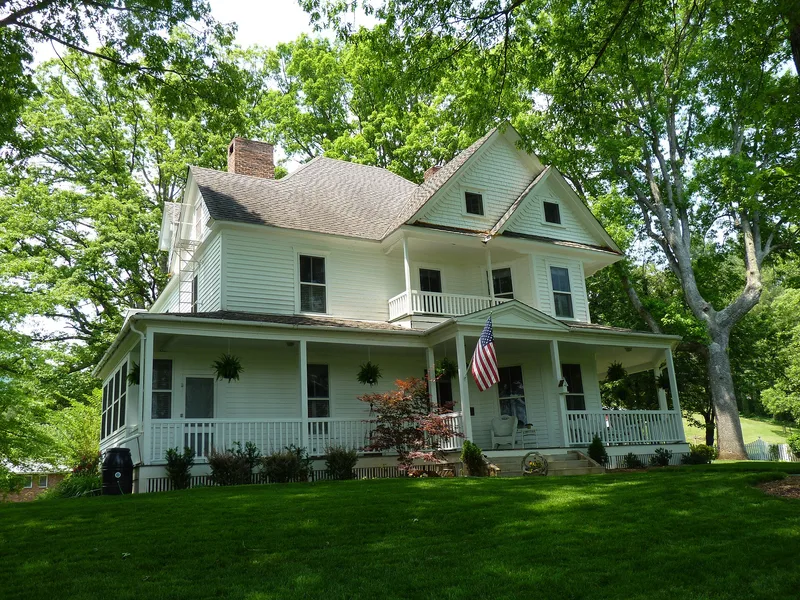
Built between 1898 and 1900 by Rhinehart Brothers Construction of Pigeon Forge, Tennessee, this two and a half-story frame house on Love Lane, about 0.4 mile northwest of downtown Waynesville, combines Colonial Revival detailing with Queen Anne massing. Its multi-gabled roof, weatherboard siding, wrap-around porch and bull's-eye window moldings reflect the styles favored by prosperous families after the railroad reached town in 1884 and 1885. The house was built for Clyde H. Ray, Sr., who arrived in Waynesville in 1887 and became one of its leading merchants, known locally as the Merchant Prince. He served as mayor in three separate terms and helped found the First National Bank. The house is valued for its association with his career in the railroad-era town and for its well-preserved interior, which includes original mantels, hardwood floors, a milled staircase and a varied set of fireplace designs. The surviving outbuilding is a brick spring house.
Significance in brief: The nomination argues the house is significant for its association with Clyde H. Ray, Sr., a Waynesville merchant, mayor and community leader, and for its role in reflecting the growth of Waynesville after the railroad arrived. It is also presented as an excellent, intact example of the Queen Anne-Colonial Revival style in Waynesville.
Machine-generated summary. This summary was generated by a language model from the official nomination document and has not been reviewed line by line by an editor. It may contain errors. Check the source document before relying on any detail. Source: nomination document (PDF) · National Archives catalog entry. NRHP reference 96001089, listed October 22, 1996. Summary generated October 2026 (model claude-haiku-5-5, prompt v1.1-2026-10-29, confidence medium).
Key facts
| Address | 803 1/2 Love Ln., Waynesville |
|---|---|
| County | Haywood County |
| Listed | October 22, 1996 |
| Reference number | 96001089 |
| Resource type | Building |
| Period of significance | 1898-1941 |
| Architect / builder | Rhinehart Bros. Construction |
| Architectural style | Queen Anne/Colonial Revival |
| Criteria |
|
| Areas of significance | Architecture, Commerce, Community Planning and Development |
| Level of significance | Local |
| Status (as stated in the nomination) | Restored to its turn-of-the-century appearance and used as a private home and bed and breakfast. |
| Acreage | 1 |
| Coordinates | 35.49705, -82.99204 (NPS GIS) |
What listing means for this property
National Register listing is honorary for a privately owned home: it does not by itself restrict what an owner may do with their own money, and it does not require public access. Restrictions come from local landmark or historic-district ordinances, which are separate (how they differ).
Owner-occupied houses are not eligible for the 20% federal rehabilitation tax credit, which applies to income-producing buildings, but many states offer credits for homeowners. Listing also opens the door to preservation easements and to buying a plaque. Start with what listing means for homeowners, renovating a listed house and selling one.
General information, not legal or tax advice. Rules change; confirm with your State Historic Preservation Office or a qualified adviser.
Sources and further reading
- National Park Service, National Register of Historic Places database (snapshot May 2026), reference 96001089.
- Nomination form (PDF, National Archives) — catalog entry
- Wikipedia article (used for cross-checking only; text not reproduced here)
- Wikidata Q19987744
- This listing as JSON
Last updated October 2026. Found an error? See the editorial policy for how to report it.