Downtown Gastonia Historic District

Why it's listed
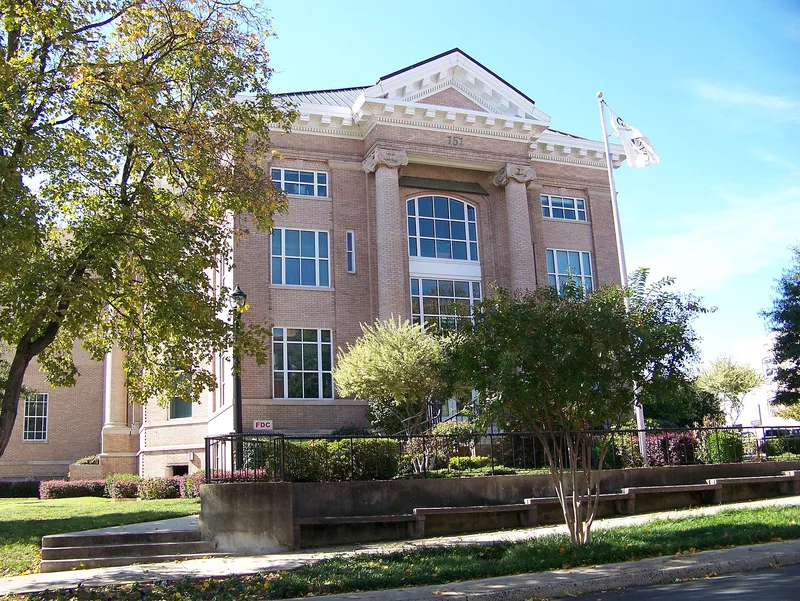
Downtown Gastonia's historic core is a dense grid of commercial, civic and institutional buildings, with some apartment buildings, laid out south of the railroad about twenty-two miles west of Charlotte. It holds 78 contributing resources, mostly brick buildings from the early 1890s to the early 1950s, including two steel-frame skyscrapers at Main Avenue and South Street, a Classical Revival bank, and an Art Deco Kress store. It was recognized because the buildings record Gastonia's growth into the leading cotton textile center of the western Piedmont. Population rose from 1,033 in 1890 to over 17,000 in 1930, and the county seat moved to the city in 1911. That prosperity paid for a courthouse, City Hall, a school, churches, banks and theaters. Local architect Hugh E. White designed six of the finest, among them City Hall, the War Memorial Hall and the Webb Theater. A 1950s fire station extends the period of significance to 1954.
Significance in brief: The district is locally significant for commerce, government and education, reflecting Gastonia's rise as the leading cotton textile manufacturing center of the western Piedmont. It is also significant for architecture, with buildings in Classical Revival, Art Deco, Moderne and other styles, including six designed by local architect Hugh E. White.
Machine-generated summary. This summary was generated by a language model from the official nomination document and has not been reviewed line by line by an editor. It may contain errors. Check the source document before relying on any detail. Source: nomination document (PDF) · National Archives catalog entry. NRHP reference 03001375, listed January 6, 2004. Summary generated October 2026 (model claude-sonnet-5-5, prompt v1.0-2026-10-29, confidence medium).
Key facts
| Address | Roughly bounded by Main Ave., Broad St., Second Ave., and Chester St., Gastonia |
|---|---|
| County | Gaston County |
| Listed | January 6, 2004 |
| Reference number | 03001375 |
| Resource type | District |
| Period of significance | c. 1890s-1954 |
| Architect / builder | Hugh E. White; Louis H. Asbury; Charles C. and Walter W. Hook; Milburn & Heister; William H. Peeps; Luther D. Proffit; Willard G. Rogers; Edward F. Sibbert; Wilson & Sompayrac; builders H. B. Pattilo and C. W. Spencer |
| Architectural style | Colonial Revival, Classical Revival, Italian Renaissance, Mission Revival, Bungalow/Craftsman, Moderne, International Style, Art Deco |
| Criteria |
|
| Areas of significance | Architecture, Commerce, Education, Politics/Government |
| Level of significance | Local |
| Status (as stated in the nomination) | Most buildings remain in use; the Woolworth's Store and Ideal Moving Picture Theater are described as long vacant and in advanced disrepair. The Webb Theater houses city offices. |
| Acreage | 46 |
| Coordinates | 35.26211, -81.18221 (NPS GIS) |
What listing means for this property
This is a historic district. Buildings within its boundary are either contributing (they add to the district's significance) or non-contributing. Owners of contributing income-producing buildings can claim the 20% federal rehabilitation tax credit; homeowners should look at state credits. National Register districts impose no design review by themselves; a local historic district ordinance, if one exists, does (the difference explained).
General information, not legal or tax advice. Rules change; confirm with your State Historic Preservation Office or a qualified adviser.
Sources and further reading
- National Park Service, National Register of Historic Places database (snapshot May 2026), reference 03001375.
- Nomination form (PDF, National Archives) — catalog entry
- Wikipedia article (used for cross-checking only; text not reproduced here)
- Wikidata Q19461391
- This listing as JSON
Last updated October 2026. Found an error? See the editorial policy for how to report it.