Hill, J. S., House
Why it's listed
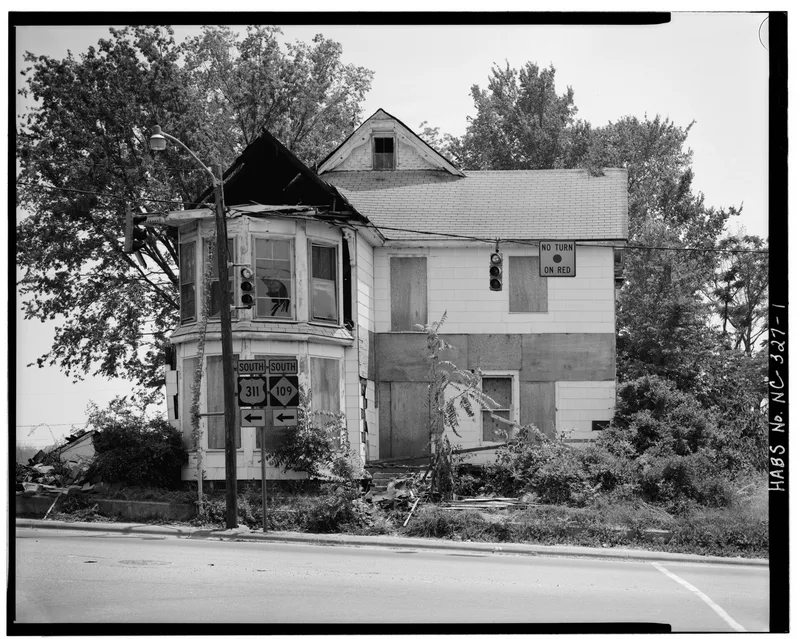
Built around 1893 at the head of Claremont Avenue, where it meets Stadium Drive near Winston-Salem State University, this two-story frame house follows a center hall plan and has a projecting two-story bay with a prominent gable on its eastern end. Its decorative features include a box cornice with returns, serrated sawnwork, louvered vents, and a sawn letter H in the facade gable. Inside, remnants of beaded surrounds, bullseye cornerblocks, and carved mantels survive despite severe vandalism after the last occupants left. The house is important chiefly because of J. S. Hill, who was born in South Carolina, graduated from Biddle University in 1889, and bought his Columbian Heights lot in 1892. Hill raised funds across the North for the Slater Industrial Academy, helping secure its physical growth. He later became a banker, founding the Forsyth Savings and Trust Company in 1907, and died in 1923. The house is regarded as one of the most architecturally important in Columbian Heights.
Significance in brief: The nomination argues the house is significant for its association with J. S. Hill, who served as chief fund raiser for the Slater Industrial Academy and helped carry out its physical development. It also cites Hill's later career as a banker and founder of the Forsyth Savings and Trust Company, and describes the house as one of the most architecturally significant in the Columbian Heights area.
Machine-generated summary. This summary was generated by a language model from the official nomination document and has not been reviewed line by line by an editor. It may contain errors. Check the source document before relying on any detail. Source: nomination document (PDF) · National Archives catalog entry. NRHP reference 79001705, listed July 22, 1979. Summary generated October 2026 (model claude-haiku-5-5, prompt v1.1-2026-10-29, confidence medium).
Key facts
| Address | 914 Stadium Dr., Winston-Salem |
|---|---|
| County | Forsyth County |
| Listed | July 22, 1979 |
| Reference number | 79001705 |
| Resource type | Building |
| Period of significance | ca. 1893 |
| Areas of significance | Commerce, Education, Social History |
| Level of significance | State, Local |
| Status (as stated in the nomination) | The interior was severely vandalized shortly after the last occupants moved out. |
| Acreage | 0.9 |
| Coordinates | 36.09008, -80.22779 (NPS GIS) |
What listing means for this property
National Register listing is honorary for a privately owned home: it does not by itself restrict what an owner may do with their own money, and it does not require public access. Restrictions come from local landmark or historic-district ordinances, which are separate (how they differ).
Owner-occupied houses are not eligible for the 20% federal rehabilitation tax credit, which applies to income-producing buildings, but many states offer credits for homeowners. Listing also opens the door to preservation easements and to buying a plaque. Start with what listing means for homeowners, renovating a listed house and selling one.
General information, not legal or tax advice. Rules change; confirm with your State Historic Preservation Office or a qualified adviser.
Sources and further reading
- National Park Service, National Register of Historic Places database (snapshot May 2026), reference 79001705.
- Nomination form (PDF, National Archives) — catalog entry
- Wikipedia article (used for cross-checking only; text not reproduced here)
- Wikidata Q18739431
- This listing as JSON
Last updated October 2026. Found an error? See the editorial policy for how to report it.