Mars Hill Baptist Church
Also known as: Fries Memorial Moravian Church

Why it's listed
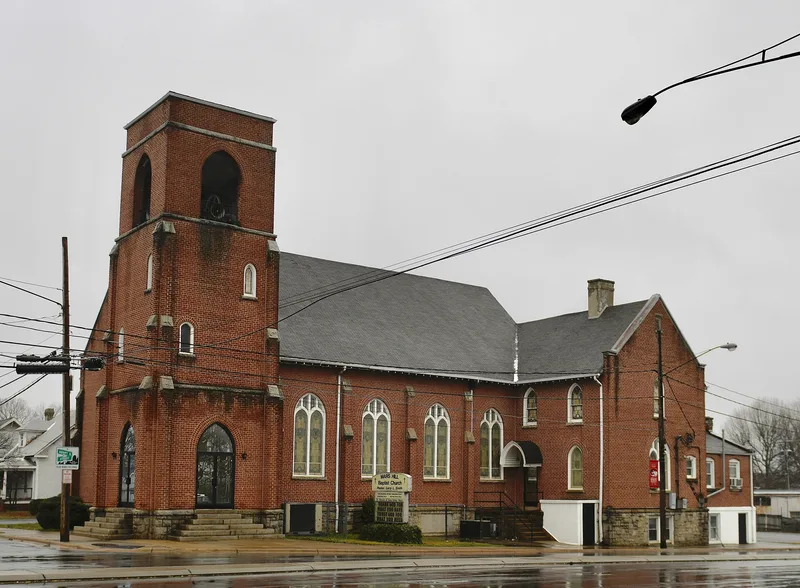
Brick Late Gothic Revival church with a square corner tower, built in 1915 at the corner of East Fourth Street and what is now Martin Luther King, Jr. Drive in Winston-Salem. It was erected for a white Moravian congregation, Fries Memorial Moravian Church, which left it in 1944. Its stained glass, pointed-arch openings, and granite trim follow the style closely, and its interior keeps abundant original woodwork, plaster walls, and a roof truss system with ornamental pendules. In August 1944 the Mars Hill Baptist congregation, founded in 1937, purchased the building during a period of rapid change in the neighborhood as African American families moved in and many white residents left. The church is regarded as a representative example of that transition and of the ability of an African American congregation to acquire an imposing building during World War II. A large southern stained glass window, damaged by Hurricane Hugo in 1989, was restored. The 1915 pebble-dash parsonage next door was included in the sale.
Significance in brief: The nomination argues the church is significant chiefly for its association with the African-American Mars Hill Baptist congregation, which bought the building in 1944 during the neighborhood's rapid racial transition, and for its architecture as a little-changed example of Gothic Revival church design. It is said to retain strong integrity of design, materials, and orientation to the street.
Machine-generated summary. This summary was generated by a language model from the official nomination document and has not been reviewed line by line by an editor. It may contain errors. Check the source document before relying on any detail. Source: nomination document (PDF) · National Archives catalog entry. NRHP reference 99000061, listed January 27, 1999. Summary generated October 2026 (model claude-haiku-5-5, prompt v1.1-2026-10-29, confidence high).
Key facts
| Address | 1331 E. Fourth St., Winston-Salem |
|---|---|
| County | Forsyth County |
| Listed | January 27, 1999 |
| Reference number | 99000061 |
| Resource type | Building |
| Period of significance | 1915-1948 |
| Architectural style | Late Gothic Revival |
| Criteria |
|
| Areas of significance | Social History, Black, Architecture |
| Level of significance | Local |
| Status (as stated in the nomination) | Church remains active; the parsonage is stated to be vacant for about a year at the time of writing. |
| Acreage | 0.9 |
| Coordinates | 36.09956, -80.22925 (NPS GIS) |
What listing means for this property
Religious properties are listed for their architectural or historical significance, not their religious use. Listing is honorary and does not restrict the congregation's use of the building. The federal rehabilitation credit is generally unavailable unless part of the building is income-producing; some state programmes and preservation grants do cover religious buildings. Federal funding or permits trigger Section 106 review.
Noted as vacant in the nomination. Nomination documents can be decades old; current status may differ. If you are considering buying an empty listed property, read the due-diligence checklist.
General information, not legal or tax advice. Rules change; confirm with your State Historic Preservation Office or a qualified adviser.
Sources and further reading
- National Park Service, National Register of Historic Places database (snapshot May 2026), reference 99000061.
- Nomination form (PDF, National Archives) — catalog entry
- Wikipedia article (used for cross-checking only; text not reproduced here)
- Wikidata Q18705847
- This listing as JSON
Last updated October 2026. Found an error? See the editorial policy for how to report it.