Watts-Hillandale Historic District
Also known as: Club Acres; Englewood

Why it's listed
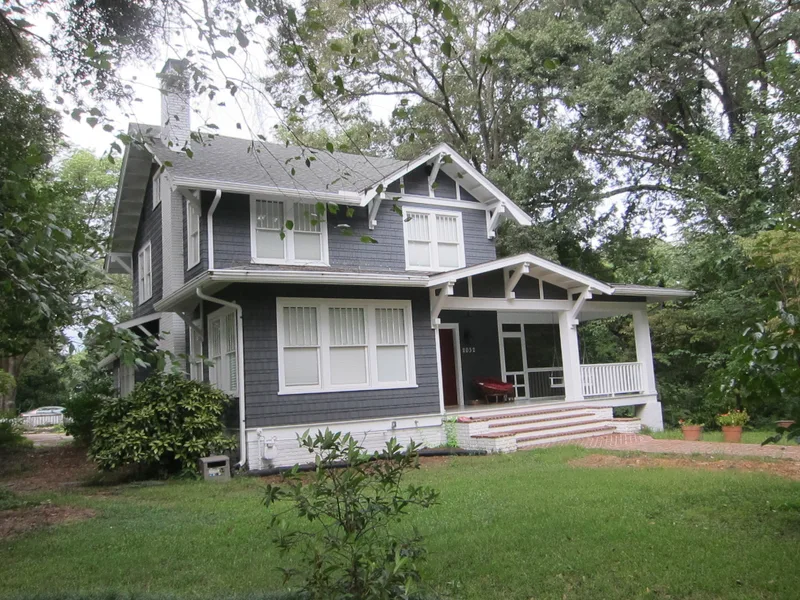
Watts-Hillandale is a residential district of about 178 acres in northwest Durham, shaped like a wide letter U. The former Watts Hospital campus and the Durham Waterworks form its two ends, joined by Club Boulevard and Englewood Avenue. Club Boulevard is the principal street, with tree-lined medians, deep lots, and large houses, while Englewood Avenue is narrower with smaller houses set close to the street. Oval Park lies at the center. The district holds 446 contributing resources, mostly houses with their garages and sheds. Early construction, about 1910 to 1925, brought Colonial-Craftsman houses, Foursquares, Colonial Revival homes, and large bungalows. The 1930s favored smaller brick period houses with Tudor or Elizabethan features, and a few early 1940s Colonial Revival cottages followed. The neighborhood developed mainly as an area of owner-occupants and had largely reached its present appearance by the early 1940s. It was recognized for its architecture and for its role in the planning and development of Durham, with significance running from 1909 to 1945.
Significance in brief: The district is significant under Criterion A for planning and community development and under Criterion C for architecture. It is a largely intact early-to-mid twentieth-century neighborhood of owner-occupied houses, with Foursquares, Colonial Revival houses, bungalows, and 1930s period cottages. Its planned street layout, medians, and Oval Park give it a cohesive character.
Machine-generated summary. This summary was generated by a language model from the official nomination document and has not been reviewed line by line by an editor. It may contain errors. Check the source document before relying on any detail. Source: nomination document (PDF) · National Archives catalog entry. NRHP reference 01000427, listed April 25, 2001. Summary generated October 2026 (model claude-sonnet-5-5, prompt v1.0-2026-10-29, confidence medium).
Key facts
| Address | Roughly bounded by Durham Waterworks, Wilson St., Sprunt Ave., Broad St., Englewood Ave., and Hillsborough Rd., Durham |
|---|---|
| County | Durham County |
| Listed | April 25, 2001 |
| Reference number | 01000427 |
| Resource type | District |
| Period of significance | 1909-1945 |
| Architect / builder | Kendall & Taylor; Sally, John; Piatt, W. M. & Co.; Thompson & Cannady; Phillips, Clarence |
| Architectural style | Spanish Colonial Revival, Colonial Revival, Tudor Revival, Bungalow/Craftsman, Romanesque |
| Criteria |
|
| Areas of significance | Architecture, Community Planning and Development |
| Level of significance | Local |
| Status (as stated in the nomination) | Houses remain in residential use, with some converted to commercial use along Broad Street; the former Watts Hospital campus is now used as a school. |
| Acreage | 178 |
| Coordinates | 36.02067, -78.92868 (NPS GIS) |
What listing means for this property
This is a historic district. Buildings within its boundary are either contributing (they add to the district's significance) or non-contributing. Owners of contributing income-producing buildings can claim the 20% federal rehabilitation tax credit; homeowners should look at state credits. National Register districts impose no design review by themselves; a local historic district ordinance, if one exists, does (the difference explained).
General information, not legal or tax advice. Rules change; confirm with your State Historic Preservation Office or a qualified adviser.
Sources and further reading
- National Park Service, National Register of Historic Places database (snapshot May 2026), reference 01000427.
- Nomination form (PDF, National Archives) — catalog entry
- Wikipedia article (used for cross-checking only; text not reproduced here)
- Wikidata Q21016324
- This listing as JSON
Last updated October 2026. Found an error? See the editorial policy for how to report it.