Blacknall, Richard D., House

Why it's listed
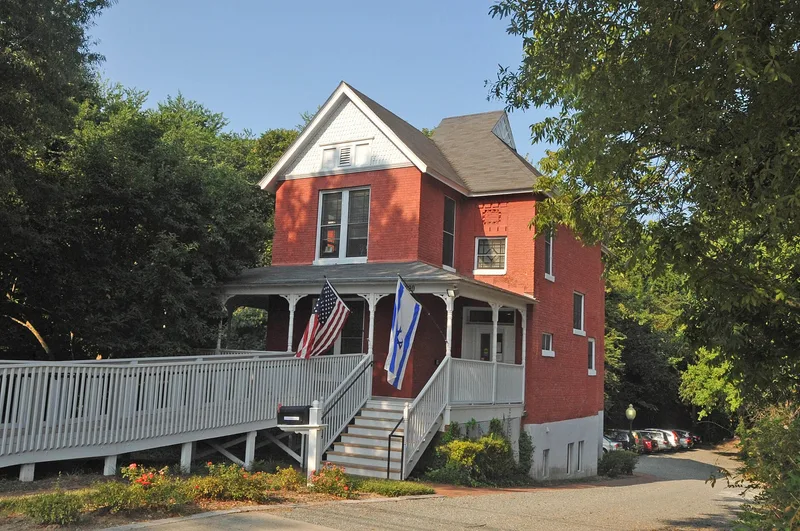
Built about 1889 for Durham pharmacist Richard D. Blacknall, this two-and-one-half story brick house is described as the city's only identified surviving nineteenth century brick residence and its only Queen Anne house in brick. It has an asymmetrical form, a multi-gabled roof, shingled gables, tall corbeled chimneys and a wraparound porch with turned posts and sawn spandrels. Inside, the side hall plan, heart pine floors, plaster walls and five coal-burning fireplaces remain. Blacknall also helped found a Presbyterian mission church in West Durham. Erwin Cotton Mills bought the house in 1909 and rented it to supervisors until Duke University acquired it in 1965. It was abandoned in 1978 and faced demolition for highway construction, so it was moved in April 1985. After restoration in 1987-1988 it was adapted for professional offices, with a new basement suite added at the rear.
Significance in brief: The house is argued to be Durham's only identified surviving nineteenth century brick residence and its only surviving Queen Anne style house built of brick. It retains characteristic Queen Anne features and a well-preserved interior. It is also tied to Richard D. Blacknall, a pharmacist and Presbyterian mission founder, and later to Erwin Cotton Mills, which housed supervisors there.
Machine-generated summary. This summary was generated by a language model from the official nomination document and has not been reviewed line by line by an editor. It may contain errors. Check the source document before relying on any detail. Source: nomination document (PDF) · National Archives catalog entry. NRHP reference 90000350, listed March 1, 1990. Summary generated October 2026 (model claude-sonnet-5-5, prompt v1.0-2026-10-29, confidence high).
Key facts
| Address | 300 Alexander Ave., Durham |
|---|---|
| County | Durham County |
| Listed | March 1, 1990 |
| Reference number | 90000350 |
| Resource type | Building |
| Period of significance | C. 1889 |
| Architectural style | Queen Anne |
| Criteria |
|
| Areas of significance | Architecture |
| Level of significance | Local |
| Status (as stated in the nomination) | Restored in 1987-1988 and in use as professional offices. |
| Acreage | 0.9 |
| Coordinates | 36.00389, -78.92698 (NPS GIS) |
What listing means for this property
National Register listing is honorary for a privately owned home: it does not by itself restrict what an owner may do with their own money, and it does not require public access. Restrictions come from local landmark or historic-district ordinances, which are separate (how they differ).
Owner-occupied houses are not eligible for the 20% federal rehabilitation tax credit, which applies to income-producing buildings, but many states offer credits for homeowners. Listing also opens the door to preservation easements and to buying a plaque. Start with what listing means for homeowners, renovating a listed house and selling one.
General information, not legal or tax advice. Rules change; confirm with your State Historic Preservation Office or a qualified adviser.
Sources and further reading
- National Park Service, National Register of Historic Places database (snapshot May 2026), reference 90000350.
- Nomination form (PDF, National Archives) — catalog entry
- Wikipedia article (used for cross-checking only; text not reproduced here)
- Wikidata Q19460551
- This listing as JSON
Last updated October 2026. Found an error? See the editorial policy for how to report it.