Emmanuel AME Church
Also known as: Deliverance Temple Holy Church

Why it's listed
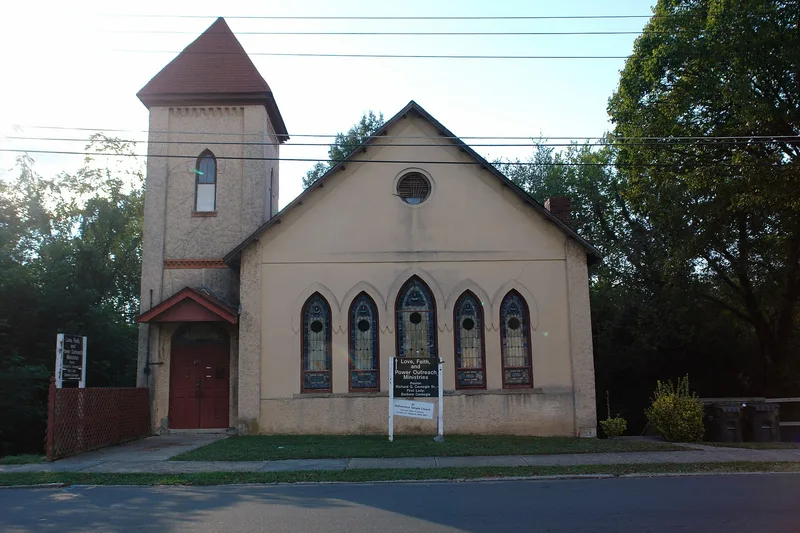
Built in 1888 of solid brick on a sloping lot in Durham's West End, the Emmanuel A.M.E. Church is a two-story gable-front building with a three-story pyramidal-roofed tower, lancet windows filled with stained glass, and a marble cornerstone inscribed with the construction date. Richard Burton Fitzgerald donated the land, deeded in 1887, and the building materials. Fitzgerald was a brickmaker who is reported to have become Durham's first black millionaire, and he operated a pharmacy and helped establish the Coleman Manufacturing Company of Concord. The congregation was the first religious institution in the West End black community and served as a community center for several decades. The church's interior retains its sanctuary layout, a tiered platform, an altar rail of sawn balusters, and two original brass chandeliers. The nomination regards it as the most distinguished surviving building linked to the Fitzgerald family and to early black church building in Durham.
Significance in brief: The nomination argues the church is the oldest surviving religious building erected by a Durham congregation and a handsome example of the Gothic Revival style. It also argues the building represents the development of the West End black community and the achievements of the Fitzgerald family, especially Richard Burton Fitzgerald, a brick manufacturer who donated the land and building materials.
Machine-generated summary. This summary was generated by a language model from the official nomination document and has not been reviewed line by line by an editor. It may contain errors. Check the source document before relying on any detail. Source: nomination document (PDF) · National Archives catalog entry. NRHP reference 85001775, listed August 9, 1985. Summary generated October 2026 (model claude-haiku-5-5, prompt v1.1-2026-10-29, confidence high).
Key facts
| Address | 710 Kent St., Durham |
|---|---|
| County | Durham County |
| Listed | August 9, 1985 |
| Reference number | 85001775 |
| Resource type | Building |
| Period of significance | 1888 |
| Architect / builder | Capt. Peyton Smith (builder) |
| Architectural style | Gothic Revival |
| Criteria |
|
| Areas of significance | Black, Architecture, Religion, Social History |
| Level of significance | Local |
| Status (as stated in the nomination) | The church was altered by stucco covering in 1962; the congregation relocated in 1971, and the building was later sold and is used by Deliverance Temple Holy Church. |
| Acreage | 0.9 |
| Within district | West End Cemeteries Historic District |
| Coordinates | 35.99473, -78.91857 (NPS GIS) |
What listing means for this property
Religious properties are listed for their architectural or historical significance, not their religious use. Listing is honorary and does not restrict the congregation's use of the building. The federal rehabilitation credit is generally unavailable unless part of the building is income-producing; some state programmes and preservation grants do cover religious buildings. Federal funding or permits trigger Section 106 review.
General information, not legal or tax advice. Rules change; confirm with your State Historic Preservation Office or a qualified adviser.
Sources and further reading
- National Park Service, National Register of Historic Places database (snapshot May 2026), reference 85001775.
- Nomination form (PDF, National Archives) — catalog entry
- Wikipedia article (used for cross-checking only; text not reproduced here)
- Wikidata Q5373112
- This listing as JSON
Last updated October 2026. Found an error? See the editorial policy for how to report it.