North Durham-Duke Park District

Why it's listed
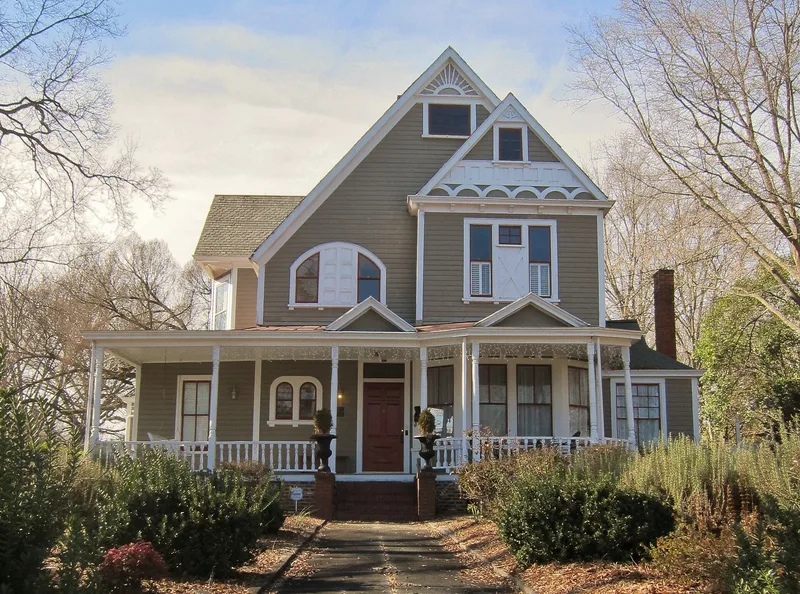
North Durham-Duke Park is a residential district in Durham, North Carolina, that combines one of the city's earliest suburbs, a small commercial node at Little Five Points, and part of the 1930s Duke Park neighborhood. Development began in the 1880s, when farmland north of downtown was converted to house lots, and continued through the 1930s. The result is an unusually varied streetscape. Queen Anne houses from the 1880s sit near Victorian homes with sawn millwork, Neo-Colonial houses, bungalows, Tudor and Spanish Revival cottages, and large Colonial Revival residences. Modest working-class houses on Glendale Avenue contrast with the larger homes on North Mangum Street. The Durham firm Rose and Rose designed several notable buildings, and the Gamble House is a rare local example of the International Style. Brick commercial buildings, apartments and churches add to the mix. Highway construction, urban renewal, new apartments and neglect have affected the southern end, but the district remains largely residential, with many owner-occupied homes.
Significance in brief: The district preserves a wide range of residential, commercial and religious architecture built over roughly fifty years, from Queen Anne and Victorian houses to bungalows, period revivals and a rare International Style house. It shows how different areas were marketed to working-class and upper-middle-class families. Works by the Durham firm Rose and Rose are among its notable buildings. The form's significance statement is not included in the text provided, so this reading rests mainly on the description section.
Machine-generated summary. This summary was generated by a language model from the official nomination document and has not been reviewed line by line by an editor. It may contain errors. Check the source document before relying on any detail. Source: nomination document (PDF) · National Archives catalog entry. NRHP reference 85001338, listed June 20, 1985. Summary generated October 2026 (model claude-sonnet-5-5, prompt v1.0-2026-10-29, confidence medium).
Key facts
| Address | Roughly bounded by Glendale Ave., W. Knox St., Roxboro Rd., Trinity Ave., Magnum & Broadway Sts., Durham |
|---|---|
| County | Durham County |
| Listed | June 20, 1985 |
| Reference number | 85001338 |
| Resource type | District |
| Architect / builder | Rose and Rose, Architects (Durham); George Carr, Sr.; contractor Lonnie Glosson (for one house) |
| Architectural style | Queen Anne, Neo-Colonial, Colonial Revival, Georgian Revival, Spanish Revival, Tudor Revival, bungalow, International Style |
| Areas of significance | Community Planning and Development, Commerce, Architecture, Religion |
| Level of significance | Local |
| Status (as stated in the nomination) | Almost entirely residential. Many larger homes have been divided into apartments, and properties at the southern end are in poor condition. Some buildings are well preserved and many homes remain owner-occupied. |
| Acreage | 71.2 |
| Coordinates | 36.00203, -78.89595 (NPS GIS) |
What listing means for this property
This is a historic district. Buildings within its boundary are either contributing (they add to the district's significance) or non-contributing. Owners of contributing income-producing buildings can claim the 20% federal rehabilitation tax credit; homeowners should look at state credits. National Register districts impose no design review by themselves; a local historic district ordinance, if one exists, does (the difference explained).
General information, not legal or tax advice. Rules change; confirm with your State Historic Preservation Office or a qualified adviser.
Sources and further reading
- National Park Service, National Register of Historic Places database (snapshot May 2026), reference 85001338.
- Nomination form (PDF, National Archives) — catalog entry
- Wikipedia article (used for cross-checking only; text not reproduced here)
- Wikidata Q19987332
- This listing as JSON
Last updated October 2026. Found an error? See the editorial policy for how to report it.