Ephphatha Church
Also known as: Faith Tabernacle

Why it's listed
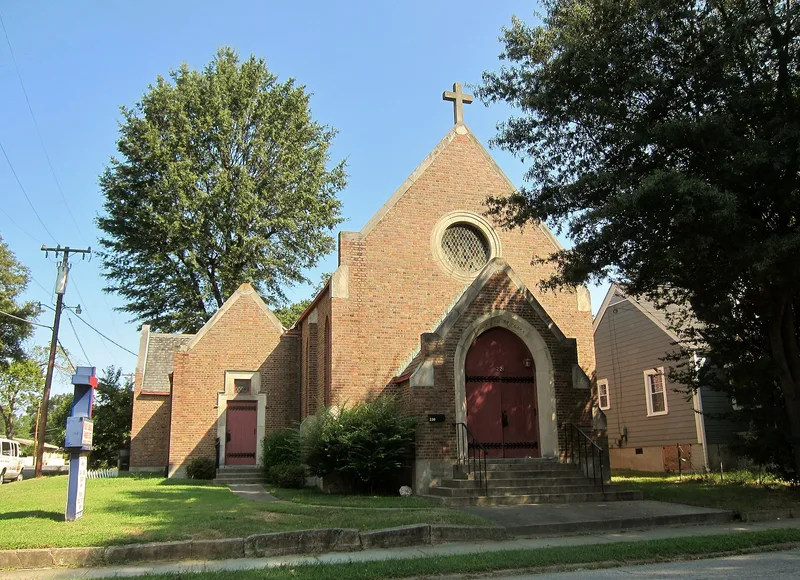
Built in 1930 on a small corner lot in Durham's North Durham neighborhood, this brick Gothic Revival church was designed by architect George Watts Carr, Sr. It has a steeply pitched slate roof, stone-accented buttresses, lancet windows with diamond-pane glass, and an interior of exposed pine trusses and brick walls. Its importance lies in its purpose: it was the first formal church in the South, and one of only four in the country, built exclusively for a deaf congregation. That congregation began in 1906 with Bible classes in sign language led by the Reverend Sidney S. Bost at St. Philip's Episcopal Church. The Reverend Roma C. Fortune, a deaf charter member trained by Bost, later served as its rector. The church was funded by a drive that raised $16,000 and was built as a memorial to Bishop Joseph Blount Cheshire. James R. Fortune, Sr. succeeded his father and served until 1977. The building now houses another congregation.
Significance in brief: When built, it was the first formal church in the South and one of only four in the nation built exclusively for a deaf congregation. It is tied to Episcopal clergy who ministered to the deaf, including Bishop Joseph Blount Cheshire and the Reverends Sidney S. Bost, Roma C. Fortune and James R. Fortune, Sr. It also exemplifies the Late Gothic Revival style used by Episcopal congregations.
Machine-generated summary. This summary was generated by a language model from the official nomination document and has not been reviewed line by line by an editor. It may contain errors. Check the source document before relying on any detail. Source: nomination document (PDF) · National Archives catalog entry. NRHP reference 85001778, listed August 9, 1985. Summary generated October 2026 (model claude-sonnet-5-5, prompt v1.0-2026-10-29, confidence high).
Key facts
| Address | 220 W. Geer St., Durham |
|---|---|
| County | Durham County |
| Listed | August 9, 1985 |
| Reference number | 85001778 |
| Resource type | Building |
| Period of significance | 1930 |
| Architect / builder | George Watts Carr, Sr. (architect); the contractor was reportedly from Sanford, North Carolina |
| Architectural style | Late Gothic Revival |
| Criteria |
|
| Areas of significance | Architecture, Religion |
| Level of significance | Local |
| Status (as stated in the nomination) | Deaf congregation used it until 1977; later rented to another congregation, which renamed it Faith Tabernacle. Described as unaltered, in good condition, and occupied. |
| Acreage | 0.9 |
| Within district | North Durham-Duke Park District |
| Coordinates | 36.00577, -78.89774 (NPS GIS) |
What listing means for this property
Religious properties are listed for their architectural or historical significance, not their religious use. Listing is honorary and does not restrict the congregation's use of the building. The federal rehabilitation credit is generally unavailable unless part of the building is income-producing; some state programmes and preservation grants do cover religious buildings. Federal funding or permits trigger Section 106 review.
General information, not legal or tax advice. Rules change; confirm with your State Historic Preservation Office or a qualified adviser.
Sources and further reading
- National Park Service, National Register of Historic Places database (snapshot May 2026), reference 85001778.
- Nomination form (PDF, National Archives) — catalog entry
- Wikipedia article (used for cross-checking only; text not reproduced here)
- Wikidata Q5382231
- This listing as JSON
Last updated October 2026. Found an error? See the editorial policy for how to report it.