North Carolina Mutual Life Insurance Company Building
Also known as: Mechanics and Farmers Bank

Why it's listed
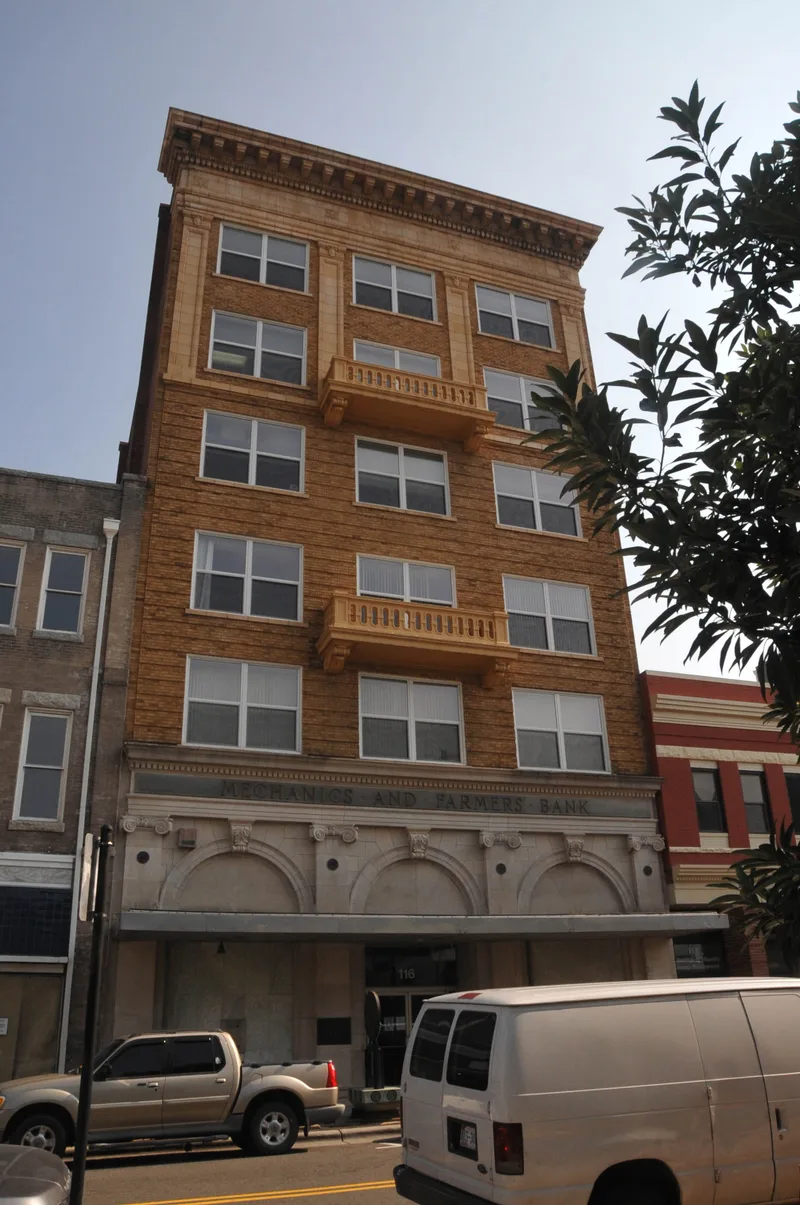
Completed in 1921 on Durham's Parrish Street, this six-story brick office building served as the second home office of the North Carolina Mutual Life Insurance Company. A local newspaper called it an architectural gem of white brick, and it was the second tallest building in Durham when built. Its front shows a marquee over the entrance, three arched windows with decorated keystones, Ionic pilasters, dentil molding, and two concrete balconies. The company was founded in 1898 by seven black men, though only John Merrick and Dr. Aaron M. Moore stayed on, and Charles Clinton Spaulding later led its growth. It became the largest black business in the country and the first black billion-dollar company. It also launched a bank, a savings and loan, a newspaper, and a cotton mill, and supported community groups. The nomination treats it as a monument to racial self-help and a national landmark of Afro-American history.
Significance in brief: The nomination argues that North Carolina Mutual, founded in 1898, became the largest black business in the nation and a lasting symbol of racial solidarity and self-help. Its significance rests on its ethnic and community identity more than on business history. It anchored the Parrish Street financial complex, called the 'black Wall Street of America', and helped make Durham the 'Capital of the Black Middle Class'. The form calls it nationally significant.
Machine-generated summary. This summary was generated by a language model from the official nomination document and has not been reviewed line by line by an editor. It may contain errors. Check the source document before relying on any detail. Source: nomination document (PDF) · National Archives catalog entry. NRHP reference 75001258, listed May 15, 1975. Summary generated October 2026 (model claude-sonnet-5-5, prompt v1.0-2026-10-29, confidence medium).
Key facts
| Address | 114-116 W. Parrish St., Durham |
|---|---|
| County | Durham County |
| Listed | May 15, 1975 |
| Reference number | 75001258 |
| Resource type | Building |
| Period of significance | 1898 - present |
| Areas of significance | Commerce, Economics, Black, Social History |
| Level of significance | National |
| National Historic Landmark | Yes, designated May 15, 1975 |
| Status (as stated in the nomination) | Condition listed as excellent and altered; occupied, with commercial present use. The entrance and marquise replaced two earlier separate entrances. |
| Acreage | 0.9 |
| Within district | Downtown Durham Historic District |
| Coordinates | 35.99558, -78.90019 (NPS GIS) |
What listing means for this property
For an income-producing building, listing (individually or as a contributing building in a district) is the gateway to the 20% federal rehabilitation tax credit on qualified rehabilitation costs, often stackable with state credits. Work claiming the credit must follow the Secretary of the Interior's Standards and be approved in advance.
Listing does not restrict a private owner acting without federal money or permits; where federal funding or licensing is involved, Section 106 review applies.
General information, not legal or tax advice. Rules change; confirm with your State Historic Preservation Office or a qualified adviser.
Sources and further reading
- National Park Service, National Register of Historic Places database (snapshot May 2026), reference 75001258.
- Nomination form (PDF, National Archives) — catalog entry
- Wikipedia article (used for cross-checking only; text not reproduced here)
- Wikidata Q7054561
- This listing as JSON
Last updated October 2026. Found an error? See the editorial policy for how to report it.