St. Peter's AME Zion Church

Why it's listed
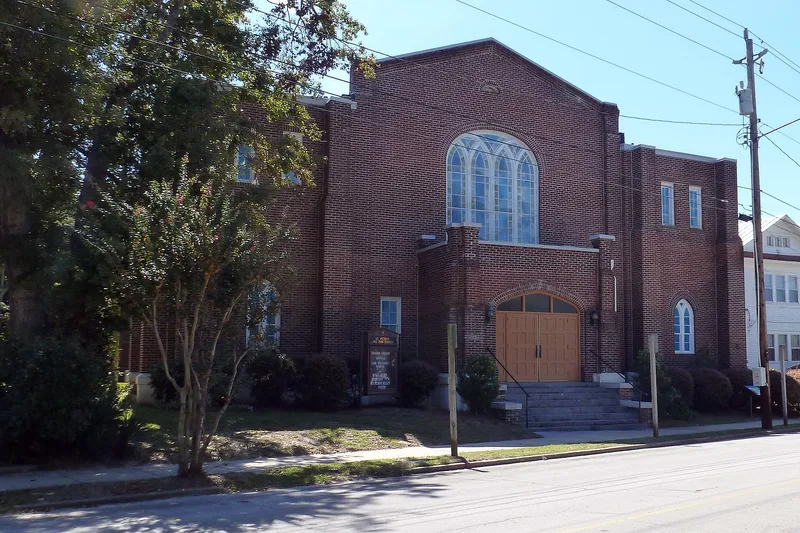
St. Peter's A.M.E. Zion Church and its parsonage occupy a half-acre lot on Queen Street in New Bern, opposite Cedar Grove Cemetery. The congregation traces its origins to Andrew Chapel, which joined the A.M.E. Zion denomination in 1864 after missionary James Walker Hood arrived in the occupied city. It later took the name St. Peter's and built churches in 1879 and 1914. The Great Fire of December 1922 destroyed the church and parsonage, and members spent nineteen years rebuilding, worshipping in the basement from 1923. The present brick Gothic Revival sanctuary, completed in 1942, has a gabled nave, buttressed walls, pointed-arch windows and twin truncated stair towers. A Craftsman-style parsonage of about 1926 is linked to it by a basement fellowship hall. The complex is recognized for its architecture and for its role in religion and Black ethnic heritage, including leaders such as Joseph C. Price and Sarah Dudley Pettey.
Significance in brief: The congregation is described as the oldest existing African Methodist Episcopal Zion congregation in the South, known as the "Mother Church of Zion Methodism in the South." It produced national leaders such as Joseph C. Price and Sarah Dudley Pettey. The present sanctuary is argued to be architecturally significant and represents the congregation's long effort to rebuild after the 1922 Great Fire.
Machine-generated summary. This summary was generated by a language model from the official nomination document and has not been reviewed line by line by an editor. It may contain errors. Check the source document before relying on any detail. Source: nomination document (PDF) · National Archives catalog entry. NRHP reference 97000571, listed June 30, 1997. Summary generated October 2026 (model claude-sonnet-5-5, prompt v1.0-2026-10-29, confidence high).
Key facts
| Address | 615 Queen St., New Bern |
|---|---|
| County | Craven County |
| Listed | June 30, 1997 |
| Reference number | 97000571 |
| Resource type | Building |
| Period of significance | 1942-1947 |
| Architect / builder | Sparrow, Henry Clay, Builder |
| Architectural style | Gothic; Bungalow/Craftsman (Gothic Revival church, Craftsman parsonage) |
| Criteria |
|
| Areas of significance | Religion, Black |
| Level of significance | Local |
| Status (as stated in the nomination) | Church and parsonage remain in religious use; the parsonage continues in use and the church has had few renovations. |
| Acreage | 0.9 |
| Within district | New Bern Historic District (Boundary Increase) (Additional Documentation) |
| Coordinates | 35.11057, -77.04339 (NPS GIS) |
What listing means for this property
Religious properties are listed for their architectural or historical significance, not their religious use. Listing is honorary and does not restrict the congregation's use of the building. The federal rehabilitation credit is generally unavailable unless part of the building is income-producing; some state programmes and preservation grants do cover religious buildings. Federal funding or permits trigger Section 106 review.
General information, not legal or tax advice. Rules change; confirm with your State Historic Preservation Office or a qualified adviser.
Sources and further reading
- National Park Service, National Register of Historic Places database (snapshot May 2026), reference 97000571.
- Nomination form (PDF, National Archives) — catalog entry
- Wikipedia article (used for cross-checking only; text not reproduced here)
- Wikidata Q7591297
- This listing as JSON
Last updated October 2026. Found an error? See the editorial policy for how to report it.