Coor-Gaston House

Why it's listed
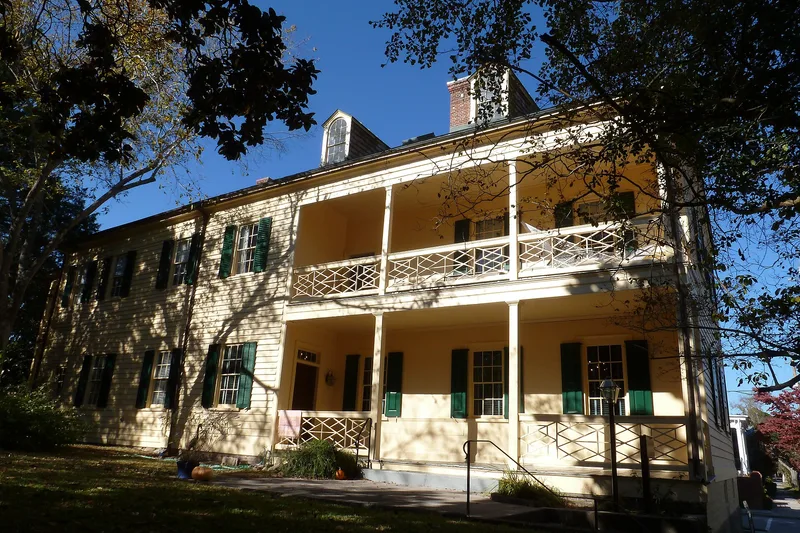
Begun soon after James Coor bought the land in 1767, this two-and-one-half-story Georgian frame house on Craven Street in New Bern has an L-shaped plan, beaded weatherboards and a two-tier porch with Chinese trellis railings. Inside, the hall and parlors carry modillioned cornices, paneled wainscots, crossetted door frames and a steep open-string stair. Coor, a house carpenter and legislator, is thought to have designed it. William Gaston, lawyer, congressman, state supreme court judge and author of the state song, bought it in 1818. In May 1821 Bishop John England held Mass here, marking the start of the Catholic congregation in New Bern. During the Civil War the house served as part of a military hospital complex. The house is valued as one of the few relatively untouched pre-Revolutionary buildings in the state. It is being restored under the Roman Catholic Diocese of Raleigh as a residence and museum.
Significance in brief: The nomination argues the house is important as the work of James Coor, an early New Bern builder. It is also one of the few relatively untouched pre-Revolutionary structures in North Carolina, with interiors of exceptional style and finish. It is further tied to William Gaston, a notable North Carolinian, and to the origins of the Roman Catholic Church in the area.
Machine-generated summary. This summary was generated by a language model from the official nomination document and has not been reviewed line by line by an editor. It may contain errors. Check the source document before relying on any detail. Source: nomination document (PDF) · National Archives catalog entry. NRHP reference 72000940, listed February 1, 1972. Summary generated October 2026 (model claude-sonnet-5-5, prompt v1.0-2026-10-29, confidence high).
Key facts
| Address | 421 Craven St., New Bern |
|---|---|
| County | Craven County |
| Listed | February 1, 1972 |
| Reference number | 72000940 |
| Resource type | Building |
| Architect / builder | James Coor |
| Architectural style | Georgian |
| Areas of significance | Architecture, Religion |
| Level of significance | State |
| Status (as stated in the nomination) | Condition is listed as excellent but altered. The main house is being restored as a combined residence and museum, and a wing has been converted to apartments. |
| Acreage | 0.3 |
| Coordinates | 35.10912, -77.03809 (NPS GIS) |
What listing means for this property
National Register listing is honorary for a privately owned home: it does not by itself restrict what an owner may do with their own money, and it does not require public access. Restrictions come from local landmark or historic-district ordinances, which are separate (how they differ).
Owner-occupied houses are not eligible for the 20% federal rehabilitation tax credit, which applies to income-producing buildings, but many states offer credits for homeowners. Listing also opens the door to preservation easements and to buying a plaque. Start with what listing means for homeowners, renovating a listed house and selling one.
General information, not legal or tax advice. Rules change; confirm with your State Historic Preservation Office or a qualified adviser.
Sources and further reading
- National Park Service, National Register of Historic Places database (snapshot May 2026), reference 72000940.
- Nomination form (PDF, National Archives) — catalog entry
- Wikipedia article (used for cross-checking only; text not reproduced here)
- Wikidata Q18149132
- This listing as JSON
Last updated October 2026. Found an error? See the editorial policy for how to report it.