Red House Presbyterian Church
Also known as: Hugh McAden Gravesite; Red House Church

Why it's listed
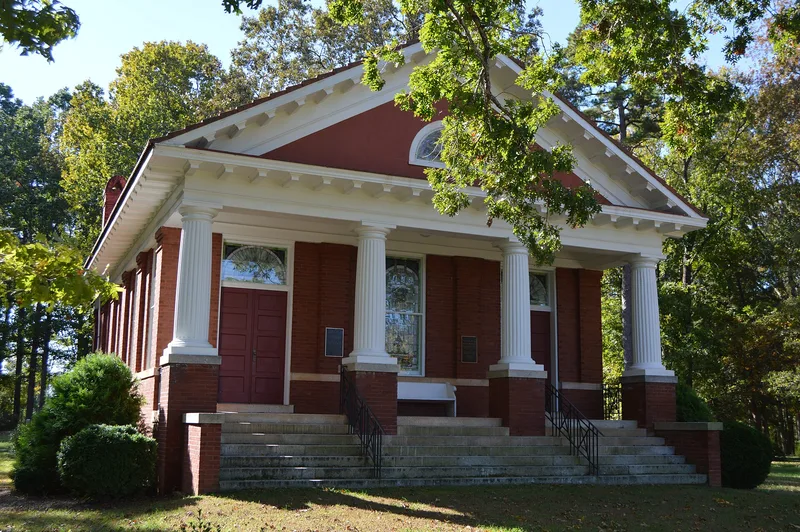
Red House Presbyterian Church is a one-story brick Classical Revival building with a basement, finished in 1913 on a knoll along North Carolina Highway 119 near Semora. It has a pedimented Doric portico, a terra cotta tile roof, twelve opalescent stained glass windows and a sanctuary with queen-post roof trusses. Behind it lies a cemetery of more than two hundred graves, with markers ranging from plain fieldstones to granite obelisks and quartz mausoleums. The congregation traces to 1755 and is described as the second oldest church in Caswell County. Its cemetery holds the grave of Rev. Hugh McAden, a missionary from Pennsylvania who helped found many Presbyterian churches in North Carolina and became the church's first resident minister, serving from 1768 until his death in 1781. The present building is the fourth on the site. It was designed by architect H. C. Linthicum and built by Henry Fields. It was listed for its association with McAden and for its architecture.
Significance in brief: The congregation dates to 1755 and the cemetery holds the grave of Hugh McAden, the first Presbyterian missionary to settle permanently in North Carolina and the first resident minister of the church. The grave is argued to be the only appropriate site directly tied to his productive life. The 1913 building is described as a sophisticated example of Classical Revival design in rural Caswell County.
Machine-generated summary. This summary was generated by a language model from the official nomination document and has not been reviewed line by line by an editor. It may contain errors. Check the source document before relying on any detail. Source: nomination document (PDF) · National Archives catalog entry. NRHP reference 07000413, listed May 1, 2007. Summary generated October 2026 (model claude-sonnet-5-5, prompt v1.0-2026-10-29, confidence high).
Key facts
| Address | 13409 NC 119 N, Semora |
|---|---|
| County | Caswell County |
| Listed | May 1, 2007 |
| Reference number | 07000413 |
| Resource type | Building |
| Period of significance | 1781-1913 |
| Architect / builder | Linthicum, Hill Carter, architect; Fields, Henry, builder |
| Architectural style | Classical Revival |
| Criteria |
|
| Areas of significance | Religion, Architecture |
| Level of significance | State |
| Status (as stated in the nomination) | Church described as in excellent condition with no substantial alteration since 1913; church and cemetery remain in active religious and funerary use. |
| Acreage | 8.5 |
| Coordinates | 36.48747, -79.16254 (NPS GIS) |
What listing means for this property
Religious properties are listed for their architectural or historical significance, not their religious use. Listing is honorary and does not restrict the congregation's use of the building. The federal rehabilitation credit is generally unavailable unless part of the building is income-producing; some state programmes and preservation grants do cover religious buildings. Federal funding or permits trigger Section 106 review.
General information, not legal or tax advice. Rules change; confirm with your State Historic Preservation Office or a qualified adviser.
Sources and further reading
- National Park Service, National Register of Historic Places database (snapshot May 2026), reference 07000413.
- Nomination form (PDF, National Archives) — catalog entry
- Wikipedia article (used for cross-checking only; text not reproduced here)
- Wikidata Q7304381
- This listing as JSON
Last updated October 2026. Found an error? See the editorial policy for how to report it.