Fort Macon

Why it's listed
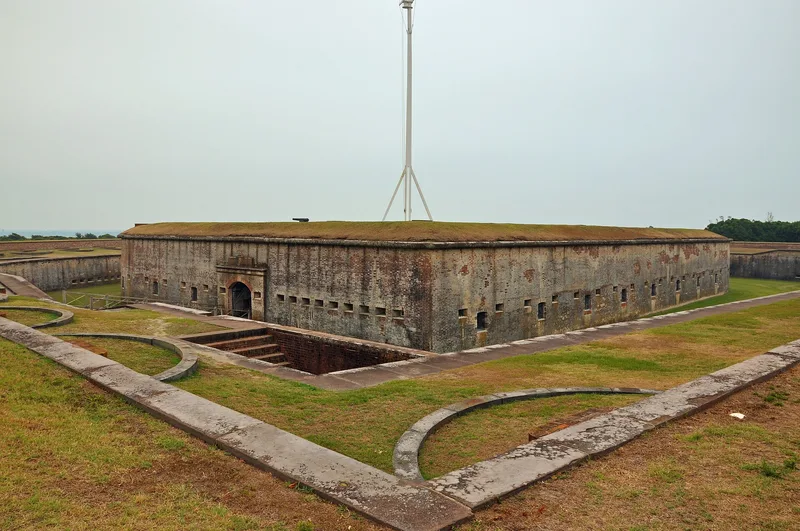
Fort Macon is a pentagonal coastal fortification at the eastern tip of Bogue Island, built to protect Beaufort Harbor. Work began in 1826 after two earlier forts on Bogue Point were lost or abandoned, and troops first occupied it in December 1834. The walls are mainly local brick, with imported Connecticut freestone and some granite. The nomination describes twenty-four casemates, three magazines, a moat and a sodded glacis, and praises the brickwork as better than most in North Carolina of the 1820s and 1830s. Robert E. Lee recommended and began the stone jetties that still help protect the site from the sea. Confederate forces took the fort in 1861 and Union forces captured it in April 1862. It later served as a military prison, was garrisoned again in the Spanish American War and World War II, and became a state park in 1924. The nomination ranks it among the state's finest brick structures and a leading example of its military type.
Significance in brief: The nomination calls Fort Macon probably the most outstanding brick structure of its era still standing in North Carolina, and one of the foremost examples of its type of military architecture. It also served through the Civil War, the Spanish American War and World War II. Robert E. Lee began the stone jetty system that protects the site, and several later Civil War generals served there.
Machine-generated summary. This summary was generated by a language model from the official nomination document and has not been reviewed line by line by an editor. It may contain errors. Check the source document before relying on any detail. Source: nomination document (PDF) · National Archives catalog entry. NRHP reference 70000445, listed February 26, 1970. Summary generated October 2026 (model claude-sonnet-5-5, prompt v1.0-2026-10-29, confidence high).
Key facts
| Address | Bogue Point, on Fort Macon Rd., 4 mi. E of Atlantic Beach, Atlantic Beach |
|---|---|
| County | Carteret County |
| Listed | February 26, 1970 |
| Reference number | 70000445 |
| Resource type | Building |
| Architect / builder | Capt. Wm. Tell Poussin (first known drawings, possibly the architect); construction supervised by Lt. Wm. A. Eliason, Capt. J.L. Smith and Lt. G. Dutton; master masons from Philadelphia and Alexandria, with a largely local, mostly enslaved labor force |
| Architectural style | Military architecture with Greek Revival interior woodwork and ironwork |
| Areas of significance | Military, Engineering, Architecture |
| Level of significance | State |
| Status (as stated in the nomination) | Owned by the State of North Carolina and used as a park and museum. Condition is listed as fair and the fort is described as unaltered, with restoration work done by the Civilian Conservation Corps in the 1930s. |
| Acreage | 9 |
| Coordinates | 34.69605, -76.67873 (NPS GIS) |
What listing means for this property
National Register listing is honorary: it recognises significance and does not restrict what a private owner may do without federal money or permits. It unlocks the 20% federal rehabilitation tax credit for income-producing buildings, state credits in many states, and Section 106 review when federal agencies are involved. See what listing means in practice.
General information, not legal or tax advice. Rules change; confirm with your State Historic Preservation Office or a qualified adviser.
Sources and further reading
- National Park Service, National Register of Historic Places database (snapshot May 2026), reference 70000445.
- Nomination form (PDF, National Archives) — catalog entry
- Wikidata Q106635799
- This listing as JSON
Last updated October 2026. Found an error? See the editorial policy for how to report it.