Ottari Sanitarium
Also known as: Coburn Apartments

Why it's listed
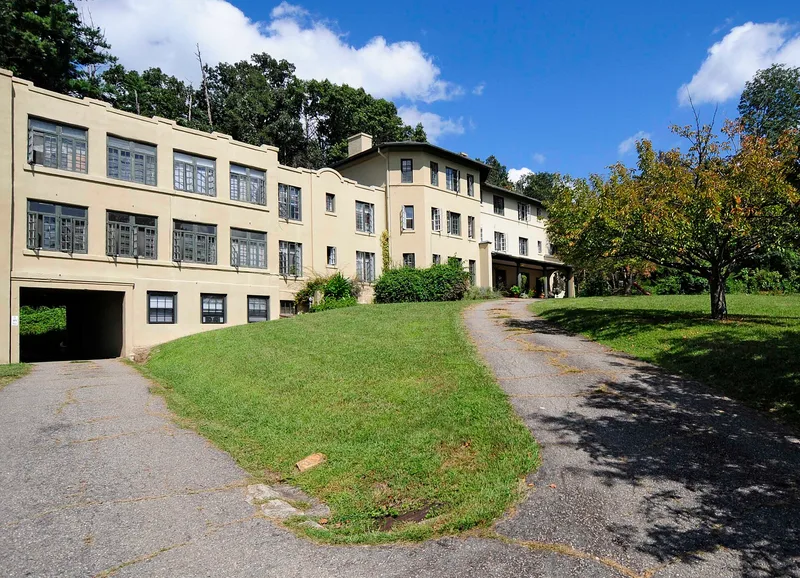
Set on a knoll at the base of Kimberly Mountain in north Asheville, this three-story stuccoed brick building began in 1912 as the Ottari Sanitarium, built and run by Dr. William Banks Meacham as a model osteopathic hospital. The original block held eighteen rooms and suites, each with a private porch. In 1923 a fourteen-bay western addition and a connecting block raised the total to forty bedrooms, thirty-five baths and thirty porches, and added flat roofs with stepped parapets showing faint Spanish detailing. Meacham, who led the National Osteopathic Association in 1916 and 1917, lost the property in the financial collapse of 1930. The city and county later held it and converted it to apartments in 1937. Harry Cutler Coburn bought it in 1940 and renamed it the Coburn Apartments. The building is recognized for its link to Asheville's reputation as a health resort, its association with Meacham, and its role as an early hospital devoted solely to osteopathy.
Significance in brief: The nomination argues that the building reflects Asheville's long history as a health resort. It was built by Dr. William Banks Meacham, a national figure in osteopathy who served as president of the National Osteopathic Association in 1916 and 1917. It was also one of the earliest hospitals built solely for osteopathic practice and reflected the state of the art of that medical philosophy.
Machine-generated summary. This summary was generated by a language model from the official nomination document and has not been reviewed line by line by an editor. It may contain errors. Check the source document before relying on any detail. Source: nomination document (PDF) · National Archives catalog entry. NRHP reference 86002876, listed October 16, 1986. Summary generated October 2026 (model claude-sonnet-5-5, prompt v1.0-2026-10-29, confidence high).
Key facts
| Address | 491 Kimberly Ave., Asheville |
|---|---|
| County | Buncombe County |
| Listed | October 16, 1986 |
| Reference number | 86002876 |
| Resource type | Building |
| Period of significance | 1900- (specific dates 1912, 1923) |
| Architect / builder | Unknown |
| Architectural style | Utilitarian sanitarium building with slight Spanish detailing (mission parapets) added in 1923 |
| Criteria |
|
| Areas of significance | Health/Medicine, Architecture |
| Level of significance | Local |
| Status (as stated in the nomination) | Occupied and in use as apartments (thirty one-bedroom and three two-bedroom units); condition listed as good and altered, with the exterior essentially as it was in 1923. |
| Acreage | 3 |
| Coordinates | 35.62926, -82.54733 (NPS GIS) |
What listing means for this property
National Register listing is honorary: it recognises significance and does not restrict what a private owner may do without federal money or permits. It unlocks the 20% federal rehabilitation tax credit for income-producing buildings, state credits in many states, and Section 106 review when federal agencies are involved. See what listing means in practice.
General information, not legal or tax advice. Rules change; confirm with your State Historic Preservation Office or a qualified adviser.
Sources and further reading
- National Park Service, National Register of Historic Places database (snapshot May 2026), reference 86002876.
- Nomination form (PDF, National Archives) — catalog entry
- Wikipedia article (used for cross-checking only; text not reproduced here)
- Wikidata Q18155521
- This listing as JSON
Last updated October 2026. Found an error? See the editorial policy for how to report it.