Blue Ridge Assembly Historic District

Why it's listed
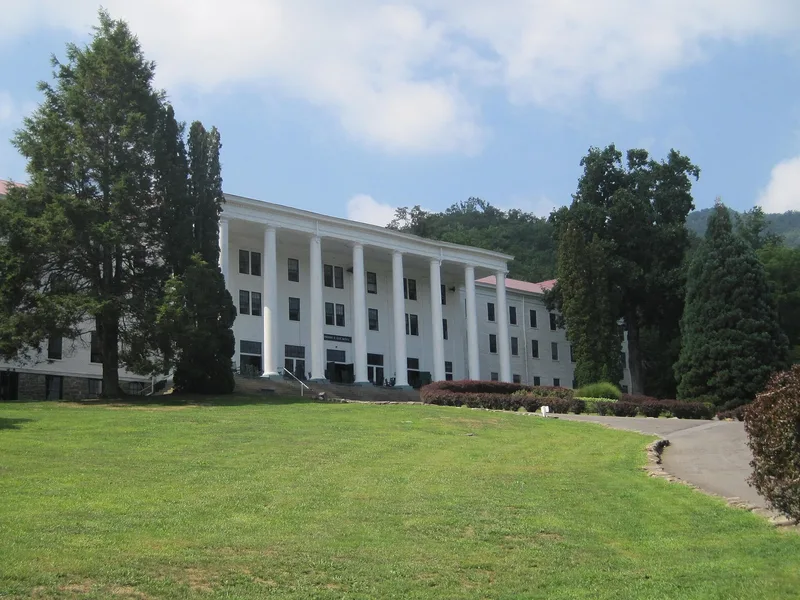
Blue Ridge Assembly is a YMCA conference center set in a cove on the north slope of the Swannanoa Mountains, south of Black Mountain. Its historic core covers about 22 acres and holds 28 white frame buildings, most with red shingle roofs, built from 1912 to about 1930. Robert E. Lee Hall, designed by New York architect Louis Jallade, is the largest and oldest, with a three-story octastyle portico. Four porticoed buildings face each other across a courtyard, and nineteen cottages with stone piers climb the slope behind, linked by winding roads and footpaths. The Assembly grew through the efforts of Willis Duke Weatherford, who promoted religious education and improved race relations. It hosted summer conferences, a YMCA war-work training school in 1917-18, and the YMCA Graduate School. Black Mountain College was founded here in 1933 and operated until 1941. The district was recognized for its role in regional religious and educational life and for its harmonious early twentieth century architecture and landscaping.
Significance in brief: The nomination argues the Assembly was a leading conference and religious-education center in the Asheville area and across the Southeast. It is linked to Willis Duke Weatherford, an author, educator and race-relations pioneer, and was the birthplace of Black Mountain College. Its Colonial and Neo-classical Revival buildings and landscaping form a cohesive, well-sited complex.
Machine-generated summary. This summary was generated by a language model from the official nomination document and has not been reviewed line by line by an editor. It may contain errors. Check the source document before relying on any detail. Source: nomination document (PDF) · National Archives catalog entry. NRHP reference 79003327, listed September 17, 1979. Summary generated October 2026 (model claude-sonnet-5-5, prompt v1.0-2026-10-29, confidence high).
Key facts
| Address | S of Black Mountain on SR 2720, Black Mountain |
|---|---|
| County | Buncombe County |
| Listed | September 17, 1979 |
| Reference number | 79003327 |
| Resource type | District |
| Period of significance | 1912-1930 |
| Architect / builder | Louis Jallade and others |
| Architectural style | Colonial Revival and Neo-classical Revival elements |
| Criteria |
|
| Areas of significance | Landscape Architecture, Education, Architecture, Religion, Social History |
| Level of significance | National |
| Status (as stated in the nomination) | Described as an active YMCA conference center; the historic core is in excellent condition and altered. |
| Acreage | 22 |
| Coordinates | 35.58296, -82.33792 (NPS GIS) |
What listing means for this property
This is a historic district. Buildings within its boundary are either contributing (they add to the district's significance) or non-contributing. Owners of contributing income-producing buildings can claim the 20% federal rehabilitation tax credit; homeowners should look at state credits. National Register districts impose no design review by themselves; a local historic district ordinance, if one exists, does (the difference explained).
General information, not legal or tax advice. Rules change; confirm with your State Historic Preservation Office or a qualified adviser.
Sources and further reading
- National Park Service, National Register of Historic Places database (snapshot May 2026), reference 79003327.
- Nomination form (PDF, National Archives) — catalog entry
- Wikipedia article (used for cross-checking only; text not reproduced here)
- Wikidata Q17985972
- This listing as JSON
Last updated October 2026. Found an error? See the editorial policy for how to report it.