Black Mountain College Historic District
Also known as: Camp Rockmont
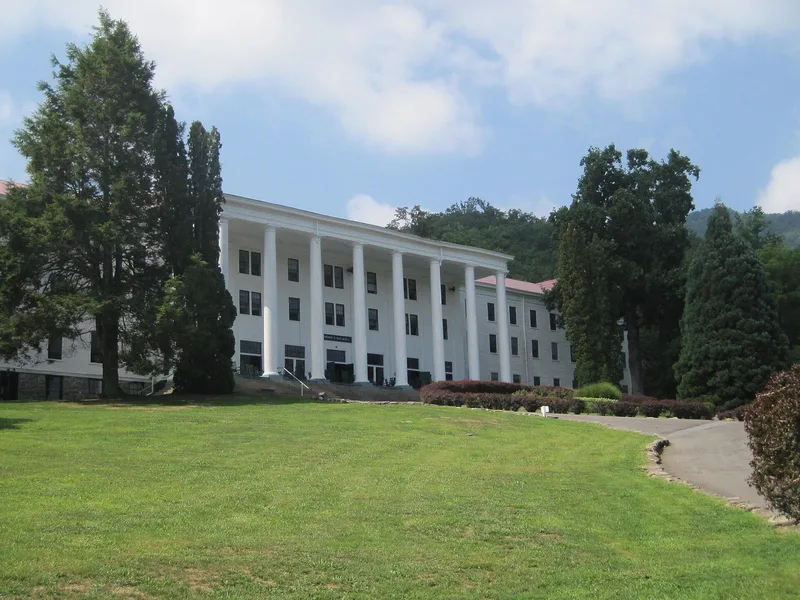

Why it's listed
Lake Eden, near Black Mountain in the Great Craggy Mountains, holds a group of buildings from two eras. In 1923-1924 developer E. W. Grove built summer lodges, a stone octagonal Round House, a dining hall and stone cottages with native stone foundations. Black Mountain College later used them as classrooms, dormitories, faculty homes and a performance space. The college added its own modern buildings in the 1940s. The largest is the Studies Building of 1940-41, designed by faculty architect A. Lawrence Kocher. It stands on concrete pilotis, has Transite sheathing and steel-sash windows, and contained fifty-five studios. Students also built the stone Quiet House and the low-cost Minimum House in 1942, and the college ran a farm with barns and silos. The property is now Camp Rockmont, a boys' summer camp. Several buildings have been altered, but the district still shows the mix of rustic cottages and International Style design from the college years.
Significance in brief: The district holds the Lake Eden campus of Black Mountain College, where faculty and students built International Style buildings on a tight budget. The Studies Building by A. Lawrence Kocher is the main example. The campus was also the setting for notable arts performances, including a 1952 mixed-media event involving John Cage, Charles Olson and Robert Rauschenberg. The form's criteria and period of significance are not legible in the text provided.
Machine-generated summary. This summary was generated by a language model from the official nomination document and has not been reviewed line by line by an editor. It may contain errors. Check the source document before relying on any detail. Source: nomination document (PDF) · National Archives catalog entry. NRHP reference 82001281, listed October 5, 1982. Summary generated October 2026 (model claude-sonnet-5-5, prompt v1.0-2026-10-29, confidence medium).
Key facts
| Address | SR 2468, Black Mountain |
|---|---|
| County | Buncombe County |
| Listed | October 5, 1982 |
| Reference number | 82001281 |
| Resource type | District |
| Architect / builder | E. W. Grove (1920s lodges); A. Lawrence Kocher (Studies Building, Jalowetz house); Paul Williams, Al Lanier and Si Sillman (Minimum House); Alex Reed and Molly Gregory (Quiet House) |
| Architectural style | International Style (1940s BMC buildings) alongside 1920s vernacular wood-shingle and native stone summer cottages |
| Areas of significance | Art, Literature, Education, Architecture |
| Level of significance | National |
| Status (as stated in the nomination) | Occupied and in use as Camp Rockmont, a summer camp. Condition is marked fair, and the buildings have been altered. The Minimum House is noted as in need of repair. |
| Acreage | 586.9 |
| Coordinates | 35.63521, -82.37050 (NPS GIS) |
What listing means for this property
This is a historic district. Buildings within its boundary are either contributing (they add to the district's significance) or non-contributing. Owners of contributing income-producing buildings can claim the 20% federal rehabilitation tax credit; homeowners should look at state credits. National Register districts impose no design review by themselves; a local historic district ordinance, if one exists, does (the difference explained).
General information, not legal or tax advice. Rules change; confirm with your State Historic Preservation Office or a qualified adviser.
Sources and further reading
- National Park Service, National Register of Historic Places database (snapshot May 2026), reference 82001281.
- Nomination form (PDF, National Archives) — catalog entry
- Wikipedia article (used for cross-checking only; text not reproduced here)
- Wikidata Q880447
- This listing as JSON
Last updated October 2026. Found an error? See the editorial policy for how to report it.