Rye Meeting House
Also known as: Milton Mission Chapel; Grace Chapel

Why it's listed
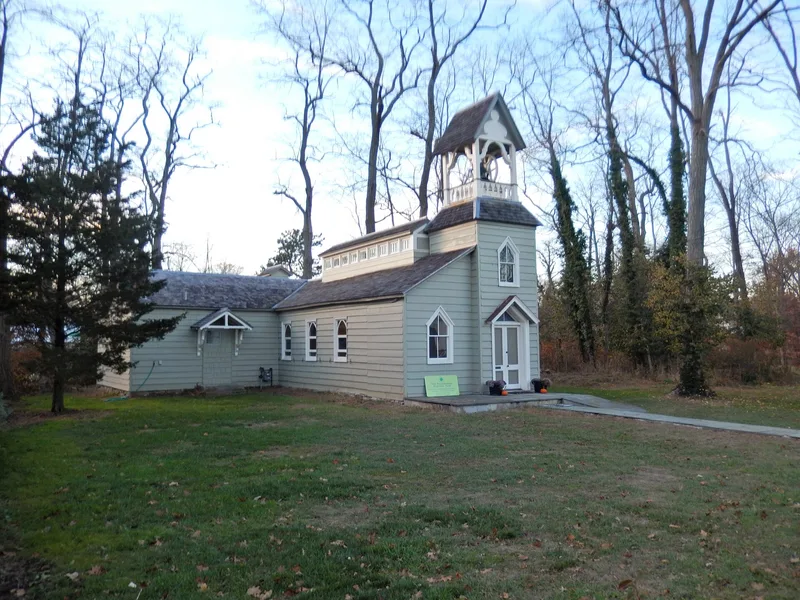
Rye Meeting House is a small wood-frame chapel on Milton Road in the Milton section of Rye, New York. It began as a schoolhouse, thought to date from before 1860, measuring 15 by 18 feet. A vestryman of Christ's Church bought it and donated it for use as a Sunday school, and it was moved to its present site in 1867. Additions in 1871 and 1875 brought a nave, a transept reading room, a chancel with stained glass, a vestry and a bell tower with Stick Style detailing. It served as the Milton Mission Chapel and later Grace Chapel. In 1959 it was converted into a Quaker meeting house, and it was later used as a Zen meditation center. The building is significant as an unusual, intact example of vernacular Victorian religious architecture in Westchester County and as a reflection of community life in a small shoreline hamlet. The nomination notes its poor condition, caused largely by flooding and moisture.
Significance in brief: The nomination argues it is an unusual and intact example of vernacular Victorian religious architecture in Westchester County (Criterion C). It also meets Criterion A in social history for its role in the life of a small waterfront community, as a Sunday school, mission chapel and later Quaker meeting house.
Machine-generated summary. This summary was generated by a language model from the official nomination document and has not been reviewed line by line by an editor. It may contain errors. Check the source document before relying on any detail. Source: nomination document (PDF) · National Archives catalog entry. NRHP reference 10001134, listed January 14, 2011. Summary generated October 2026 (model claude-sonnet-5-5, prompt v1.0-2026-10-29, confidence medium).
Key facts
| Address | 624 Milton Rd, Rye |
|---|---|
| County | Westchester County |
| Listed | January 14, 2011 |
| Reference number | 10001134 |
| Resource type | Building |
| Period of significance | 1867-1959 |
| Architect / builder | unknown |
| Architectural style | Late Victorian: Stick Style |
| Criteria |
|
| Areas of significance | Architecture, Social History |
| Level of significance | Local |
| Status (as stated in the nomination) | Condition described as fair to poor, with water infiltration, flooding, rotting wood near the foundation and non-weathertight windows. Historic and current function is listed as a religious facility. |
| Acreage | 1.2 |
| Coordinates | 40.95882, -73.68920 (NPS GIS) |
What listing means for this property
Religious properties are listed for their architectural or historical significance, not their religious use. Listing is honorary and does not restrict the congregation's use of the building. The federal rehabilitation credit is generally unavailable unless part of the building is income-producing; some state programmes and preservation grants do cover religious buildings. Federal funding or permits trigger Section 106 review.
General information, not legal or tax advice. Rules change; confirm with your State Historic Preservation Office or a qualified adviser.
Sources and further reading
- National Park Service, National Register of Historic Places database (snapshot May 2026), reference 10001134.
- Nomination form (PDF, National Archives) — catalog entry
- Wikipedia article (used for cross-checking only; text not reproduced here)
- Wikidata Q7384979
- This listing as JSON
Last updated October 2026. Found an error? See the editorial policy for how to report it.