Mapleton
Also known as: Alumnae House,College of Whie Plains

Why it's listed
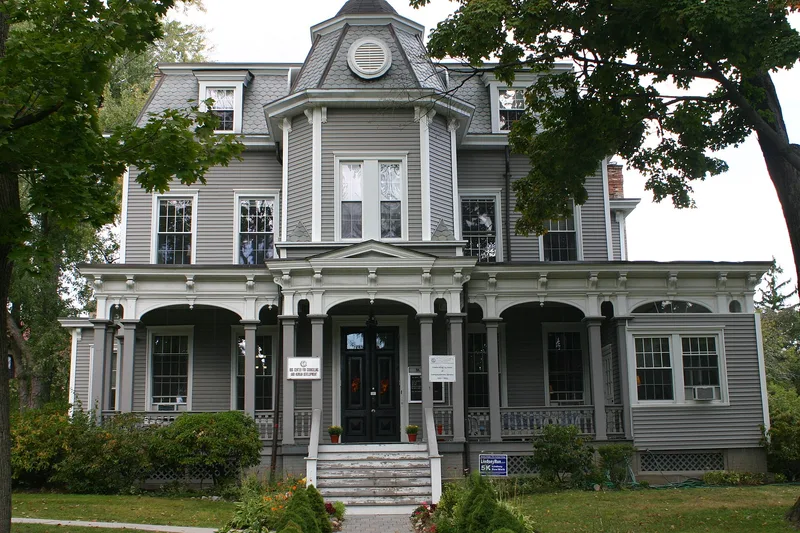
Mapleton is a large frame house at 52 North Broadway in White Plains, built around 1867 for carriage manufacturer William Franklin Dusenbury. Its five-bay, rectangular form is dressed with Italianate and Second Empire details: a full-width veranda on paired square posts, paired brackets at the eaves, a slate mansard roof with pedimented dormers, and a central tower capped by a later dome. Inside are a Moorish-style fireplace, etched glass sliding doors and molded plaster ceilings with Gothic tracery. Nathan Hand, a manufacturer and mining company president, bought the house in 1884. In 1894 it passed to Mother Mary Veronica Dannot's Sisters of the Divine Compassion, who used it as a convent until the College of White Plains opened in 1925. It has since served as a dormitory, library and administrative building. It is valued as one of the few surviving suburban villas of the area's mid-nineteenth-century boom, now surrounded by modern development.
Significance in brief: It is one of the few surviving suburban villas built by successful businessmen who turned lower Westchester County into a fashionable suburb by the mid-nineteenth century. Its eclectic detailing shows how porches, tower pavilions and historical ornament enlivened an otherwise vernacular rectangular house. Later owners included a wealthy entrepreneur and a religious order, and the house later served the College of White Plains.
Machine-generated summary. This summary was generated by a language model from the official nomination document and has not been reviewed line by line by an editor. It may contain errors. Check the source document before relying on any detail. Source: nomination document (PDF) · National Archives catalog entry. NRHP reference 76001295, listed September 28, 1976. Summary generated October 2026 (model claude-sonnet-5-5, prompt v1.0-2026-10-29, confidence high).
Key facts
| Address | 52 N. Broadway, White Plains |
|---|---|
| County | Westchester County |
| Listed | September 28, 1976 |
| Reference number | 76001295 |
| Resource type | Building |
| Period of significance | 1800-1899 |
| Architectural style | Eclectic with Second Empire elements (Italianate and Second Empire decorative elements) |
| Areas of significance | Architecture |
| Level of significance | Local |
| Status (as stated in the nomination) | Described as occupied, in good condition and altered; a small section of the veranda is enclosed and the tower dome is not original. Formerly a convent, dormitory and library, it later became a college administration building. |
| Acreage | 1.2 |
| Within district | Good Counsel Complex |
| Coordinates | 41.03830, -73.76469 (NPS GIS) |
What listing means for this property
National Register listing is honorary: it recognises significance and does not restrict what a private owner may do without federal money or permits. It unlocks the 20% federal rehabilitation tax credit for income-producing buildings, state credits in many states, and Section 106 review when federal agencies are involved. See what listing means in practice.
General information, not legal or tax advice. Rules change; confirm with your State Historic Preservation Office or a qualified adviser.
Sources and further reading
- National Park Service, National Register of Historic Places database (snapshot May 2026), reference 76001295.
- Nomination form (PDF, National Archives) — catalog entry
- Wikipedia article (used for cross-checking only; text not reproduced here)
- Wikidata Q6754076
- This listing as JSON
Last updated October 2026. Found an error? See the editorial policy for how to report it.