Grainger, Percy, Home and Studio

Why it's listed
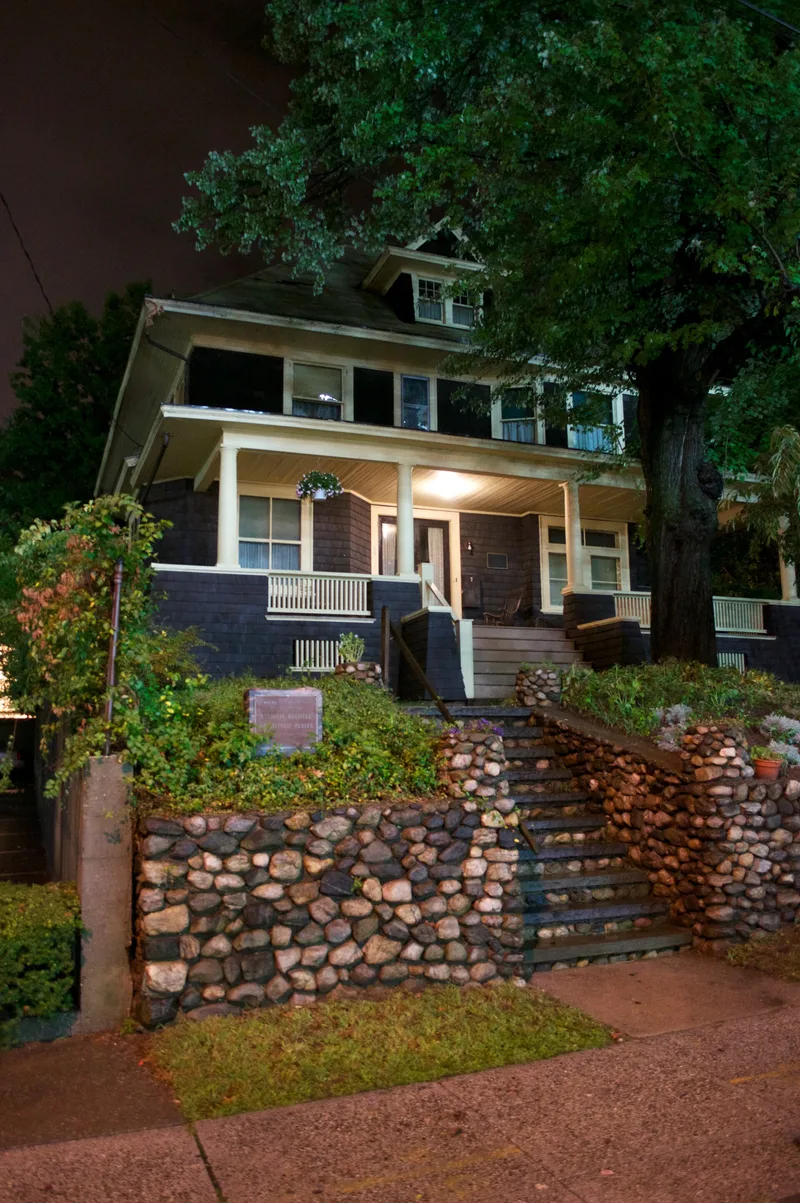
Built around 1893 by local banker David Cromwell, this two-story shingled house at 7 Cromwell Place in White Plains is a typical middle-class suburban home with American Four-Square features, a pyramidal hipped roof and a full-width front porch with Doric columns. Composer and pianist Percy Grainger, born in Australia, bought it in 1921 and lived there until his death in 1961. He used the house for daily life, practice and rehearsal, with two grand pianos in the music room. From 1946 he turned the living room into a laboratory where he and physicist Burnett Cross built machines to produce his "Free Music," which he considered his most important contribution. Grainger made few changes, replacing a fireplace with a large window and leaving the shingles unpainted. The house is recognized for its link to Grainger's work in America and as an intact example of its architectural type. It now serves as a museum, though nearby development has changed the street's setting.
Significance in brief: The house is significant under Criterion B for its association with composer and pianist Percy Grainger (1882-1961), who lived and worked there for forty years and developed his experimental "Free Music" machines in the living room. It is also significant under Criterion C as an intact example of a late-nineteenth-century middle-class suburban house with American Four-Square elements.
Machine-generated summary. This summary was generated by a language model from the official nomination document and has not been reviewed line by line by an editor. It may contain errors. Check the source document before relying on any detail. Source: nomination document (PDF) · National Archives catalog entry. NRHP reference 93000234, listed April 8, 1993. Summary generated October 2026 (model claude-sonnet-5-5, prompt v1.0-2026-10-29, confidence high).
Key facts
| Address | 7 Cromwell Pl., White Plains |
|---|---|
| County | Westchester County |
| Listed | April 8, 1993 |
| Reference number | 93000234 |
| Resource type | Building |
| Period of significance | 1893; 1921-1961 |
| Architect / builder | David Cromwell, builder |
| Architectural style | Late 19th and Early 20th Century American Movements (American Four-Square elements) |
| Criteria |
|
| Areas of significance | Architecture, Performing Arts |
| Level of significance | National, Local |
| Status (as stated in the nomination) | Currently used as a museum; the house retains a high level of integrity to Grainger's period, though the surrounding Cromwell Place neighborhood has been substantially altered by downtown development. |
| Acreage | 0.9 |
| Coordinates | 41.02733, -73.76691 (NPS GIS) |
What listing means for this property
National Register listing is honorary for a privately owned home: it does not by itself restrict what an owner may do with their own money, and it does not require public access. Restrictions come from local landmark or historic-district ordinances, which are separate (how they differ).
Owner-occupied houses are not eligible for the 20% federal rehabilitation tax credit, which applies to income-producing buildings, but many states offer credits for homeowners. Listing also opens the door to preservation easements and to buying a plaque. Start with what listing means for homeowners, renovating a listed house and selling one.
General information, not legal or tax advice. Rules change; confirm with your State Historic Preservation Office or a qualified adviser.
Sources and further reading
- National Park Service, National Register of Historic Places database (snapshot May 2026), reference 93000234.
- Nomination form (PDF, National Archives) — catalog entry
- Wikipedia article (used for cross-checking only; text not reproduced here)
- Wikidata Q7167366
- This listing as JSON
Last updated October 2026. Found an error? See the editorial policy for how to report it.