Bell Place-Locust Avenue Historic District

Why it's listed
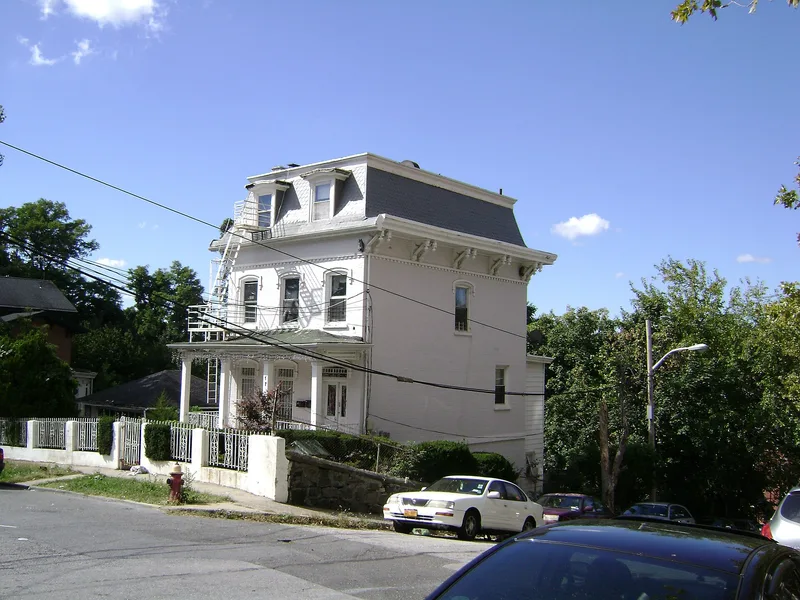
Bell Place and a single block of Locust Hill Avenue sit on a hill above downtown Yonkers, forming a small district of eight houses and three carriage houses built between 1855 and 1887. The land was part of the original Philipse patent and stayed undeveloped until the mid-1800s. After the Hudson River Railroad opened in 1849, Yonkers grew quickly, and William W. Woodworth divided the hilltop into small speculative lots. Prosperous merchants, such as Philip A. Deyo and the Elting brothers, built homes here close to the commercial center. The houses are mostly brick and range from two to three stories. Their styles include Italianate, French Second Empire, High Victorian Gothic and Queen Anne, which together show the changing tastes of the period. Some buildings have been altered or converted to multi-family use, and the surrounding area has seen twentieth-century intrusions and decay. The district nonetheless keeps the scale and character of a fashionable nineteenth-century neighborhood, which is the basis for its architectural significance.
Significance in brief: The district is described as one of the last relatively intact and cohesive mid-nineteenth century residential neighborhoods in Yonkers. It was developed as a residential enclave for prosperous middle-class merchants. Its buildings show the progression of Italianate, French Second Empire, High Victorian Gothic and Queen Anne styles. It keeps the scale and character of a nineteenth-century neighborhood despite alterations and a blighted surrounding area.
Machine-generated summary. This summary was generated by a language model from the official nomination document and has not been reviewed line by line by an editor. It may contain errors. Check the source document before relying on any detail. Source: nomination document (PDF) · National Archives catalog entry. NRHP reference 85001936, listed August 29, 1985. Summary generated October 2026 (model claude-sonnet-5-5, prompt v1.0-2026-10-29, confidence medium).
Key facts
| Address | Roughly bounded by Cromwell Pl., Locust Hill Ave., Baldwin Pl. & N. Broadway, Yonkers |
|---|---|
| County | Westchester County |
| Listed | August 29, 1985 |
| Reference number | 85001936 |
| Resource type | District |
| Period of significance | 1855-1887 |
| Architect / builder | Unknown |
| Architectural style | Italianate, French Second Empire, High Victorian Gothic, Queen Anne, and Italian Villa |
| Areas of significance | Architecture |
| Level of significance | Local |
| Status (as stated in the nomination) | Mostly well-preserved single-family houses, with a few converted to multi-family use. One church owns 57 Locust Hill Avenue. A carriage house at 7 Bell Place was destroyed by fire in 1983. |
| Acreage | 2 |
| Coordinates | 40.93586, -73.89643 (NPS GIS) |
What listing means for this property
This is a historic district. Buildings within its boundary are either contributing (they add to the district's significance) or non-contributing. Owners of contributing income-producing buildings can claim the 20% federal rehabilitation tax credit; homeowners should look at state credits. National Register districts impose no design review by themselves; a local historic district ordinance, if one exists, does (the difference explained).
General information, not legal or tax advice. Rules change; confirm with your State Historic Preservation Office or a qualified adviser.
Sources and further reading
- National Park Service, National Register of Historic Places database (snapshot May 2026), reference 85001936.
- Nomination form (PDF, National Archives) — catalog entry
- Wikipedia article (used for cross-checking only; text not reproduced here)
- Wikidata Q4883230
- This listing as JSON
Last updated October 2026. Found an error? See the editorial policy for how to report it.