Kingston Stockade District
Also known as: See Also:Senate House; Clinton Avenue Historic District
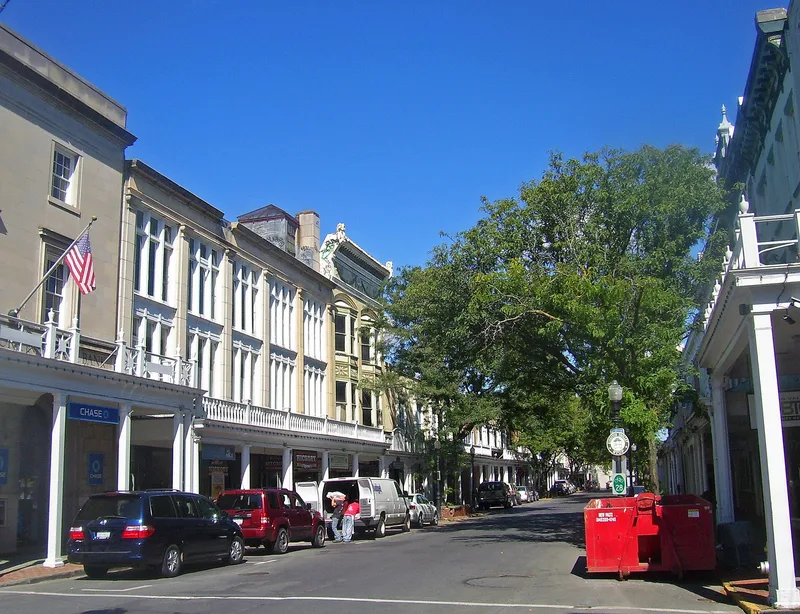

Why it's listed
Uptown Kingston's Stockade District preserves the footprint of a Dutch village fortified in 1658 under Peter Stuyvesant, after Indian raids devastated nearby settlements. The stockade's boundary streets, Green, Main, Clinton Avenue and North Front, remain in place, and the bluff that protected the settlement is still largely intact. In 1777 the village became New York's first state capital, hosting the convention that adopted the first state constitution; the British burned it that October, and it was rebuilt on its original plan. Today the eight-block area holds eight late 17th-century stone houses and about a dozen more from the 18th and early 19th centuries, alongside Federal, Greek Revival, Italianate and Queen Anne buildings. Notable examples include the 1852 Old Dutch Church by Minard LaFever, the 1818 county courthouse, the 1857 Firemen's Hall and the Clermont Building on Wall Street. The district remains the city's commercial center and a focus of county government.
Significance in brief: The nomination argues the district is one of three early colonial settlements in New York State and the only one where authentic elements of the original fortification remain. It served as the state's first capital in 1777, where the first state constitution was framed. It also presents about three centuries of architecture, from late 17th-century stone houses to 19th-century commercial buildings.
Machine-generated summary. This summary was generated by a language model from the official nomination document and has not been reviewed line by line by an editor. It may contain errors. Check the source document before relying on any detail. Source: nomination document (PDF) · National Archives catalog entry. NRHP reference 75001231, listed June 19, 1975. Summary generated October 2026 (model claude-sonnet-5-5, prompt v1.0-2026-10-29, confidence high).
Key facts
| Address | Area bounded by both sides of Clinton Ave., Main, Green, and Front Sts., Kingston |
|---|---|
| County | Ulster County |
| Listed | June 19, 1975 |
| Reference number | 75001231 |
| Resource type | District |
| Architect / builder | Old Dutch Church designed by Minard LaFever (1852); 124 Green Street cottage built by Charles Paige Carter |
| Architectural style | Mixed styles from Dutch colonial stone houses through Federal, Greek Revival, Italianate, Queen Anne/Eastlake and French Mansard |
| Areas of significance | Community Planning and Development, Historic - Non-Aboriginal, Military, Politics/Government, Architecture, Commerce |
| Level of significance | State |
| Status (as stated in the nomination) | Described as in good condition, largely unaltered and on its original site; now the Kingston business district with residential and commercial use, and an important focus for county government. |
| Acreage | 32.1 |
| Coordinates | 41.93442, -74.01993 (NPS GIS) |
What listing means for this property
This is a historic district. Buildings within its boundary are either contributing (they add to the district's significance) or non-contributing. Owners of contributing income-producing buildings can claim the 20% federal rehabilitation tax credit; homeowners should look at state credits. National Register districts impose no design review by themselves; a local historic district ordinance, if one exists, does (the difference explained).
General information, not legal or tax advice. Rules change; confirm with your State Historic Preservation Office or a qualified adviser.
Sources and further reading
- National Park Service, National Register of Historic Places database (snapshot May 2026), reference 75001231.
- Nomination form (PDF, National Archives) — catalog entry
- Wikipedia article (used for cross-checking only; text not reproduced here)
- Wikidata Q1742166
- This listing as JSON
Last updated October 2026. Found an error? See the editorial policy for how to report it.