Holy Cross Monastery

Why it's listed
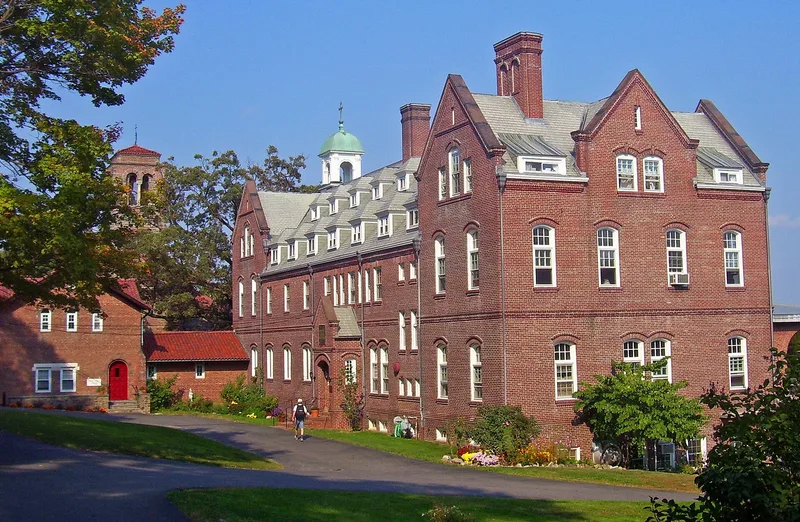
Holy Cross Monastery is the mother house of the Episcopal Order of the Holy Cross, set on a hillside above the Hudson River in West Park. Three main buildings run in a north-south line: the 1902-04 brick guesthouse designed by Henry Vaughan in Tudor Revival style, a 1921 group by Ralph Adams Cram with Middle House, cloister, and St. Augustine's Chapel, and a 1965 octagonal residence. A campanile rises above the complex and can be seen from the river. The property was listed as the first new monastery for Anglican monks since 1534 and the home of the first successful American monastic community for men. It is also tied to Father James Otis Sargent Huntington, the founder, who lived here from 1904 until his death in 1935 and is interred in the chapel crypt. His work for laborers and the poor influenced the Episcopal Church's commitment to social ministry. The guesthouse still welcomes thousands of retreat guests each year.
Significance in brief: The nomination argues it was the first new monastery built for Anglican monks since 1534 and the mother house of the first successful American monastic community for men. It was also the home and burial place of Father James Otis Sargent Huntington, the order's founder and a social reformer. The buildings represent the work of two leading ecclesiastical architects, Henry Vaughan and Ralph Adams Cram.
Machine-generated summary. This summary was generated by a language model from the official nomination document and has not been reviewed line by line by an editor. It may contain errors. Check the source document before relying on any detail. Source: nomination document (PDF) · National Archives catalog entry. NRHP reference 95000045, listed February 24, 1995. Summary generated October 2026 (model claude-sonnet-5-5, prompt v1.0-2026-10-29, confidence medium).
Key facts
| Address | US 9W, E side, West Park |
|---|---|
| County | Ulster County |
| Listed | February 24, 1995 |
| Reference number | 95000045 |
| Resource type | Building |
| Period of significance | 1902-1935 |
| Architect / builder | Vaughan, Henry, architect; Cram, Ralph Adams, architect |
| Architectural style | Tudor Revival, Spanish Revival |
| Criteria |
|
| Areas of significance | Religion, Architecture |
| Level of significance | Local |
| Status (as stated in the nomination) | The complex remains in religious use as the Order's mother house. The original monastery now serves as a guesthouse and retreat facility. |
| Acreage | 25.9 |
| Coordinates | 41.80298, -73.95699 (NPS GIS) |
What listing means for this property
National Register listing is honorary: it recognises significance and does not restrict what a private owner may do without federal money or permits. It unlocks the 20% federal rehabilitation tax credit for income-producing buildings, state credits in many states, and Section 106 review when federal agencies are involved. See what listing means in practice.
General information, not legal or tax advice. Rules change; confirm with your State Historic Preservation Office or a qualified adviser.
Sources and further reading
- National Park Service, National Register of Historic Places database (snapshot May 2026), reference 95000045.
- Nomination form (PDF, National Archives) — catalog entry
- Wikipedia article (used for cross-checking only; text not reproduced here)
- Wikidata Q12060458
- This listing as JSON
Last updated October 2026. Found an error? See the editorial policy for how to report it.