Tuthill, David, Farmstead

Why it's listed
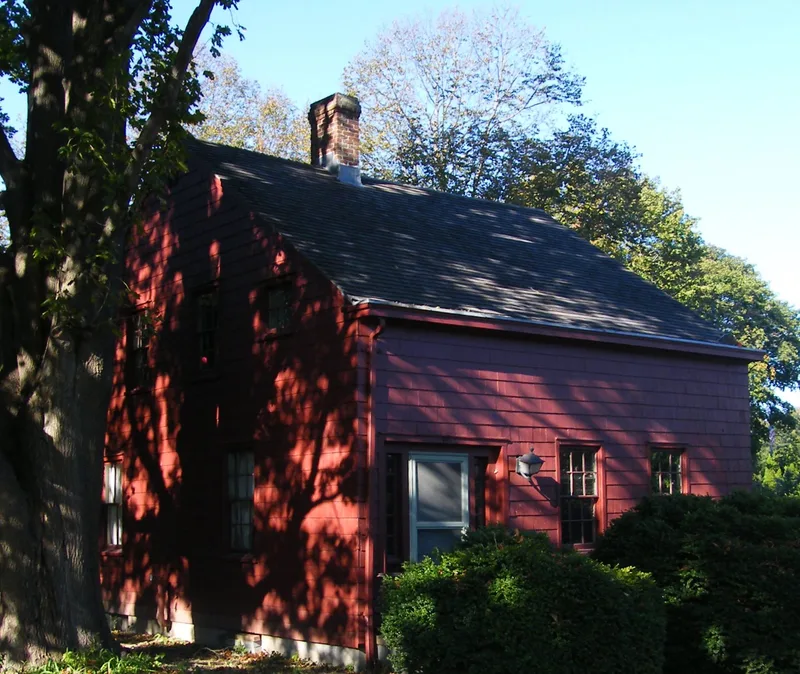
This farmstead on New Suffolk Lane in Cutchogue, at the eastern end of Long Island's north fork, combines a clapboard farmhouse with a full set of farm support buildings. David Tuthill, a farmer descended from one of Cutchogue's first settling families, built the five-bay, center-chimney house in 1798. In 1880 a two-story wing doubled its size, reflecting the growth and prosperity of the family, which kept the property until the mid-1970s. Behind the house stand a wash house, shop, privy, garage and a large barn dated 1852, built with heavy timbers salvaged from a demolished eighteenth-century church, and later fitted with a water tower. The buildings are modest but little altered, and interiors keep plaster walls, wide board floors, wainscoting, paneled doors and original hardware. Surrounded by undeveloped farmland south of the village center, the complex is described as one of the most complete and best preserved farm groups on the north fork, illustrating local vernacular building and farming practice.
Significance in brief: The nomination argues the farmstead recalls the eighteenth-century settlement and later farming development of Cutchogue. It is a remarkably unchanged, representative example of an eastern Long Island farm complex. Its modest buildings show local vernacular building and craft practices of the eighteenth and nineteenth centuries.
Machine-generated summary. This summary was generated by a language model from the official nomination document and has not been reviewed line by line by an editor. It may contain errors. Check the source document before relying on any detail. Source: nomination document (PDF) · National Archives catalog entry. NRHP reference 84000295, listed November 23, 1984. Summary generated October 2026 (model claude-sonnet-5-5, prompt v1.0-2026-10-29, confidence high).
Key facts
| Address | New Suffolk Lane, Cutchogue |
|---|---|
| County | Suffolk County |
| Listed | November 23, 1984 |
| Reference number | 84000295 |
| Resource type | Building |
| Period of significance | 1700-1799 (specific dates 1798 & 1880) |
| Architect / builder | Unknown (house built by David Tuthill in 1798) |
| Architectural style | Vernacular |
| Areas of significance | Exploration/Settlement, Architecture |
| Level of significance | Local |
| Status (as stated in the nomination) | Occupied private residence in good condition; the setting is described as a virtually intact agricultural landscape. |
| Acreage | 0.8 |
| Coordinates | 41.00704, -72.49367 (NPS GIS) |
What listing means for this property
National Register listing is honorary for a privately owned home: it does not by itself restrict what an owner may do with their own money, and it does not require public access. Restrictions come from local landmark or historic-district ordinances, which are separate (how they differ).
Owner-occupied houses are not eligible for the 20% federal rehabilitation tax credit, which applies to income-producing buildings, but many states offer credits for homeowners. Listing also opens the door to preservation easements and to buying a plaque. Start with what listing means for homeowners, renovating a listed house and selling one.
General information, not legal or tax advice. Rules change; confirm with your State Historic Preservation Office or a qualified adviser.
Sources and further reading
- National Park Service, National Register of Historic Places database (snapshot May 2026), reference 84000295.
- Nomination form (PDF, National Archives) — catalog entry
- Wikipedia article (used for cross-checking only; text not reproduced here)
- Wikidata Q5240536
- This listing as JSON
Last updated October 2026. Found an error? See the editorial policy for how to report it.