Moran, Thomas, House

Why it's listed
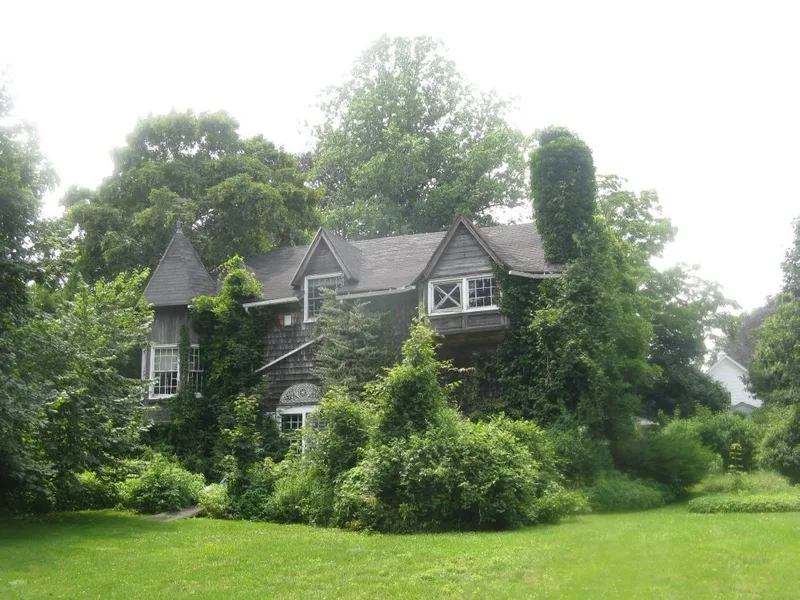
Overlooking Main Street in East Hampton, Long Island, this shingled house was built in 1884 by landscape painter Thomas Moran, who lived and worked there for about 32 years. A 40-foot studio dominates the front, added to an existing butler's pantry and laundry. Moran used second-hand materials, including glass doors and windows bought in New York City, which gave the studio its irregular features. Inside are original wall panelling and an Adam mantelpiece set with miniatures by various artists. The grounds hold a garage, a former outhouse now used as a potting shed, and the Gondola House, named for Moran's Venetian gondola. Moran is remembered for bringing the scenery of the American West to public attention. After an 1871 Yellowstone expedition he painted 'The Grand Canyon of the Yellowstone,' and a later Colorado trip produced 'The Chasm of the Colorado.' Congress bought both works for the Capitol. The house remains a private residence.
Significance in brief: Moran (1837-1926) was described as the first painter to bring Americans to a consciousness of the natural splendors of the West. His paintings 'The Grand Canyon of the Yellowstone' and 'The Chasm of the Colorado' were bought by Congress for $10,000 each and hung in the Capitol. He lived and worked in this house for about 32 years.
Machine-generated summary. This summary was generated by a language model from the official nomination document and has not been reviewed line by line by an editor. It may contain errors. Check the source document before relying on any detail. Source: nomination document (PDF) · National Archives catalog entry. NRHP reference 66000574, listed October 15, 1966. Summary generated October 2026 (model claude-sonnet-5-5, prompt v1.0-2026-10-29, confidence medium).
Key facts
| Address | Main St., East Hampton |
|---|---|
| County | Suffolk County |
| Listed | October 15, 1966 |
| Reference number | 66000574 |
| Resource type | Building |
| Period of significance | 1884-1916 |
| Architect / builder | Thomas Moran |
| Areas of significance | Art |
| Level of significance | National |
| National Historic Landmark | Yes, designated December 21, 1965 |
| Status (as stated in the nomination) | Described as in excellent condition, occupied as a private residence and still used as a studio and living room; privately owned and not open to the public. |
| Acreage | 0.9 |
| Within district | East Hampton Village District |
| Coordinates | 40.95405, -72.19432 (NPS GIS) |
What listing means for this property
National Register listing is honorary for a privately owned home: it does not by itself restrict what an owner may do with their own money, and it does not require public access. Restrictions come from local landmark or historic-district ordinances, which are separate (how they differ).
Owner-occupied houses are not eligible for the 20% federal rehabilitation tax credit, which applies to income-producing buildings, but many states offer credits for homeowners. Listing also opens the door to preservation easements and to buying a plaque. Start with what listing means for homeowners, renovating a listed house and selling one.
General information, not legal or tax advice. Rules change; confirm with your State Historic Preservation Office or a qualified adviser.
Sources and further reading
- National Park Service, National Register of Historic Places database (snapshot May 2026), reference 66000574.
- Nomination form (PDF, National Archives) — catalog entry
- Wikipedia article (used for cross-checking only; text not reproduced here)
- Wikidata Q7792536
- This listing as JSON
Last updated October 2026. Found an error? See the editorial policy for how to report it.