East Hampton Village District
Also known as: See Also:Moran, Thomas, House; East Hampton Village (Boundary

Why it's listed
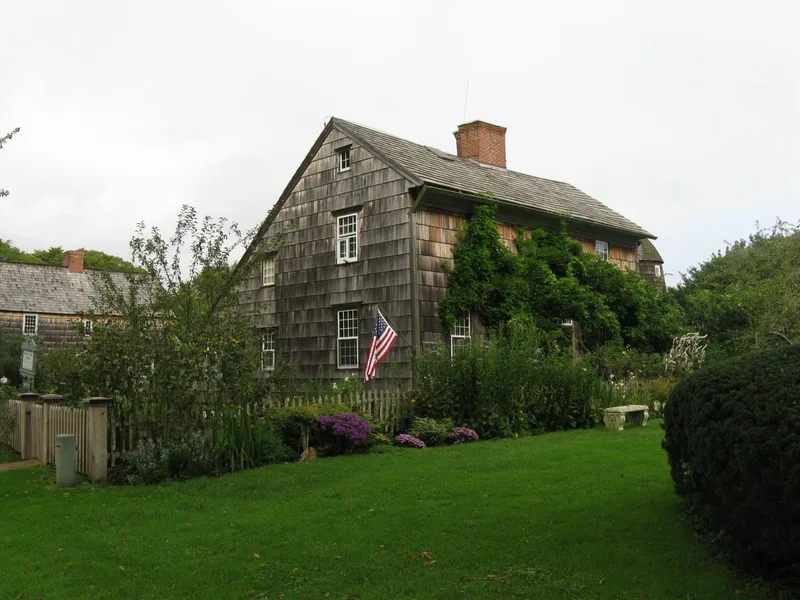
East Hampton Village District covers roughly 20 acres around the Village Green on the south shore of Long Island's south fork. The green marks the site of the original settlement, founded in 1648 and known for its first fourteen years as Maidstone. It holds the South End Burying Ground, a town pond and the site of the first meetinghouse. Mostly wood-frame houses of one to two-and-a-half stories line both sides along Main Street, James Lane and Woods Lane. Among them are the Mulford House and the John Howard Payne House, both with central chimneys and lean-to wings, plus windmills believed to date from the 18th century. Later buildings include the Hedges Inn, a mansard-roofed house, the 1883 Thomas Moran Studio and St. Luke's Church of 1910. The district was listed because these structures trace the village's shift from a quiet farming community, described by Timothy Dwight in 1804, to a popular summer resort and artists' colony after the mid-19th century.
Significance in brief: Through its surviving domestic vernacular architecture, the district recalls East Hampton's growth from an isolated agricultural community into a seaside resort and artists' colony in the later 19th century. The green, pond, burying ground and surrounding houses still look much as described in 1874, and the buildings show early settlement, tradition-bound habits, summer-visitor income and lasting popularity as a retreat.
Machine-generated summary. This summary was generated by a language model from the official nomination document and has not been reviewed line by line by an editor. It may contain errors. Check the source document before relying on any detail. Source: nomination document (PDF) · National Archives catalog entry. NRHP reference 74001309, listed May 2, 1974. Summary generated October 2026 (model claude-sonnet-5-5, prompt v1.0-2026-10-29, confidence medium).
Key facts
| Address | Bounded by Main St. and James and Woods Lanes, East Hampton |
|---|---|
| County | Suffolk County |
| Listed | May 2, 1974 |
| Reference number | 74001309 |
| Resource type | District |
| Architectural style | Vernacular domestic architecture, including half houses, five-bay forms, and a late 19th century shingle-style building |
| Areas of significance | Architecture |
| Level of significance | Local |
| Status (as stated in the nomination) | Condition listed as excellent; the form marks the district as occupied, with commercial, private residence, religious and museum uses. |
| Acreage | 20 |
| Within district | East Hampton Village Historic District (Boundary Increase) |
| Coordinates | 40.95492, -72.19055 (NPS GIS) |
What listing means for this property
This is a historic district. Buildings within its boundary are either contributing (they add to the district's significance) or non-contributing. Owners of contributing income-producing buildings can claim the 20% federal rehabilitation tax credit; homeowners should look at state credits. National Register districts impose no design review by themselves; a local historic district ordinance, if one exists, does (the difference explained).
General information, not legal or tax advice. Rules change; confirm with your State Historic Preservation Office or a qualified adviser.
Sources and further reading
- National Park Service, National Register of Historic Places database (snapshot May 2026), reference 74001309.
- Nomination form (PDF, National Archives) — catalog entry
- Wikipedia article (used for cross-checking only; text not reproduced here)
- Wikidata Q5328543
- This listing as JSON
Last updated October 2026. Found an error? See the editorial policy for how to report it.