Greenport Railroad Station

Why it's listed
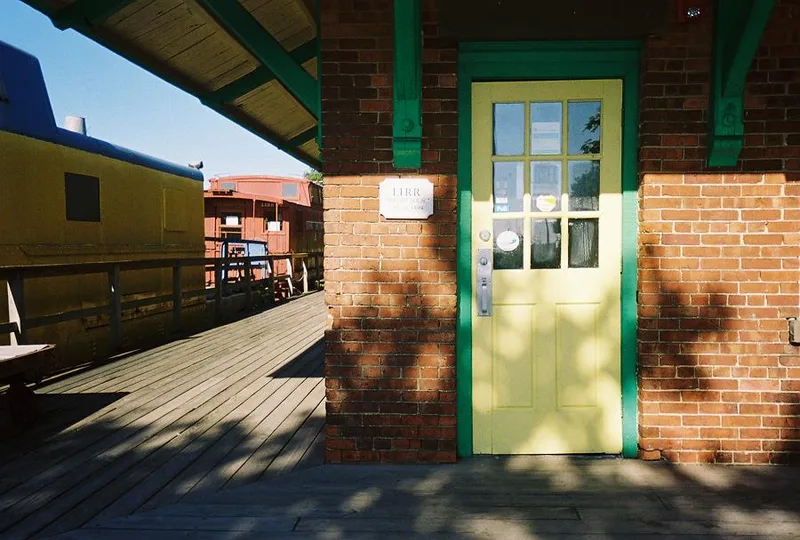
Greenport's railroad terminal sits on a 4.8-acre parcel beside the harbor at the end of the Long Island Railroad's main line. The surviving resources are a brick passenger station, a brick freight depot, a turntable and track, all dating to a major building campaign in 1892. The passenger station has a hipped slate roof with broad bracketed eaves, arched doorways and stone window surrounds, and its original ticket office and waiting room layout remain. The turntable, enlarged between 1917 and 1928, is the only one in Suffolk County. The line opened in 1844 as part of a rail and steamship route toward Boston, and later carried farm produce, summer visitors and freight, employing more than fifty people by 1900. Activity declined after about 1930 as automobiles and trucks took over, and the turntable was last used in 1976. The complex was listed as one of the most intact late nineteenth century railroad terminals on Long Island. The village plans restoration and a transportation museum.
Significance in brief: The complex is argued to be a distinctive, intact example of late nineteenth century railroad station design and one of the most intact such complexes on Long Island. It recalls the Long Island Railroad's role in the growth of Greenport and eastern Long Island. The surviving turntable is also significant in engineering, being the only one in Suffolk County.
Machine-generated summary. This summary was generated by a language model from the official nomination document and has not been reviewed line by line by an editor. It may contain errors. Check the source document before relying on any detail. Source: nomination document (PDF) · National Archives catalog entry. NRHP reference 89000947, listed July 20, 1989. Summary generated October 2026 (model claude-sonnet-5-5, prompt v1.0-2026-10-29, confidence medium).
Key facts
| Address | Third and Wiggins St., Greenport |
|---|---|
| County | Suffolk County |
| Listed | July 20, 1989 |
| Reference number | 89000947 |
| Resource type | District |
| Period of significance | 1892 to 1930 |
| Architectural style | Late Victorian |
| Areas of significance | Community Planning and Development, Engineering, Transportation, Architecture |
| Level of significance | Local |
| Status (as stated in the nomination) | The passenger station is vacant and not in use; the freight depot is leased for storage. The village plans to restore the buildings and turntable and create a regional transportation museum. |
| Acreage | 4.8 |
| Coordinates | 41.09969, -72.36324 (NPS GIS) |
What listing means for this property
This is a historic district. Buildings within its boundary are either contributing (they add to the district's significance) or non-contributing. Owners of contributing income-producing buildings can claim the 20% federal rehabilitation tax credit; homeowners should look at state credits. National Register districts impose no design review by themselves; a local historic district ordinance, if one exists, does (the difference explained).
Noted as vacant in the nomination. Nomination documents can be decades old; current status may differ. If you are considering buying an empty listed property, read the due-diligence checklist.
General information, not legal or tax advice. Rules change; confirm with your State Historic Preservation Office or a qualified adviser.
Sources and further reading
- National Park Service, National Register of Historic Places database (snapshot May 2026), reference 89000947.
- Nomination form (PDF, National Archives) — catalog entry
- Wikipedia article (used for cross-checking only; text not reproduced here)
- Wikidata Q5604401
- This listing as JSON
Last updated October 2026. Found an error? See the editorial policy for how to report it.