Brecknock Hall

Why it's listed
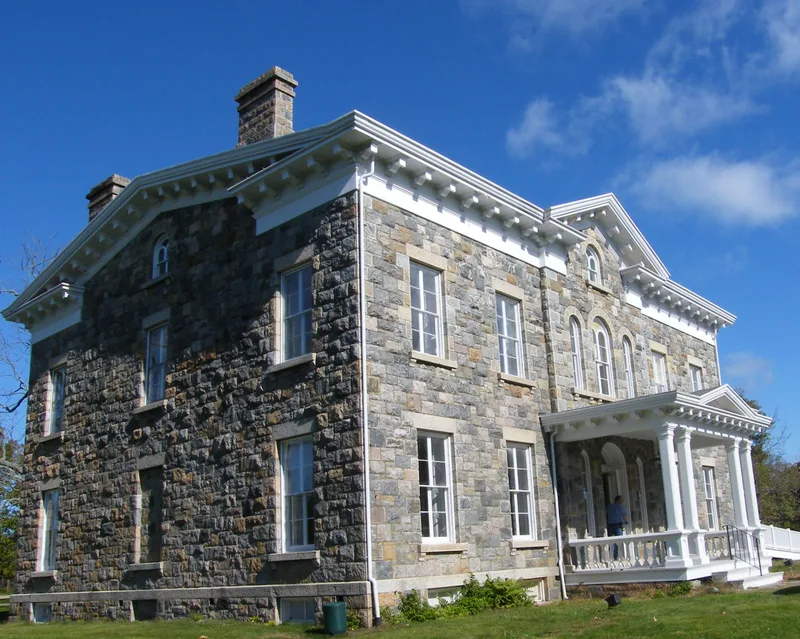
Brecknock Hall is a two and one-half story Italianate mansion of square-cut ashlar stone in Stirling, northeast of Greenport on Long Island's North Fork. Shipping and whaling businessman David Gelston Floyd broke ground in 1851, and the house was finished in 1857 at an estimated cost of $30,000. Scottish masons did the stonework, and Italian craftsmen did much of the interior woodwork. Stone corbel brackets under the south and west windows are an unusual feature. The house had speaking tubes, indoor bathrooms, central heating and gas lighting. Stone buildings were rare in the area because of the lack of quarries. Floyd was a local bank officer and a state legislator, and four generations of his family lived here. Early twentieth century changes are attributed to architect Francis DeLancey Robinson. After years of changing ownership and vacancy, the hall remains highly intact. It sits on an estate that now includes a retirement community, with its barn, greenhouse and caretaker's cottage still standing.
Significance in brief: It is significant under Criterion B for its association with David Gelston Floyd, a shipping businessman, town supervisor and state legislator, and his descendants. Under Criterion C it is an outstanding and rare example of a mid-nineteenth century Italianate stone residence on eastern Long Island. It retains a high degree of integrity in design, materials and workmanship.
Machine-generated summary. This summary was generated by a language model from the official nomination document and has not been reviewed line by line by an editor. It may contain errors. Check the source document before relying on any detail. Source: nomination document (PDF) · National Archives catalog entry. NRHP reference 05000331, listed April 22, 2005. Summary generated October 2026 (model claude-sonnet-5-5, prompt v1.0-2026-10-29, confidence high).
Key facts
| Address | North Rd. near Manhassett Ave., Stirling/Town of Southold |
|---|---|
| County | Suffolk County |
| Listed | April 22, 2005 |
| Reference number | 05000331 |
| Resource type | Building |
| Period of significance | 1851-1954 |
| Architect / builder | Francis DeLancey Robinson (early 20th century alterations) |
| Architectural style | Italianate |
| Criteria |
|
| Areas of significance | Architecture, Social History |
| Level of significance | Local |
| Status (as stated in the nomination) | The form states the hall had been vacant for several years but retains high integrity. The estate is now part of the Peconic Landing retirement community, whose foundation is committed to preserving and restoring the hall. |
| Acreage | 12.8 |
| Coordinates | 41.11603, -72.35964 (NPS GIS) |
What listing means for this property
National Register listing is honorary for a privately owned home: it does not by itself restrict what an owner may do with their own money, and it does not require public access. Restrictions come from local landmark or historic-district ordinances, which are separate (how they differ).
Owner-occupied houses are not eligible for the 20% federal rehabilitation tax credit, which applies to income-producing buildings, but many states offer credits for homeowners. Listing also opens the door to preservation easements and to buying a plaque. Start with what listing means for homeowners, renovating a listed house and selling one.
Noted as vacant in the nomination. Nomination documents can be decades old; current status may differ. If you are considering buying an empty listed property, read the due-diligence checklist.
General information, not legal or tax advice. Rules change; confirm with your State Historic Preservation Office or a qualified adviser.
Sources and further reading
- National Park Service, National Register of Historic Places database (snapshot May 2026), reference 05000331.
- Nomination form (PDF, National Archives) — catalog entry
- Wikipedia article (used for cross-checking only; text not reproduced here)
- Wikidata Q4960056
- This listing as JSON
Last updated October 2026. Found an error? See the editorial policy for how to report it.