Hoosick Falls Historic District

Why it's listed
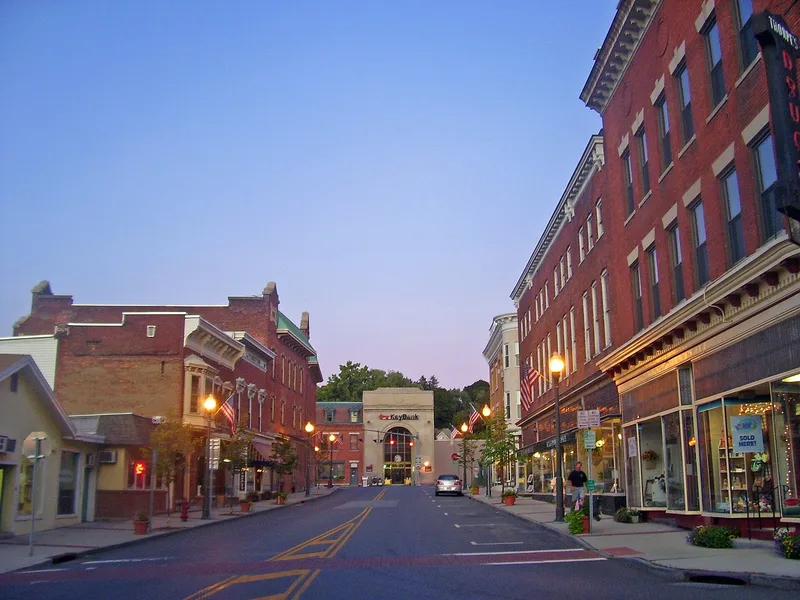
Hoosick Falls Historic District covers the downtown commercial core of a village on the south bank of the Hoosic River in Rensselaer County, New York. About forty buildings stand within it, mostly brick and stone blocks with shops on the ground floor and housing or storage above, along with a few wood-frame houses. Most date from the late nineteenth and early twentieth centuries and show Italianate, Second Empire, Georgian Revival, Eastlake and Stick-style design. The village grew on the water power of the nearby falls, first through cotton mills and then through the Walter A. Wood Mowing and Reaping Machine Manufactory, which by 1890 employed over 2,000 local residents and was widely celebrated for its harvesting machines. The Wood Block at John and Main Streets served as the company's business headquarters. Although the factories are gone, the commercial center survives with little alteration, preserving the look of a prosperous manufacturing town around 1900.
Significance in brief: The district reflects the village's peak growth and productivity as an industrial community around 1900, driven by water power and the Walter A. Wood harvesting machine company. Its commercial buildings are described as the finest built in the village at the height of its industrial development. Few alterations have kept the scale and density of the turn-of-the-century town intact.
Machine-generated summary. This summary was generated by a language model from the official nomination document and has not been reviewed line by line by an editor. It may contain errors. Check the source document before relying on any detail. Source: nomination document (PDF) · National Archives catalog entry. NRHP reference 80004280, listed December 3, 1980. Summary generated October 2026 (model claude-sonnet-5-5, prompt v1.0-2026-10-29, confidence medium).
Key facts
| Address | Central Ave. and Main St., Hoosick Falls |
|---|---|
| County | Rensselaer County |
| Listed | December 3, 1980 |
| Reference number | 80004280 |
| Resource type | District |
| Period of significance | 1800-1899, 1900- |
| Architectural style | Italianate, Second Empire, Georgian Revival, Eastlake and Stick-style influences |
| Criteria |
|
| Areas of significance | Industry, Commerce, Architecture |
| Level of significance | Local |
| Status (as stated in the nomination) | Occupied; mixed commercial and private residential use, with a few vacant lots and some altered storefronts. |
| Acreage | 8 |
| Coordinates | 42.90121, -73.35129 (NPS GIS) |
What listing means for this property
This is a historic district. Buildings within its boundary are either contributing (they add to the district's significance) or non-contributing. Owners of contributing income-producing buildings can claim the 20% federal rehabilitation tax credit; homeowners should look at state credits. National Register districts impose no design review by themselves; a local historic district ordinance, if one exists, does (the difference explained).
General information, not legal or tax advice. Rules change; confirm with your State Historic Preservation Office or a qualified adviser.
Sources and further reading
- National Park Service, National Register of Historic Places database (snapshot May 2026), reference 80004280.
- Nomination form (PDF, National Archives) — catalog entry
- Wikipedia article (used for cross-checking only; text not reproduced here)
- Wikidata Q1627480
- This listing as JSON
Last updated October 2026. Found an error? See the editorial policy for how to report it.