Bussey, Esek, Firehouse
Also known as: Engine No. 8, Pumper No. 8

Why it's listed
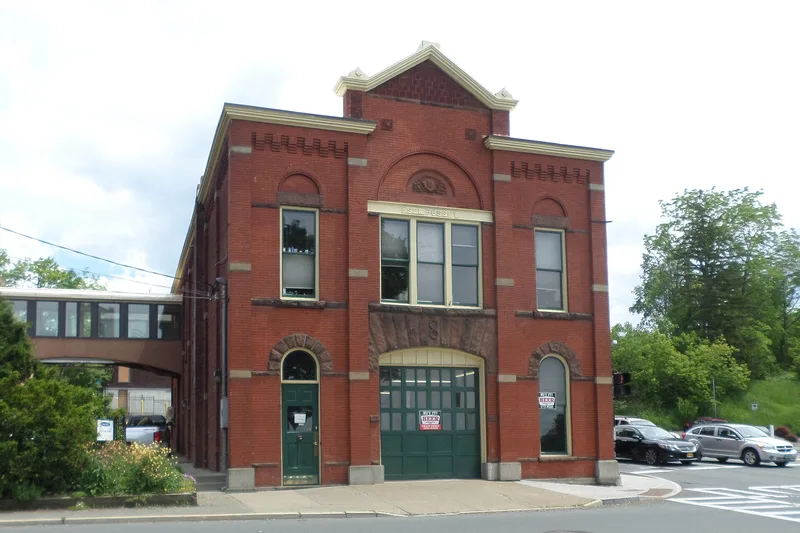
At the northeast corner of Tenth and Hoosick Streets in Troy stands a two-story firehouse of pressed red brick, built in 1891-92 and designed by local architect H. P. Fielding. Stone trim, rusticated stonework over the apparatus entrance, terra cotta detailing in the pediment and a corbeled brick frieze below the cornice decorate the exterior, and the roof is flat. Inside, the general layout, finish and detailing, including wooden wainscoting and ceiling, remain largely intact. The building grew out of an 1884 petition by residents and manufacturers east of Eighth Street for a hose cart. The city bought the lot in 1886, and in 1888 neighbors organized a volunteer company that joined the Fire Department in 1889 as the Esek Bussey Hose Company, named for a leading stove manufacturer. The firehouse was recognized for showing how Troy's industrialists sponsored fire companies and how firehouses served as civic landmarks, as well as for its well-preserved design.
Significance in brief: The firehouse reflects Troy's physical growth and the role of the city's industrialists in sponsoring fire companies and firehouses in the nineteenth century. It is notable for the integrity of its interior and exterior design. Firehouses of this kind were civic monuments designed by the city's leading architects.
Machine-generated summary. This summary was generated by a language model from the official nomination document and has not been reviewed line by line by an editor. It may contain errors. Check the source document before relying on any detail. Source: nomination document (PDF) · National Archives catalog entry. NRHP reference 73001252, listed July 16, 1973. Summary generated October 2026 (model claude-sonnet-5-5, prompt v1.0-2026-10-29, confidence medium).
Key facts
| Address | 302 10th St., Troy |
|---|---|
| County | Rensselaer County |
| Listed | July 16, 1973 |
| Reference number | 73001252 |
| Resource type | Building |
| Period of significance | 19th Century (specific dates 1891-92) |
| Architect / builder | H. P. Fielding (1863-1932), local architect |
| Areas of significance | Industry, Architecture |
| Level of significance | Local |
| Status (as stated in the nomination) | The form lists the property as city-owned and occupied. Later correspondence says the city planned to abandon it and that a highway bridge project threatened it. |
| Acreage | 0.9 |
| Coordinates | 42.73917, -73.67356 (NPS GIS) |
What listing means for this property
For a publicly owned building or structure, listing mainly matters when federal funds, permits or licences are involved: projects then go through Section 106 review so effects on the property are considered. Listing also strengthens applications for preservation grants and, for leased income-producing uses, can enable the federal rehabilitation tax credit.
General information, not legal or tax advice. Rules change; confirm with your State Historic Preservation Office or a qualified adviser.
Sources and further reading
- National Park Service, National Register of Historic Places database (snapshot May 2026), reference 73001252.
- Nomination form (PDF, National Archives) — catalog entry
- Wikipedia article (used for cross-checking only; text not reproduced here)
- Wikidata Q5397555
- This listing as JSON
Last updated October 2026. Found an error? See the editorial policy for how to report it.