Mullany, Kate, House

Why it's listed
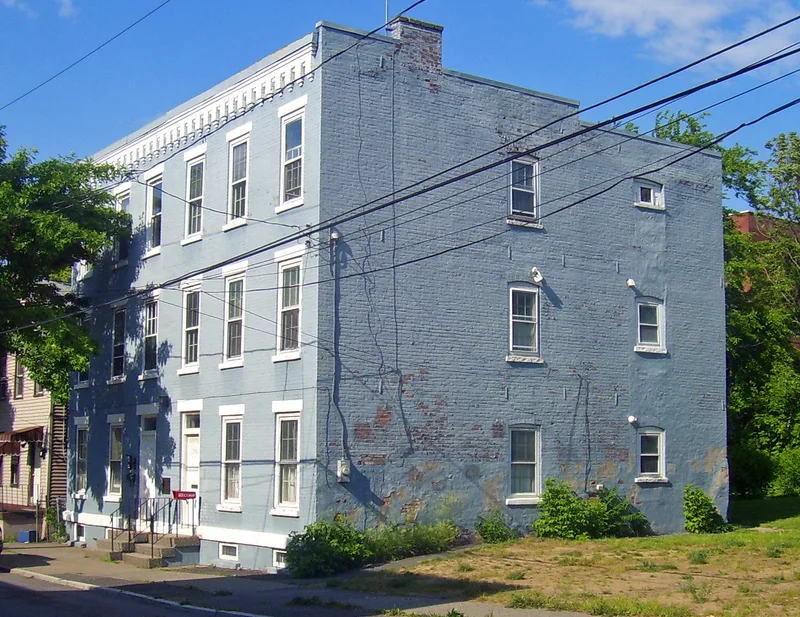
This three-story brick row house at 350 Eighth Street in Troy, New York, is the southern half of an identical double house with an ornate brick cornice of alternating long and short dentils. It was built as income property, with one apartment per floor, and the owning family lived in the larger top unit. Bridget Mullany bought the lots in 1864, and the family was in residence by 1869. Her daughter Kate Mullany, an Irish-born laundry worker, organized the all-female Collar Laundry Union in February 1864 to protest low wages and punishing working conditions. The union grew to about 500 members and won a 25% wage increase. In 1868 the National Labor Union appointed her special assistant secretary, the first woman named to a national labor union office. Her earlier homes and the union cooperative building have been demolished, so this house is the only surviving structure tied to her years of labor leadership. It remains an apartment building with a largely unchanged exterior and floor plan.
Significance in brief: It is the only remaining structure associated with Kate Mullany during her years as a labor leader. She was the Irish immigrant laundry worker who organized the all-female Collar Laundry Union in Troy in 1864. The union is described as the first continuously organized women's trade union in the nation, and Mullany became the first woman appointed to a national labor union office. The house reflects the stability and upward mobility that union activity made possible for workers.
Machine-generated summary. This summary was generated by a language model from the official nomination document and has not been reviewed line by line by an editor. It may contain errors. Check the source document before relying on any detail. Source: nomination document (PDF) · National Archives catalog entry. NRHP reference 98000453, listed April 1, 1998. Summary generated October 2026 (model claude-sonnet-5-5, prompt v1.0-2026-10-29, confidence high).
Key facts
| Address | 350 8th St., Troy |
|---|---|
| County | Rensselaer County |
| Listed | April 1, 1998 |
| Reference number | 98000453 |
| Resource type | Building |
| Period of significance | 1869-1906 |
| Architect / builder | Unknown |
| Architectural style | Italianate |
| Criteria |
|
| Areas of significance | Social History |
| Level of significance | National |
| National Historic Landmark | Yes, designated April 1, 1998 |
| Status (as stated in the nomination) | Still used as a multiple dwelling (three apartments). The exterior is largely original, and the interior finishes were replaced in renovations in the early 1960s. |
| Acreage | 0.9 |
| Coordinates | 42.74007, -73.68124 (NPS GIS) |
What listing means for this property
National Register listing is honorary for a privately owned home: it does not by itself restrict what an owner may do with their own money, and it does not require public access. Restrictions come from local landmark or historic-district ordinances, which are separate (how they differ).
Owner-occupied houses are not eligible for the 20% federal rehabilitation tax credit, which applies to income-producing buildings, but many states offer credits for homeowners. Listing also opens the door to preservation easements and to buying a plaque. Start with what listing means for homeowners, renovating a listed house and selling one.
General information, not legal or tax advice. Rules change; confirm with your State Historic Preservation Office or a qualified adviser.
Sources and further reading
- National Park Service, National Register of Historic Places database (snapshot May 2026), reference 98000453.
- Nomination form (PDF, National Archives) — catalog entry
- Wikipedia article (used for cross-checking only; text not reproduced here)
- Wikidata Q6375677
- This listing as JSON
Last updated October 2026. Found an error? See the editorial policy for how to report it.