Kingsland Homestead

Why it's listed
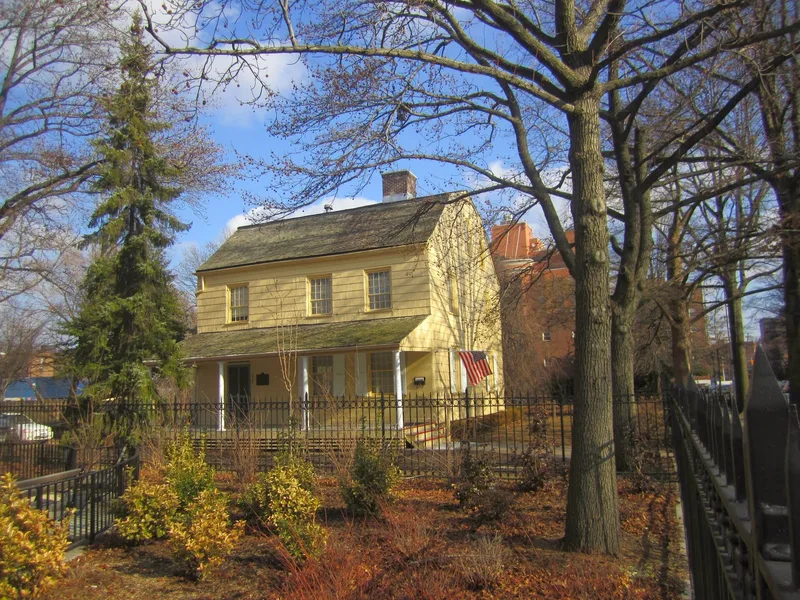
Built in 1774 for Charles Doughty, this two-and-a-half-story wood frame house in Flushing, Queens, is a well-preserved colonial farmhouse with a gambrel roof and a massive central chimney. Dutch influence appears in the roof form and the original divided front and rear doors, while the round-headed and quadrant windows in the gable reflect English Georgian taste. Much original trim, paneling and mantels survive. Doughty's son-in-law, Captain Joseph King, gave the house its name, and it later passed to the Murray family, who kept it until 1956. John Murray helped found the Society for the Manumission of Slaves, and the first slave freed in Flushing was freed here in 1799. Threatened by development and vandalism at its original site, the house was moved in the 1930s and again in 1968 to Weeping Beech Park, near the 17th-century Bowne House. It is regarded as an excellent example of a late eighteenth-century well-to-do farmer's house.
Significance in brief: The nomination calls it the second-oldest residential structure in Flushing and a typical colonial house combining Dutch and English building features. It has changed little in almost two centuries and is a rare example of a type once common on western Long Island. It is also linked to the Murray family and the freeing of the first slave in Flushing in 1799.
Machine-generated summary. This summary was generated by a language model from the official nomination document and has not been reviewed line by line by an editor. It may contain errors. Check the source document before relying on any detail. Source: nomination document (PDF) · National Archives catalog entry. NRHP reference 72000905, listed May 31, 1972. Summary generated October 2026 (model claude-sonnet-5-5, prompt v1.0-2026-10-29, confidence medium).
Key facts
| Address | 37th St. and Parsons Blvd., New York |
|---|---|
| County | Queens |
| Listed | May 31, 1972 |
| Reference number | 72000905 |
| Resource type | Building |
| Period of significance | 18th Century (specific date 1774) |
| Architect / builder | Built by craftsmen in 1774 for Charles Doughty; no architect named |
| Architectural style | Colonial, combining Dutch and English (Georgian) features |
| Areas of significance | Architecture |
| Level of significance | Local |
| Status (as stated in the nomination) | Owned by the City of New York and moved to Weeping Beech Park in 1968; condition listed as good and altered, with restoration under way and plans for use as a civic center and architectural museum. |
| Acreage | 0.9 |
| Coordinates | 40.76381, -73.82369 (NPS GIS) |
What listing means for this property
National Register listing is honorary for a privately owned home: it does not by itself restrict what an owner may do with their own money, and it does not require public access. Restrictions come from local landmark or historic-district ordinances, which are separate (how they differ).
Owner-occupied houses are not eligible for the 20% federal rehabilitation tax credit, which applies to income-producing buildings, but many states offer credits for homeowners. Listing also opens the door to preservation easements and to buying a plaque. Start with what listing means for homeowners, renovating a listed house and selling one.
General information, not legal or tax advice. Rules change; confirm with your State Historic Preservation Office or a qualified adviser.
Sources and further reading
- National Park Service, National Register of Historic Places database (snapshot May 2026), reference 72000905.
- Nomination form (PDF, National Archives) — catalog entry
- Wikipedia article (used for cross-checking only; text not reproduced here)
- Wikidata Q6413258
- This listing as JSON
Last updated October 2026. Found an error? See the editorial policy for how to report it.