Hyde Hall

Why it's listed
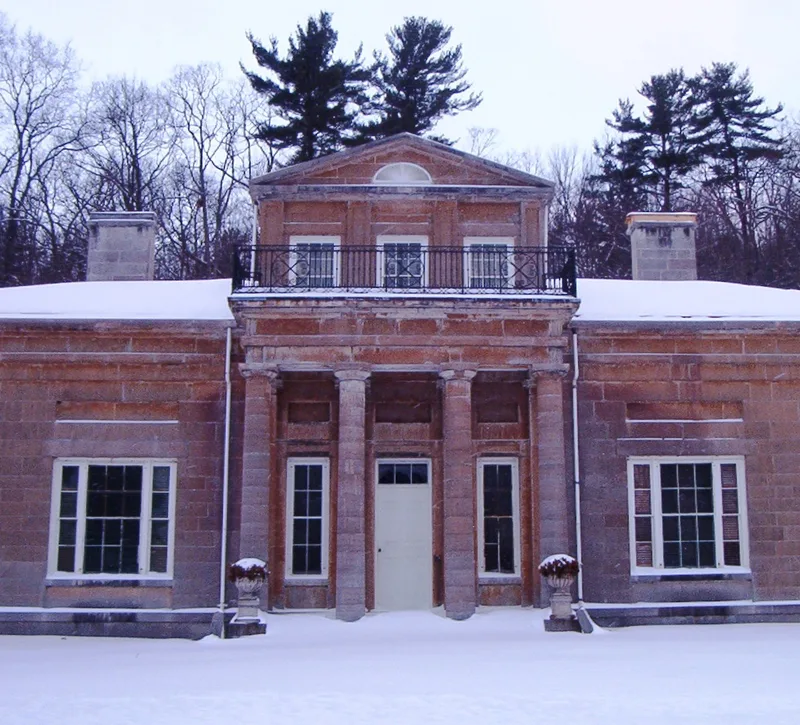
Hyde Hall is a vast stone and brick mansion set in Glimmerglass State Park in Otsego County, New York. Built between 1817 and 1835, it was the country seat of the Hyde Clarke family, one of the state's great landowning families. George Clarke designed it together with Philip Hooker, described as upstate New York's leading architect of the period. Three large blocks joined by links and corridors enclose a central court, and the east front has a tetrastyle Doric portico of tooled limestone. Inside are two great rooms with coved ceilings, a circular mahogany stair, two libraries and an early central heating system from about 1833. The house remained in the builder's family until the State of New York acquired it, so it survives with almost no structural change. Most of its documented furniture and a large body of family papers and household accounts remain, and a group of stone and frame outbuildings stands to the east.
Significance in brief: The nomination calls Hyde Hall the culminating architectural monument of New York's quasi-feudal system of landholding and one of the nation's greatest private architectural undertakings between 1800 and 1860. Its scale, courtyard plan and neo-classic entertainment wing set it apart from comparable houses, and it survives virtually unchanged with most original furnishings and extensive family papers.
Machine-generated summary. This summary was generated by a language model from the official nomination document and has not been reviewed line by line by an editor. It may contain errors. Check the source document before relying on any detail. Source: nomination document (PDF) · National Archives catalog entry. NRHP reference 71000555, listed October 7, 1971. Summary generated October 2026 (model claude-sonnet-5-5, prompt v1.0-2026-10-29, confidence high).
Key facts
| Address | S of Springfield Center in Glimmerglass State Park, Springfield Center |
|---|---|
| County | Otsego County |
| Listed | October 7, 1971 |
| Reference number | 71000555 |
| Resource type | Building |
| Period of significance | 1817-1835 |
| Architect / builder | George Clarke (1768-1855) and Philip Hooker |
| Architectural style | Romantic classical architecture (neo-classic) |
| Areas of significance | Architecture |
| Level of significance | National |
| National Historic Landmark | Yes, designated June 24, 1986 |
| Status (as stated in the nomination) | Condition listed as deteriorated and unaltered, with preservation work in progress; owned by the State of New York and used as a museum, with other uses under development. |
| Acreage | 218 |
| Within district | Glimmerglass Historic District |
| Coordinates | 42.79344, -74.87342 (NPS GIS) |
What listing means for this property
National Register listing is honorary for a privately owned home: it does not by itself restrict what an owner may do with their own money, and it does not require public access. Restrictions come from local landmark or historic-district ordinances, which are separate (how they differ).
Owner-occupied houses are not eligible for the 20% federal rehabilitation tax credit, which applies to income-producing buildings, but many states offer credits for homeowners. Listing also opens the door to preservation easements and to buying a plaque. Start with what listing means for homeowners, renovating a listed house and selling one.
General information, not legal or tax advice. Rules change; confirm with your State Historic Preservation Office or a qualified adviser.
Sources and further reading
- National Park Service, National Register of Historic Places database (snapshot May 2026), reference 71000555.
- Nomination form (PDF, National Archives) — catalog entry
- Wikipedia article (used for cross-checking only; text not reproduced here)
- Wikidata Q14706507
- This listing as JSON
Last updated October 2026. Found an error? See the editorial policy for how to report it.