Old Town Cemetery and Palatine Church Site

Why it's listed
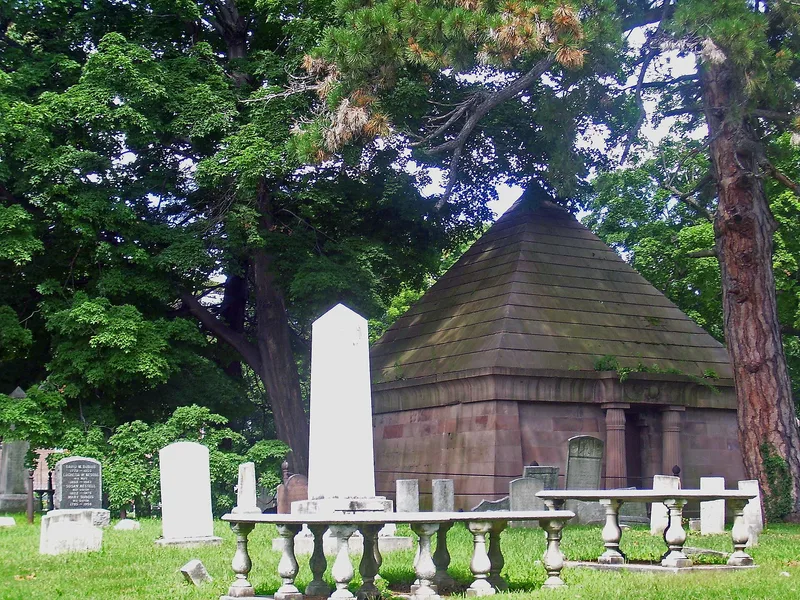
Old Town Cemetery and the Palatine church site occupy about 2.8 acres in northern Newburgh, New York. The L-shaped property is enclosed by a wrought iron fence put up by the city in 1886. It was once part of the Glebe, land set aside under the 1714 Palatine patent for a minister and schoolmaster, and it is the only intact portion of that original settlement. A timber frame church about twenty feet square was built there in the 1730s and closed in 1749. The cemetery holds an estimated 2,600 burials and about 1,240 surviving markers dating from roughly 1740 to 1950. They include winged death's heads, soul effigies, three-lobed sandstone tablets, Neoclassical motifs and plain marble slabs, some attributed to carver Simian Utter. The Egyptian Revival Robinson Mausoleum, built in 1853 for Captain Henry Robinson, is a rare early example of its type. Together these features record the area's settlement and changing burial customs.
Significance in brief: The nomination argues it is the only intact portion of the original 1708-9 Palatine settlement of Newburgh and the site of the Palatine church, built in the 1730s. It also holds an intact 18th-century burial ground with a wide range of funerary art, including work attributed to master carver Simian Utter and the Egyptian Revival Robinson Mausoleum of 1853.
Machine-generated summary. This summary was generated by a language model from the official nomination document and has not been reviewed line by line by an editor. It may contain errors. Check the source document before relying on any detail. Source: nomination document (PDF) · National Archives catalog entry. NRHP reference 00000746, listed June 30, 2000. Summary generated October 2026 (model claude-sonnet-5-5, prompt v1.0-2026-10-29, confidence high).
Key facts
| Address | Grand St., Newburgh |
|---|---|
| County | Orange County |
| Listed | June 30, 2000 |
| Reference number | 00000746 |
| Resource type | District |
| Period of significance | ca.1710-1950 |
| Criteria |
|
| Areas of significance | Art, Exploration/Settlement |
| Level of significance | State |
| Status (as stated in the nomination) | Owned by the city of Newburgh and undergoing restoration; the Palatine church no longer stands but its archeological potential is described as high. |
| Acreage | 2.8 |
| Within district | East End Historic District |
| Coordinates | 41.50768, -74.00970 (NPS GIS) |
What listing means for this property
This is a historic district. Buildings within its boundary are either contributing (they add to the district's significance) or non-contributing. Owners of contributing income-producing buildings can claim the 20% federal rehabilitation tax credit; homeowners should look at state credits. National Register districts impose no design review by themselves; a local historic district ordinance, if one exists, does (the difference explained).
General information, not legal or tax advice. Rules change; confirm with your State Historic Preservation Office or a qualified adviser.
Sources and further reading
- National Park Service, National Register of Historic Places database (snapshot May 2026), reference 00000746.
- Nomination form (PDF, National Archives) — catalog entry
- Wikipedia article (used for cross-checking only; text not reproduced here)
- Wikidata Q7085274
- This listing as JSON
Last updated October 2026. Found an error? See the editorial policy for how to report it.