Byington Mill (Frisbie & Stansfield Knitting Company)
Also known as: J. A. Firsching & Son Building

Why it's listed
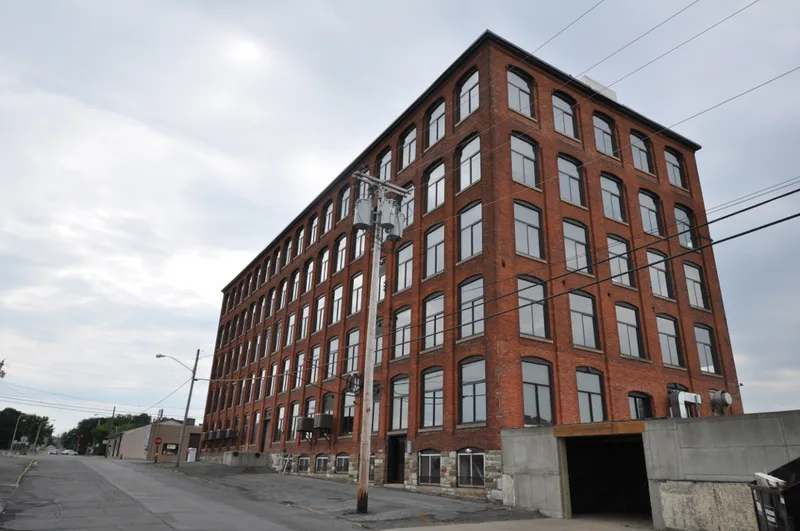
Byington Mill is a five-story brick knitting mill at Broad and Second streets in Utica, built in 1910 for the Frisbie-Stansfield Knitting Company, then the largest knit-goods corporation in the world. An office wing added in 1912 has a pressed-brick front, granite base, red tile roof and copper cornice, in contrast to the plain, window-filled mill. The mill has heavy timber framing and load-bearing brick walls, and its fifth floor was added before 1929. Utica was the nation's chief textile center in this period, helped by canals, expanded railroad yards and abundant electric power. The mill reflects that boom and the growth of Bagg's Square East. It was sold in 1929, and J. A. Firsching converted it in 1936 to making textile machinery, a use that continued until 1991. Its interior remains largely intact, and the building is now vacant. It was listed for its industrial history and its architecture.
Significance in brief: It is an intact industrial complex from the early twentieth century, when Utica led the nation in textile manufacturing. Frisbie-Stansfield was then the largest knit-goods corporation in the world. The mill is also a representative example of early twentieth-century mill construction, with a high ratio of window to wall and an unusually elaborate office wing.
Machine-generated summary. This summary was generated by a language model from the official nomination document and has not been reviewed line by line by an editor. It may contain errors. Check the source document before relying on any detail. Source: nomination document (PDF) · National Archives catalog entry. NRHP reference 93000458, listed May 27, 1993. Summary generated October 2026 (model claude-sonnet-5-5, prompt v1.0-2026-10-29, confidence high).
Key facts
| Address | 421--423 Broad St., Utica |
|---|---|
| County | Oneida County |
| Listed | May 27, 1993 |
| Reference number | 93000458 |
| Resource type | Building |
| Period of significance | 1910-ca.1929 |
| Architect / builder | Attributed to Frederick H. Gouge (Architect) |
| Architectural style | Late 19th and Early 20th Century American Movements/Commercial Style |
| Criteria |
|
| Areas of significance | Industry, Architecture |
| Level of significance | Local |
| Status (as stated in the nomination) | Listed as vacant/not in use; the interior is described as substantially intact. A business making textile machinery operated there until 1991. |
| Acreage | 0.6 |
| Within district | Bagg's Square East Historic District |
| Coordinates | 43.10251, -75.22179 (NPS GIS) |
What listing means for this property
For an income-producing building, listing (individually or as a contributing building in a district) is the gateway to the 20% federal rehabilitation tax credit on qualified rehabilitation costs, often stackable with state credits. Work claiming the credit must follow the Secretary of the Interior's Standards and be approved in advance.
Listing does not restrict a private owner acting without federal money or permits; where federal funding or licensing is involved, Section 106 review applies.
Noted as vacant in the nomination. Nomination documents can be decades old; current status may differ. If you are considering buying an empty listed property, read the due-diligence checklist.
General information, not legal or tax advice. Rules change; confirm with your State Historic Preservation Office or a qualified adviser.
Sources and further reading
- National Park Service, National Register of Historic Places database (snapshot May 2026), reference 93000458.
- Nomination form (PDF, National Archives) — catalog entry
- Wikipedia article (used for cross-checking only; text not reproduced here)
- Wikidata Q5004097
- This listing as JSON
Last updated October 2026. Found an error? See the editorial policy for how to report it.