Enlarged Double Lock No. 33 Old Erie Canal

Why it's listed
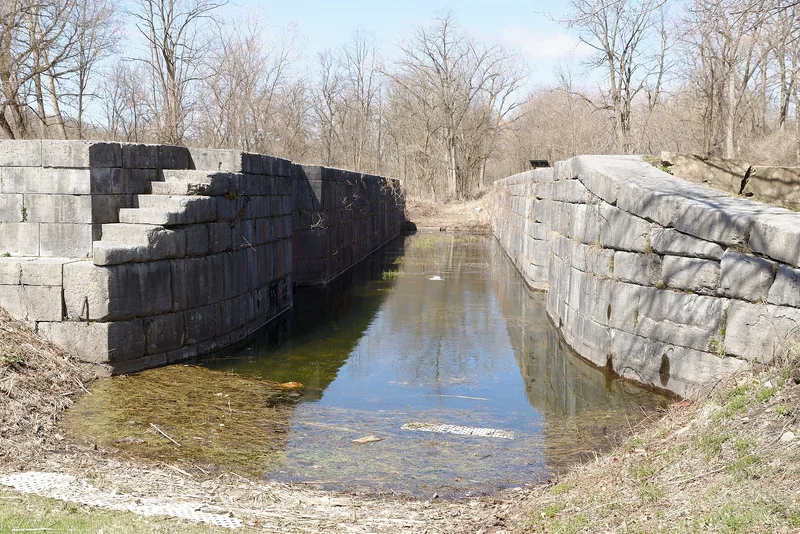
Enlarged Double Lock No. 33 is a cut-limestone canal lock on the abandoned Old Erie Canal right-of-way, just south of St. Johnsville in Montgomery County, New York. It began in 1824 as a single-chamber lock on the original Erie Canal. In 1840, during the First Enlargement, a second chamber and a center pier with a sluice were added, creating the double lock. In 1888 the south chamber was lengthened westward on the berm side to 210 feet. Only three locks were extended this way, and this is the only surviving double lock with that modification. The finely fitted ashlar masonry is largely intact, and portions of plank floors and collapsed timber gates remain submerged. After the Barge Canal opened in 1918 the lock fell into disuse and became a village trash dump. Local volunteers began reclaiming it in 1997. It was listed for its transportation history and its engineering and masonry craftsmanship.
Significance in brief: The nomination argues the lock is a well-preserved example of Erie Canal masonry engineering and an illustration of the canal's transportation history under Criteria A and C. It shows the canal's evolution from the original canal through the First Enlargement and the 1880s lengthening. It is also the only surviving double lock extended on the berm side rather than the towpath side.
Machine-generated summary. This summary was generated by a language model from the official nomination document and has not been reviewed line by line by an editor. It may contain errors. Check the source document before relying on any detail. Source: nomination document (PDF) · National Archives catalog entry. NRHP reference 02000315, listed April 1, 2002. Summary generated October 2026 (model claude-sonnet-5-5, prompt v1.0-2026-10-29, confidence high).
Key facts
| Address | Towpath Rd., St. Johnsville |
|---|---|
| County | Montgomery County |
| Listed | April 1, 2002 |
| Reference number | 02000315 |
| Resource type | Structure |
| Period of significance | 1824-1918 |
| Architectural style | No style |
| Criteria |
|
| Areas of significance | Transportation, Engineering |
| Level of significance | Local |
| Status (as stated in the nomination) | Listed in the form as vacant/not in use. The chambers remain partially watered, and local volunteers have been reclaiming and restoring the lock since 1997. |
| Acreage | 4.3 |
| Coordinates | 42.99075, -74.66689 (NPS GIS) |
What listing means for this property
National Register listing is honorary: it recognises significance and does not restrict what a private owner may do without federal money or permits. It unlocks the 20% federal rehabilitation tax credit for income-producing buildings, state credits in many states, and Section 106 review when federal agencies are involved. See what listing means in practice.
Noted as vacant in the nomination. Nomination documents can be decades old; current status may differ. If you are considering buying an empty listed property, read the due-diligence checklist.
General information, not legal or tax advice. Rules change; confirm with your State Historic Preservation Office or a qualified adviser.
Sources and further reading
- National Park Service, National Register of Historic Places database (snapshot May 2026), reference 02000315.
- Nomination form (PDF, National Archives) — catalog entry
- Wikipedia article (used for cross-checking only; text not reproduced here)
- Wikidata Q5379049
- This listing as JSON
Last updated October 2026. Found an error? See the editorial policy for how to report it.