St. Paul-North Water Streets Historic District

Why it's listed
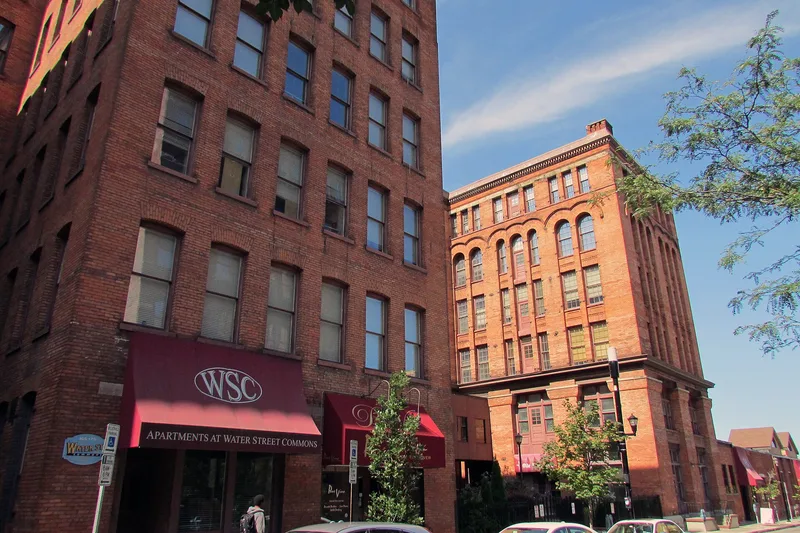
Seventeen brick commercial and industrial buildings make up this small district on the east bank of the Genesee River in Rochester. Most date from 1884 to the late 1920s and rise two to six stories. Those on St. Paul Street served as showrooms and offices for the garment trade and carry pressed brick, terra cotta, stamped metal and cast-iron details, often in Romanesque style. Buildings on North Water Street housed light manufacturing and are plainer, with corbelled brick and segmental arch windows. Other notable structures include a former fire station with a limestone facade and Egyptian-influenced details, and a Spanish Renaissance-style taxi company building. The district grew after the 1882 construction of the New York Central station, when garment firms moved across the river. Rochester's clothing industry declined between the world wars, and later demolition and urban renewal removed most of the garment center. This cluster is the sole survivor of that area and retains a high degree of integrity, with no non-contributing buildings.
Significance in brief: The district is cited as a cohesive group of Romanesque Revival and early twentieth century commercial and industrial buildings, many with unusually rich ornament for industrial use. It also holds the only surviving cluster of buildings tied to Rochester's garment industry, a major part of the city's economy from about 1870 to 1930.
Machine-generated summary. This summary was generated by a language model from the official nomination document and has not been reviewed line by line by an editor. It may contain errors. Check the source document before relying on any detail. Source: nomination document (PDF) · National Archives catalog entry. NRHP reference 84000398, listed October 11, 1984. Summary generated October 2026 (model claude-sonnet-5-5, prompt v1.0-2026-10-29, confidence medium).
Key facts
| Address | St. Paul, N. Water, and Andrews Sts., Rochester |
|---|---|
| County | Monroe County |
| Listed | October 11, 1984 |
| Reference number | 84000398 |
| Resource type | District |
| Period of significance | 1884-1928 |
| Architect / builder | Oscar Knebel (165-173 St. Paul St.; Davie Building); Charles Ellis (Smith Gormley Building); Ellis and Ellis / Charles and Harvey Ellis (Ellis Building, 187-195 North Water St.) |
| Architectural style | Romanesque Revival, Renaissance Revival and early twentieth century commercial styles |
| Areas of significance | Industry, Architecture |
| Level of significance | Local |
| Acreage | 0.9 |
| Coordinates | 43.16026, -77.61103 (NPS GIS) |
What listing means for this property
This is a historic district. Buildings within its boundary are either contributing (they add to the district's significance) or non-contributing. Owners of contributing income-producing buildings can claim the 20% federal rehabilitation tax credit; homeowners should look at state credits. National Register districts impose no design review by themselves; a local historic district ordinance, if one exists, does (the difference explained).
General information, not legal or tax advice. Rules change; confirm with your State Historic Preservation Office or a qualified adviser.
Sources and further reading
- National Park Service, National Register of Historic Places database (snapshot May 2026), reference 84000398.
- Nomination form (PDF, National Archives) — catalog entry
- Wikipedia article (used for cross-checking only; text not reproduced here)
- Wikidata Q7591212
- This listing as JSON
Last updated October 2026. Found an error? See the editorial policy for how to report it.