Eastman, George, House

Why it's listed
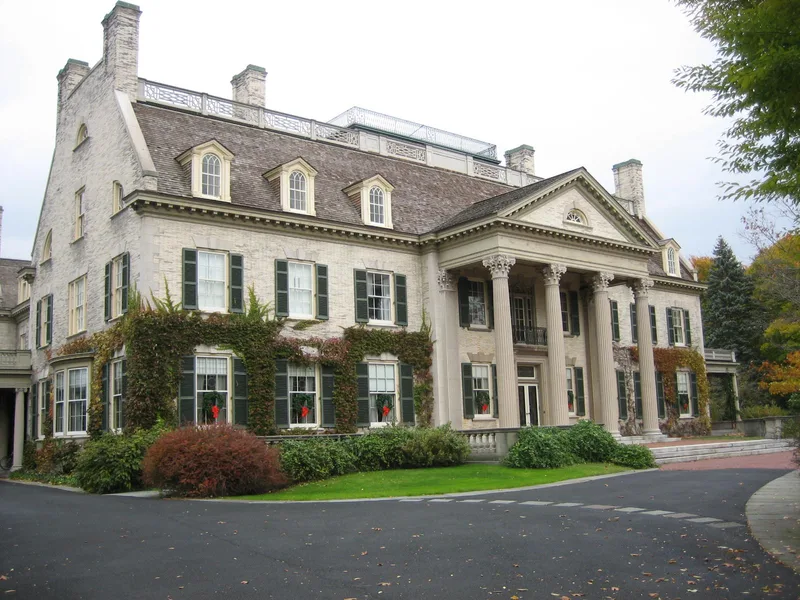
This Georgian style house at 900 East Avenue in Rochester was built in 1905 as the residence of George Eastman, inventor of the portable Kodak camera and flexible film. Local architect J. Foster Warner supervised construction, but Eastman chose the design and insisted on details he had observed in other houses. Faced with cream-colored brick, the T-shaped building has a fireproof reinforced concrete structure and a pedimented portico with Corinthian columns. In 1919 the music room, known as the Marble Room, was lengthened by cutting the house in half and moving the north section 9 feet 4 inches. The twelve-acre estate once supported gardens, cattle and a private power plant, and a power house, tunnel and cow barn survive. Eastman's work made photography accessible to ordinary people, and his company dominated the industry until his death in 1932. After a period as a university president's residence, the house became a museum of photography in 1948.
Significance in brief: The house was the residence of George Eastman, inventor of the portable Kodak camera and flexible film and founder of the Eastman Kodak Company, who brought photography to the general public. It reflects his personal taste, since he chose the design and insisted on many details. Since 1948 it has housed an international museum of photography.
Machine-generated summary. This summary was generated by a language model from the official nomination document and has not been reviewed line by line by an editor. It may contain errors. Check the source document before relying on any detail. Source: nomination document (PDF) · National Archives catalog entry. NRHP reference 66000529, listed November 13, 1966. Summary generated October 2026 (model claude-sonnet-5-5, prompt v1.0-2026-10-29, confidence high).
Key facts
| Address | 900 East Ave., Rochester |
|---|---|
| County | Monroe County |
| Listed | November 13, 1966 |
| Reference number | 66000529 |
| Resource type | Building |
| Period of significance | 1905-1932 |
| Architect / builder | J. Foster Warner |
| Architectural style | Georgian |
| Areas of significance | Invention |
| Level of significance | National |
| National Historic Landmark | Yes, designated November 13, 1966 |
| Status (as stated in the nomination) | Adapted in 1948-49 as a museum of photography; the form lists it as occupied and in museum use. Some original estate features survive, while others have been altered or lost. |
| Acreage | 12 |
| Within district | East Avenue Historic District |
| Coordinates | 43.15271, -77.58020 (NPS GIS) |
What listing means for this property
National Register listing is honorary for a privately owned home: it does not by itself restrict what an owner may do with their own money, and it does not require public access. Restrictions come from local landmark or historic-district ordinances, which are separate (how they differ).
Owner-occupied houses are not eligible for the 20% federal rehabilitation tax credit, which applies to income-producing buildings, but many states offer credits for homeowners. Listing also opens the door to preservation easements and to buying a plaque. Start with what listing means for homeowners, renovating a listed house and selling one.
General information, not legal or tax advice. Rules change; confirm with your State Historic Preservation Office or a qualified adviser.
Sources and further reading
- National Park Service, National Register of Historic Places database (snapshot May 2026), reference 66000529.
- Nomination form (PDF, National Archives) — catalog entry
- Wikipedia article (used for cross-checking only; text not reproduced here)
- Wikidata Q1507284
- This listing as JSON
Last updated October 2026. Found an error? See the editorial policy for how to report it.