East Avenue Historic District
Also known as: See Also:Eastman, George, House
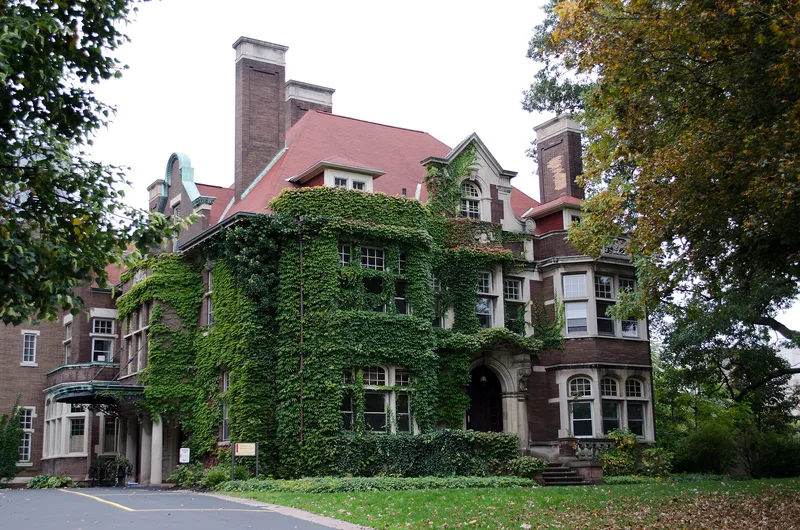

Why it's listed
East Avenue in Rochester, New York, is lined for about a mile and a half with large houses, churches, meeting houses and museums set back behind tree-lined sidewalks and wide lawns. The district holds roughly 700 structures, with the grandest on the avenue itself and smaller residences on the cross streets. Styles run from Greek Revival town houses of the 1840s to Italianate villas, Queen Anne homes, and the Prairie-style Boynton House by Frank Lloyd Wright. Other landmarks include the Sibley House, Woodside, and George Eastman's forty-two room mansion, now a photographic museum. Third Presbyterian Church, dedicated in 1893, has a 140-foot tower. The avenue developed after the 1830s as millers, bankers and executives left the crowded Third Ward for more spacious grounds. Unlike Buffalo's Delaware Avenue and Syracuse's James Street, it avoided heavy commercial intrusion, and many mansions now serve as clubs, museums and offices. The district was listed for its architectural and social history.
Significance in brief: The nomination cites the district as one of the greatest catalogues of nineteenth and early twentieth century urban residential architecture in New York State. Unlike comparable avenues in Buffalo and Syracuse, it kept much of its original character as Rochester's "grand boulevard". It was home to the city's wealthy business and professional leaders from the 1830s onward. The side streets echo the avenue's styles on a smaller scale.
Machine-generated summary. This summary was generated by a language model from the official nomination document and has not been reviewed line by line by an editor. It may contain errors. Check the source document before relying on any detail. Source: nomination document (PDF) · National Archives catalog entry. NRHP reference 79001589, listed April 17, 1979. Summary generated October 2026 (model claude-sonnet-5-5, prompt v1.0-2026-10-29, confidence medium).
Key facts
| Address | Irregular pattern along East Ave. from Probert St. to Alexander St., Rochester |
|---|---|
| County | Monroe County |
| Listed | April 17, 1979 |
| Reference number | 79001589 |
| Resource type | District |
| Period of significance | 1800-1899 and 1900- |
| Architect / builder | Frank Lloyd Wright; McKim, Mead and White; J. Foster Warner; Claude Bragdon; Leon Stern |
| Architectural style | Mixed styles from Greek Revival through Italianate, Queen Anne, Colonial Revival and Prairie style to 1950s-60s "new formalism" |
| Areas of significance | Architecture, Social History |
| Level of significance | State |
| Status (as stated in the nomination) | Condition is marked excellent to good and altered. Many mansions have been converted to institutional use or multiple dwellings, and the turn-of-the-century residential character remains largely intact despite some intrusions. |
| Acreage | 362 |
| Coordinates | 43.15396, -77.58349 (NPS GIS) |
What listing means for this property
This is a historic district. Buildings within its boundary are either contributing (they add to the district's significance) or non-contributing. Owners of contributing income-producing buildings can claim the 20% federal rehabilitation tax credit; homeowners should look at state credits. National Register districts impose no design review by themselves; a local historic district ordinance, if one exists, does (the difference explained).
General information, not legal or tax advice. Rules change; confirm with your State Historic Preservation Office or a qualified adviser.
Sources and further reading
- National Park Service, National Register of Historic Places database (snapshot May 2026), reference 79001589.
- Nomination form (PDF, National Archives) — catalog entry
- Wikipedia article (used for cross-checking only; text not reproduced here)
- Wikidata Q5327764
- This listing as JSON
Last updated October 2026. Found an error? See the editorial policy for how to report it.