South Street Seaport
Also known as: See Also:Wavertree; Schermerhorn Row Block; South Street Seapo

Why it's listed
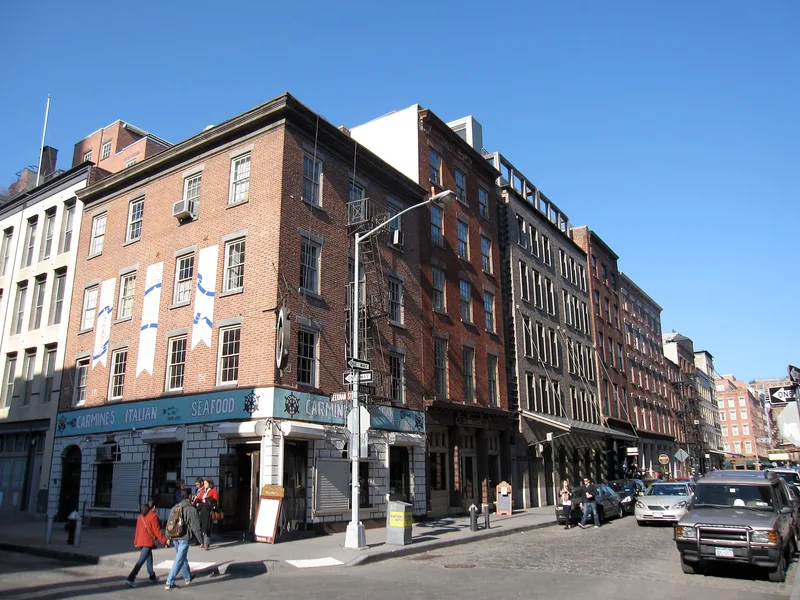
South Street Seaport is a five-block district of brick commercial buildings on the East River in Lower Manhattan, together with two piers where historic ships are moored. Most buildings are four or five stories, built flush to the street, with shops below and storage or living quarters above. Details include granite or cast iron storefront piers, splayed stone lintels, and terra cotta reliefs, such as the fish carved on the window arches of 142 Beekman Street, designed by George B. Post in 1885. The area was created by landfill between the late seventeenth century and 1804. From the late eighteenth century to the mid-nineteenth, it was the heart of New York's port, home to packet lines, clipper ships, and the Fulton Market. Its warehouses and counting houses recall the trade that built the city's commercial power. The district survived the fires of 1835 and 1845 and later redevelopment, and plans called for converting its buildings into a maritime museum and compatible commercial uses.
Significance in brief: South Street was the center of New York City's commercial life from the late eighteenth to the mid-nineteenth century, when this stretch of the East River served as the city's port. The district holds some of the last remaining buildings tied to that maritime trade, which helped make New York the nation's financial and commercial center. It also survived the fires of 1835 and 1845 and later development pressure.
Machine-generated summary. This summary was generated by a language model from the official nomination document and has not been reviewed line by line by an editor. It may contain errors. Check the source document before relying on any detail. Source: nomination document (PDF) · National Archives catalog entry. NRHP reference 72000883, listed October 18, 1972. Summary generated October 2026 (model claude-sonnet-5-5, prompt v1.0-2026-10-29, confidence medium).
Key facts
| Address | Bounded by Burling (John St.) and Peck Slips, and Water and South Sts., New York |
|---|---|
| County | Manhattan |
| Listed | October 18, 1972 |
| Reference number | 72000883 |
| Resource type | District |
| Architect / builder | George B. Post (142 Beekman Street, 1885); S. D. Hatch (213-215 Water Street); Douglas Smyth (Fulton Fish Market, 1881-83) |
| Architectural style | Late eighteenth- and nineteenth-century urban commercial architecture, mostly brick in Flemish bond |
| Areas of significance | Community Planning and Development, Commerce, Transportation, Architecture |
| Level of significance | National |
| Status (as stated in the nomination) | Condition rated good and altered; occupied, with preservation work in progress. Most buildings serve the fish market, and adaptive reuse as a maritime museum with compatible commercial uses is planned. |
| Acreage | 3.5 |
| Within district | South Street Seaport Historic District |
| Coordinates | 40.70617, -74.00286 (NPS GIS) |
What listing means for this property
This is a historic district. Buildings within its boundary are either contributing (they add to the district's significance) or non-contributing. Owners of contributing income-producing buildings can claim the 20% federal rehabilitation tax credit; homeowners should look at state credits. National Register districts impose no design review by themselves; a local historic district ordinance, if one exists, does (the difference explained).
General information, not legal or tax advice. Rules change; confirm with your State Historic Preservation Office or a qualified adviser.
Sources and further reading
- National Park Service, National Register of Historic Places database (snapshot May 2026), reference 72000883.
- Nomination form (PDF, National Archives) — catalog entry
- Wikipedia article (used for cross-checking only; text not reproduced here)
- Wikidata Q223000
- This listing as JSON
Last updated October 2026. Found an error? See the editorial policy for how to report it.